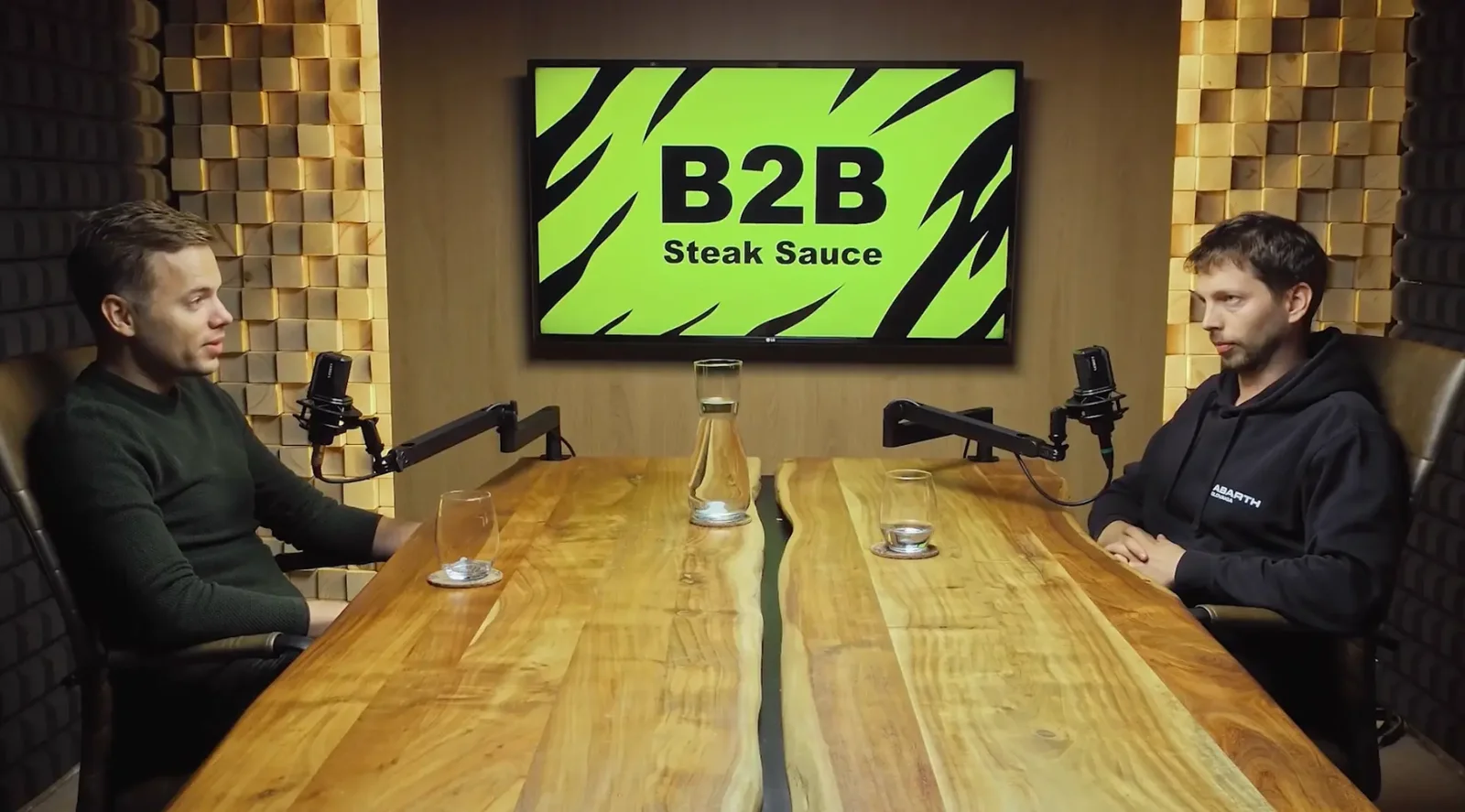
Full English transcript
The conversation was recorded in Slovak; this is the supplied English translation. The source transcript did not separate the speakers, so the attribution of each question to Martin Brath and each answer to Bohumil Pokštefl is an editorial reconstruction from the context. Names misspelled by the transcription (Kontentino, Pokštefl, SaaSGarden) have been corrected, and bracketed notes mark wording that was unclear in the source. The episode was published on 24 September 2024 and runs 50 minutes.
Leading a team of 5 versus 50
Martin Brath: I welcome every viewer and listener to another edition of B2B Steak Sauce. I have with me Bohumil Pokštefl, who is the founder of Deal Harvest, the founder of SaaSGarden, was on Forbes 30 Under 30, and worked for a very long time at Kontentino as CEO. Bohumil, welcome.
Bohumil Pokštefl: Hi everyone, I'm glad to be here.
Martin Brath: We're glad you're here too. Okay, I'd start with a question. You worked at one of the fastest-growing Slovak technology companies. This will be like the beginning, so I'll open with that. You had a team under you that had three people, then 10, and then you were up to 50 people. I'd start with this: what's the difference for you between leading a team of, say, 5, where you know everyone, you all sit together, and then 50, if that's how it went?
Bohumil Pokštefl: Since I'm the one answering, one word resonated with me, and that's "worked." Because to me, when someone "works," they're an employee doing some tasks. But I feel that I built it together with that original team. When I arrived there, there were maybe five clients, I could count them on one hand. The product was basically an MVP, so I don't take it as "I worked for Kontentino," but as me being a kind of late founder, who together with the team brought it to a relatively successful company – without sounding too arrogant. As for the difference between leading a company with 5 employees and one with 50, the difference is striking. I started to feel it most when there were about 20 of us. And then COVID came, and suddenly you need to deal with processes and communication. That's where I had the biggest problem, in communication – people didn't know what they were actually doing, what our goal was, what we were solving.
And to us as management it seemed very simple back then, after all, we had told each other. We know what we're going to do, and we also felt that we were communicating it clearly, but then time and situations showed that not everyone understood why we were doing what and to what end. So that was the biggest difference: the communication started to fall apart. Because, you know, when you're sitting together – and we really did sit at one table, back at Devine in Triad [unclear in transcript], we had a little cellar there, a former kitchen, that we set up as our mini office. And we crowded around one table, maybe seven, maybe ten of us, I don't know how many we were back then. And we came in to work every day. Remote work didn't exist then the way it's standard now, and whatever was said in that small room, everyone knew it. Everyone knew what was happening in the product, in marketing, in sales, what the numbers were and how the company was growing.
And then suddenly you have people who are remote, and the communication starts to fall apart. We also introduced Objectives and Key Results, OKRs, the well-known framework for managing teams. It took us a very long time to grasp it and use it properly. The question is whether we ever managed to use it properly over those years. It was definitely a great help, a great tool, but today, if I had a company of 50 people, I'd probably look at a different framework, I'd probably create my own, and I do have something in my head about how I could simplify those OKRs. So that was the biggest challenge – the communication, the clarity about which direction we're paddling.
Early mistakes and selling before the product exists
Martin Brath: Okay, what's the top piece of advice you'd have liked someone to give you at the very beginning of your journey?
Bohumil Pokštefl: The very beginning? Because I started when I was 18 and had a snack bar at Zlatý Kresk [unclear in transcript].
Martin Brath: Well, let's say, then, when you signed up as an account manager at Triad. So you still didn't know what awaited you, but you went for it. What tip would you have liked to have back then?
Bohumil Pokštefl: At Kontentino, I made one very clear mistake, and that was that I was too, I was relatively naive and I had certain assumptions – how do you say "assumptions" in Slovak?
Martin Brath: "Assumptions" is fine.
Bohumil Pokštefl: "Assumptions" is fine, so I had certain assumptions about how we function as a business and how we function as co-owners. The whole time, I mentally treated that company as "well, it's my company." Everyone knew that I had built it together with the people, and that youthful naive recklessness of thinking that something belonged to me which de facto didn't belong to me. But on the other hand, if it hadn't been like that, Kontentino might not be where it is. It was a certain motivating factor that drove me. I adopted that child from Triad and took it as my own kid, and as a result I had absolute motivation. If I had perhaps lived in a reality where the ownership structures were set up a bit differently, it might have looked different, and Kontentino might have ended much sooner. But I can still tell you, because this is a very specific case, what I think I did even earlier, before Kontentino, when I was trying to run businesses and start startups, which by the way were all fails.
I think I should have started selling before I even had a product. And I also made a mistake when I was kicking off an e-commerce project in America that was supposed to sell high-school merch – hoodies, T-shirts and the like – through e-commerce platforms, because that's how it works, or probably still works, in America: the coach or the PE teacher comes and says, kids, new merch, here's a sheet of paper, write down which sizes of T-shirts and hoodies you want, bring me cash tomorrow. We were supposed to digitize it all and put it online. And the problem was that at the start we spent terrifying amounts of money on developing the platform, when Shopify could have been used, which already existed back then, and it could all have been done faster and cheaper, and we actually didn't have any sales yet. And then when we started chasing sales, we found out it wasn't nearly as easy as we had thought.
So this is maybe advice not just for me but for everyone: let's not get bogged down in developing the product, let's simply sell it first and then somehow patch it together manually. I have an example, a guy who is building a tool, who sits with me in the coworking space – or let me put it this way, he sits in my coworking space, roughly. He basically has an application that creates any website for you using AI: you enter some prompts, parameters, and it spits out a website. But that guy has only developed it to about 20%. The other 80% he does manually, but he pretends that this is the website. And he has cash, I mean, it earns him money, and he'll gradually get to the point where the application does 80, 90, 100 percent at the end. But he already has some validation of the value proposition, of the product – it works for him, people are willing to pay for it, even though the product isn't fully ready.
But it's already solving the problem in some way. So, to sum up: we sell before we even have a product ready.
Product-led markets and why HubSpot stays on top
Martin Brath: Okay, do you think that's relevant even when you're in a market that would typically be product-led, so something like Kontentino, where people want to try it out, all the competitors already offer a service that gives you the option of a 14-day free trial?
Bohumil Pokštefl: So with sales-led I absolutely agree, product-led is a bit harder. It depends on what you'd go into such a saturated space with. If I were to go and compete with Kontentino and the hundreds of other social media tools on the market, I'd rather focus and look at the one single small thing those tools don't do properly and build that one single piece of functionality that solves the problem. So again, I'm not going to build a colossus, I'm going to solve one specific problem that the other tools simply don't solve and put it out there, so I don't spend a year of my time on development, but maybe three months, and I try again to – and even before I start the development, I'd do some kind of, not even early access, I can't think right now what it's called, anyway what we did was put a website out there with a waiting list. I simply make a waiting list, test with ads whether there's any demand for that solution at all, create the waiting list there, and when I see that people are interested in the solution, then I have some indication, so I try to build it, since there's interest.
Martin Brath: So again, you're selling before you have the product ready.
Bohumil Pokštefl: In a way. As in, you're not entering a saturated market head-on.
Martin Brath: Now you mentioned that you need to find a product niche. I assume that if you have competitors who are quite big, they can build the feature themselves later. On the other hand, you can position yourself so that the feature is somehow the core of how your product is perceived.
Bohumil Pokštefl: Yes, that depends very much on your positioning, right, that if I have a certain very specific target group that needs exactly that one piece of functionality to solve their specific problem, then they won't use and pay for a solution that solves ten other problems which aren't their specific problem. That's very generalized now, but it's about positioning, and of course anyone can build you – and let's be honest, SaaS these days is easy to replicate – "give me money and I'll build you a second HubSpot in a year and a half, maybe sooner." So talking about how defendable your technology is in the market within a SaaS business is, in my view, irrelevant.
Martin Brath: How does a company like HubSpot manage to stay on top, you have to wonder.
Bohumil Pokštefl: Because it's already like Coca-Cola, it's a household name, they've built their brand, HubSpot has its flywheel, its inbound methodology, they also move the market in terms of methodologies and marketing approaches, they're the leader, they're the thought leader within that industry, so it's less about the product and more about trust, and about you wanting to use HubSpot because it's number one, top of mind for you. That's why they hold on, even though better solutions than HubSpot may exist. Yes.
Pressure, ego and working with a coach
Martin Brath: Okay, let me go back one step. You mentioned your drive and motivation. At Kontentino you were relatively open about the fact that in some parts of the company you put too much stress on yourself, and you felt it to the point that you actually sought solutions for it. How did you handle that? So this stress was primarily produced by you. Nobody puts pressure on you, but you put yourself under pressure.
Bohumil Pokštefl: And when we talk about the last two years at Kontentino, then of course the pressure also arose externally in some way, but I also needed to prove to myself that I have something in me. That pressure – I think many entrepreneurs put that pressure on themselves. It doesn't work without it. The question is where the level of pressure you put on yourself lies. And what was the problem for me back then was that I took some things extremely personally, and a big part of that whole, if I can call it that, whole situation I was dealing with for those two years, ego played its role too. And there was less and less rationality in it, I think. So it was more of a mistake that I... some things that could have been handled more rationally were handled very personally and with ego, and so it perhaps had some impact on my, say, mental health – I'm not saying now that I had some mental problems, but I felt that something was going on with me, and I naturally sought professional help, which these days isn't shameful at all. And especially when you realize that something is approaching and it could end badly, you'd rather go to a coach or straight to a therapist and go work with your brain and your thinking, as if you were training your muscles at the gym, because it's also a kind of muscle.
Martin Brath: What would be an indicator that I should perhaps be dealing with this?
Bohumil Pokštefl: I think everyone has it completely differently.
Martin Brath: Right, so whether... You mentioned that most entrepreneurs definitely feel this, yes? So I'd be interested in whether I'm already past that point, or...
Bohumil Pokštefl: For me it was absolute, total demotivation, or a reluctance to deal with the business, or rather the product itself, because I loved the product. I also loved the industry and so on, but within that dispute we had there, I wasn't doing business as usual, I was dealing in my head with – pardon the expression – interpersonal relationships, if I may say so, and I simply didn't have the focus on the business that I should have had. Another indication was that I reacted very emotionally in situations where I didn't need to. I don't mean that I burst into tears or started shouting, but I felt in my body that this simply wasn't me, and that my answers and reactions weren't professional and were rather childish, and that's when I told myself I have to do something about this, because it's not a CEO speaking here, it's some junior letting his emotions surface. So that was the first trigger, like, okay, I have to start working with my emotions.
Martin Brath: What was the best piece of advice you got from the therapist who helped you?
Bohumil Pokštefl: It wasn't advice, but we created a kind of phrase, mainly about the approaches. I worked on this mainly with one coach, whom I salute, I'm saying hi to him. I don't know if we can do advertising here, but we basically first identified what the trigger of the emotion is, and then where the emotion is located in the body. Because emotion and body are often connected. We have certain markers. I hadn't believed in this before, but when we practiced it in those sessions, I suddenly realized that yes, really, pressure starts to appear on my chest or around the diaphragm, and it was a strange kind of pressure and tingling, and that was a marker that something is starting to happen and it's passing into my thoughts, and we practiced those situations there, and what's happening in my body, and as soon as I discovered it, I had a phrase – I won't say what the phrase was – but that phrase simply brought me back down to earth, and I started to look at the whole situation with perspective, outside of my ego, with perspective and very rationally. So this helped me a lot. To calm the situation inside me, say one little phrase and return to reality and not take things personally.
Leaving Kontentino and taking a break
Martin Brath: Cool, great. Okay, you mentioned that you left Kontentino, it was your child, and you took a longer vacation for yourself. How did you experience that period?
Bohumil Pokštefl: It was a great period. I really enjoyed it, because on the one hand a stone fell from my heart, however sorry I was about all of it, but I must say that the guys behaved very fairly, that the agreement went really fair, for which I thank them, that there weren't any pointless drawn-out fights, it could have been worse. But I enjoyed it, I suddenly realized that I needed to get out of there, I needed to be alone with myself. A week later I actually went for seven days to a cottage somewhere in Slovenia where I had no signal, and it was just me, the forest and sheep and some farmer. And there I just read and thought and basically switched off completely. And then I went to Patagonia, where I rode a motorbike the whole time, and there I realized a great many things. And for me it was one of the most important and most beautiful periods I've had in my life, because I knew that something great and wonderful had ended and I needed such a break, and again something great and wonderful will come. So it was very liberating.
Martin Brath: Okay, you also found out that you want to focus more on family.
Bohumil Pokštefl: I don't have a family yet, but yes, there I realized that family is also something I'd want to have in life and that I have to approach my private relationships a bit differently than I did, and I think it helped me to realize where my values are and what I want from life going forward. That it's not just business and glitter and so on, but that it's probably also about building something family-oriented.
Rapid-fire round, books and role models
Martin Brath: Okay, let's now try the so-called rapid-fire round, so I'll give you quick questions, many of them will have an answer for you, it depends, but try to say the first thing that comes closest to what you feel. Okay, early bird or night owl?
Bohumil Pokštefl: Early bird.
Martin Brath: Work in an office or home office?
Bohumil Pokštefl: In an office.
Martin Brath: Solo founder or co-founder?
Bohumil Pokštefl: Co-founder.
Martin Brath: Bootstrapping or venture capital?
Bohumil Pokštefl: Bootstrapping.
Martin Brath: Hands-on or delegating?
Bohumil Pokštefl: Delegating.
Martin Brath: Growth or stability?
Bohumil Pokštefl: Both. Sensible, steady growth.
Martin Brath: Product or service?
Bohumil Pokštefl: Product.
Martin Brath: Data or instinct?
Bohumil Pokštefl: Instinct. Instinct, because it arises from data.
Martin Brath: Work hard or smart?
Bohumil Pokštefl: Smart.
Martin Brath: Local market or global market?
Bohumil Pokštefl: Global.
Martin Brath: Technically skilled or people-skilled?
Bohumil Pokštefl: People-skilled.
Martin Brath: Big picture or details?
Bohumil Pokštefl: Big picture.
Martin Brath: More marketing or product improvement?
Bohumil Pokštefl: More marketing and product improvement. Wow, I said the first thing, marketing, it goes hand in hand.
Martin Brath: Fast scaling or steady growth?
Bohumil Pokštefl: Steady growth.
Martin Brath: The best book on entrepreneurship you've read?
Bohumil Pokštefl: I've read a great many books on entrepreneurship and I don't want to name the last one I read, because it's definitely not the best. But... Just one, I'm supposed to name?
Martin Brath: The best you've read? About entrepreneurship.
Bohumil Pokštefl: About entrepreneurship. Zero to One. I read it terribly long ago, I no longer remember what it's about, but I know that when I read it, I was blown away. I should probably re-read it.
Martin Brath: And I had that feeling about Zero to One until I found out that Peter Thiel is a Trump fan.
Bohumil Pokštefl: Yes, I found that out too, and I'm even reading Horowitz's book The Hard Thing About Hard Things right now.
Martin Brath: And he's a supporter, sure.
Bohumil Pokštefl: And I deliberately pulled it out only after I learned he's a Trump supporter, but well, it's understandable, there's business in it. Trump promised him he would have a positive influence on crypto trading and crypto and so on, because he has a lot invested in exactly that direction, so I'll support this guy. He's a businessman, although it's a pity that the world's businessmen sometimes lack a moral compass, I feel.
Martin Brath: Okay, who do you see as a role model in entrepreneurship?
Bohumil Pokštefl: I really like Bill Gates. I don't know, and I also like Ray Dalio. I find him really good too. Those are two older gentlemen who... God knows what they were like during their peak. I've never worked with them, maybe I wouldn't even want to work with them in my life. But what they built, how they approach the world as such, and both of them approach philanthropy too, I find very inspiring, and many multimillionaires should take an example from them. Who do you have?
Martin Brath: Good question. For me it would be Tarek Müller, he's one of the founders of About You and also currently head of marketing. He also does podcasts and I find him very good. Also from Andreessen Horowitz, since you mentioned Horowitz, Andreessen also seems very good to me, but he's primarily an investor. It seems to me he was also a co-founder of Netscape, the first first browser, what was it, Mask, but well, now that's very questionable, and Thiel too.
Bohumil Pokštefl: Okay, okay, I mean, great names.
Martin Brath: Yes. The names are great.
Bohumil Pokštefl: The names are great, the question is, and maybe I have a badly set moral compass, maybe they wouldn't point a finger at us and say, what are you crazy about.
Martin Brath: It's possible. So we live in our own bubble to a certain extent. Do you like your bubble?
Bohumil Pokštefl: So, do I like it? Well, I stay in it, but maybe I could be more open. I know how quickly I can switch off an opinion that comes from outside my bubble, so even if my mom tells me something about conspiracy theories, within 0.3 seconds I switch off and take it as, it can't be true. So maybe there's room for improvement there. I know that if the other side does this too, we can't get to any compromise.
Martin Brath: I like my bubble. My problem is that my bubble is so strong that I don't personally know anyone who would know and believe conspiracy theories, or who would vote for Robert Fico.
Bohumil Pokštefl: I can introduce you afterwards.
Bubbles and how his definition of success changed
Martin Brath: Please. And I definitely miss that in a way, because I'm not confronting them. I confront guys who are non-voters and have slightly different views on how the world works, but they're not a totally opposite extreme, they're somewhere in the middle and we can talk about those things. So... Right. Okay. Regarding success, how has your definition changed over the last 10 years, what is success for you, or who is successful, or what does success mean for you?
Bohumil Pokštefl: For me, success is combining life, or lifestyle, so that you're content, happy, and at the same time useful to those around you. If you're doing something that truly entertains and fulfills you, plus it earns you some financial resources, above-standard financial resources, which you can later use for some positive impact around you, then that's success for me, and that's something I want to keep creating. Even at Kontentino it fulfilled me a great deal when we could support non-profit organizations. And I want to keep doing that now and going forward. And it's not only about non-profits, it's also about creating some kind of company organization where people are simply content, happy, enjoy what they do, where I give them freedom, opportunity and so on – that's success for me. If I can build something like that again, the way we did at Kontentino, then I believe I'll build it within SaaSGarden or Deal Harvest too. So that's success for me. And how I saw success ten years ago was probably very superficial and material. Probably like all motivated university guys who want to conquer the world.
Education, nature and staying in Slovakia
Martin Brath: You mentioned a philanthropic focus. What is the most interesting area for you, where you would invest?
Bohumil Pokštefl: If we're talking only about our region, then it's clearly education. That's something we're very much lagging behind in.
Martin Brath: High school, elementary school, results?
Bohumil Pokštefl: In the sense of high school, university. I'm not an expert on education, but I studied at high school and at university, both in Slovakia and abroad, so I can compare the differences. And if I want to stay in this country, which will prosper, will be safe, where we'll live well and free and have some kind of foundation, then we simply can't allow young people to go study abroad and never come back. That's important, never come back. If they go to study abroad and come back, great. But this seems to me a very big problem of Slovakia, that educated people leave and are demotivated to stay here. And that education actually also shapes society. Both economically and socially. So education is one area, and the second area is some kind of ecology. But I don't mean now that we'll recycle five bottles. I mean really ecology in the sense that we have a climate crisis here. The European continent is the continent that, of all the continents, is warming the fastest, and we can feel it.
This summer was extreme, we simply have... Europe will face enormous problems in the future when it comes to climate and climate change, and we are absolutely not prepared for it. We can no longer avert it. We just need to mitigate it somehow. For example, a huge problem is the deforestation of Europe. And that means we can't retain water in the landscape. And we can tell ourselves that we're on Žitný ostrov (the Rye Island), but eastern Slovakia, Czechia, all of Central Europe has been going through a huge drought for several years, which can ultimately have an impact on us as people too. So this is another topic that I pursue and support. I've also supported organizations that try to restore things. For example BROS. They basically revitalize, I don't know whether it's the Danube Delta, but in short, along the Danube waters on the Slovak side, in some way, so that they keep the water in the landscape and restore biodiversity here, which is interesting, because for example Žitný ostrov, or the landscape in Žitný ostrov, is much more efficient at retaining carbon than mountain forests, than pine forests.
And that's another problem, that our Slovak forests are industrial forests, if I can call them that, forests planted so that after a few decades they're cut down and then planted again. It's like corn. They're monoculture forests, which are weak, they can't retain water in the landscape, and that's, in my opinion, a huge problem. And the worst thing about it is that very few people profit from destroying this country of ours, that it's a nasty business, and I don't know if this is a topic we want to talk about here, but it's one that personally interests me a lot, because it affects all of us. We say, what do we care about animals, but no. We can't survive without nature, nature can survive without us, but we can't without it.
Martin Brath: Do you plan to stay in Slovakia?
Bohumil Pokštefl: For now, yes.
Martin Brath: Where do you see yourself in ten years? In which country?
Bohumil Pokštefl: Well, apparently in Slovakia for now. I'd really like to stay here, not "for now," aside from our political situation, which of course bothers us a lot. But if we all leave, who else will stay here? I think we should stay and fight as much as we can. Of course, I'm frustrated that I don't have that much power to change things, but at least I can talk about it and support the people who are trying to change something. And so far, knock on wood, these political moods or the government that's in place doesn't really affect me yet. But as soon as some freedom of mine were restricted, whether in business or in general, or the societal mood were very bad, that could also be a trigger for me to say, to hell with it, I'm going to a country where I might live better. But for now these are only hypotheses, I have no reason to leave. I'm still doing well here, I still live very well here, despite all those statistics that Slovakia is at the tail end of everything everywhere, but maybe that's also because I don't have a family and kids, so I don't know, maybe when I have to deal with putting a child into kindergarten or school and I see how it really works – my contact or interaction with the state administration is very minimal.
The only thing is that I've been waiting 3.5 years for a building permit, which is another thing... Wow, I could complain about that, but fortunately nothing frustrates me so much that I'd say, okay, I want to leave.
Martin Brath: I see. And I assume you'd go to Czechia.
Bohumil Pokštefl: No.
Martin Brath: No? Where would you go?
Bohumil Pokštefl: It would be natural to go to Prague, because we have a lot of contacts there, there's business, but I might go, I'd think about other options. For example Slovenia and Copenhagen, and maybe the total exotic, going somewhere to South America, I don't know, I have no idea, but I'd rather try to avoid Prague, so if I were to relocate, then not there.
Martin Brath: Something more interesting. You liked Argentina as a place to live.
Bohumil Pokštefl: Yes, as long as you earn non-Argentinian money, it's pleasant to live there. If you're an Argentinian and you live in Argentina, you earn Argentinian money and you experience that crazy hyperinflation, then life there is probably not that easy, and yet people there are happy and great. So you don't feel like they have some kind of problem.
Deal Harvest, social selling and leaving consulting
Martin Brath: I see. Okay, we can move on to your new ventures, which you're just starting. Or rather, you started recently, one of them is Deal Harvest, which offers social selling, so you give founders or people who are in business the opportunity to become visible. How? What's the biggest benefit there, or what is it that convinces them to go with you?
Bohumil Pokštefl: For one thing, we created our own social selling methodology, and those B2B tech businesses, or founders, or CEOs come to us for two motivations. The first motivation is that they want to speed up the acquisition of new clients, and the second is that they need to become visible, because they know that founder-led sales still works for them but they don't have the time, they don't know how, and they simply need to create some kind of demand there. And LinkedIn is simply a trending social network in our region too. More and more people are active there, and more and more people understand it, they're starting to see it more as a business platform, not just some kind of CV. Unfortunately some are starting to treat it like Facebook, but that's another topic. We really try to create content in the name of these CEOs that is relevant and interesting for that whole group. And that's interesting to those businesses, that they don't have to take care of anything.
Because even if they take a workshop that gives them the ways and techniques for doing it, to be active on a social network like LinkedIn, you have to enjoy it. And there are simply few CEOs I've met who would truly enjoy it and do it diligently, regularly, with passion, so that's why we do it for them. It's not easy to create good, relevant, consistent content, to find topics and so on. So when they dedicate an hour of their time per month and they know they'll have two quality posts every week that bring them tens of thousands of relevant impressions, then why not? So that's the first phase, the first reason why they come to us. And simply to make themselves and their business visible. And the second phase, or second reason why they come to us, is that they want to do a bit of a sales push, so we do it by creating some thought leadership content, then we sponsor that thought leadership content with paid advertising to a very specific target audience, and you know well that LinkedIn is absolutely great for targeting B2B businesses, so we target that audience, we keep "massaging" that audience so that the person is simply seen and that target audience somehow perceives them, and as soon as we see a certain frequency of views there, we tell ourselves, okay, that target group probably already perceives this person, so let's launch an automated campaign on them, and we start directly reaching out to that target group, in that we connect in the name of that CEO on LinkedIn, we send them a message, and we don't try to send sales-pitch messages but try to open a conversation or discussion on some topic.
Because surely every CEO or founder knows how many sales messages they get in their LinkedIn inbox every week. It's all the same, no differentiation, it simply ends up in the trash. We go about it differently, we try to somehow warm them up, or rather start a discussion and conversation on some specific problem or topic. And this works relatively well for us. And that's where our work actually ends. We open the discussion, we have a great response rate, on average it's around 15 to 20%, and in the best cases 55% of people respond positively to the message, that they want to keep talking. And then either a salesperson from that company or the CEO himself takes it over, depending on the size of the company, and they start talking together and book calls and try to close some business there. We help with this too, in that we try to consult on how to steer the discussion so that it heads toward the goal of closing the business.
So it has two levels. Brand awareness, and then some sales push.
Martin Brath: You did business consulting for a very long time. You did it for a while. Why did you stop? What feelings did you have about it?
Bohumil Pokštefl: It's very simple, there are two reasons. Business consulting is only selling my time. There's nothing to scale there, you do an hour, you sell your time. And the second thing that relatively frustrated me was that I didn't have an impact on whether it actually happens. So I made the effort to steer them in the best possible direction, but it often happened that they simply did it their own way anyway, and to me that seemed like a waste of my time. So it might be different, and this is completely common in the USA or in the West, that these consultants take an equity stake in the company, that they become part of the cap table. That way the consultant is also motivated completely differently, and the company, the startup, is motivated differently to listen to that person, it's a completely different dynamic. So that's why I cut it off.
Martin Brath: Do you want to scale?
Bohumil Pokštefl: Yes, you need to, I like a sustainably scalable business.
SaaSGarden and building with young talent
Martin Brath: Good, and your second venture, which is called SaaSGarden, is probably like a coworking space, I won't take it as a business you want to scale.
Bohumil Pokštefl: Coworking isn't a business you'd want to make money on, but coworking is more that I wanted to give something back to the community, I wanted to create a space where people can sit on a relatively low budget, where early-stage founders sit, so that we can help each other by example, which is really true, that most of the people sitting at my place are people who are starting and launching their business. So it's more just a kind of side hustle. And plus, it pays for my office space, you know.
Martin Brath: You have really nice office space, so it's worth going there. About SaaSGarden, if I understand correctly, you're looking more for people who have drive. They're young, want to start a business, but you already have the ideas. So you give them an idea, right, here's an idea. I want to see how you can implement it, execute it, and that's it.
Bohumil Pokštefl: Yes, and your question is?
Martin Brath: I assume there's more to it, because they also need money, they may need team guidance.
Bohumil Pokštefl: I'll try it somehow, we realized, and in SaaSGarden we'll be doing a certain pivot, that our vision was that we really wanted to work with young talent from Slovakia and possibly attract young talent from abroad to Slovakia, to work with us on quality, ideally within the marketing and sales vertical. And then we also started doing Fresh or Trash events, which are events where anyone can come with their idea and we give them uncompromising feedback, and it also works as a kind of talent pool, we can find talent there that I want to work with. Actually all the people who work or have worked at SaaSGarden, we found them this way, through that event. What is somewhat challenging for us, though, is that we've rarely found people who had a good business idea and wanted to go into it with us. It happened to us actually, we now have one startup where we went into it together, where someone came from outside.
On the other hand, when we give them a project that's already up and running in some way, they're very enthusiastic at the beginning, everything works, but very quickly they lose motivation, because they find out it's not that simple and that there are a great many fails and a great many mistakes being made there. Still, a person thinks, sure, we've been through all of that. No, we keep making mistakes, not the same ones, but the mistakes do get found, we have to try things, because the business is changing, the projects are different. So they relatively quickly lose motivation to continue with it, so now we're rather reconsidering how to continue with it, because we have three projects there that have several thousand euros in MRR, but it's not like a rocket, where something grows terribly fast. It's growing, but we need to get over some threshold. And here we realized that we'll probably need to get over some threshold, for example 10 to 15 thousand MRR, and have some stable growth there, so that the person who comes in is sufficiently motivated by that growth.
Because when it stagnates, they lose motivation very quickly, and it's hard to explain to them that this is normal. After all, we're at the beginning, going from 0 to 1 is harder than going from 1 to 100. And with this we're struggling a bit now, with what to do about it. And we've started to approach it rather like this: we'll rather take talented people as employees and gradually build from them the directors of those companies, those leadership positions, rather than immediately looking for some generalist who will lead the whole thing. That, unfortunately, didn't work out for us. We actually wanted to replicate what happened to me. I came to Kontentino as a total generalist, I had drive, I adopted that child and it went. But unfortunately, for some reason, we're not managing to replicate this fully. So we're making a certain pivot in how to approach it.
Martin Brath: Do you think the biggest difference is in production?
Bohumil Pokštefl: Not only in production, but in how you do acquisition and so on, those ways. If I were starting Kontentino again today, what worked for us 7 years ago would absolutely not work today. So the market and the way the business grows is completely different, and it changes every year. And you simply need to... What doesn't change is that you have to try and experiment quickly. That doesn't change. The sooner you make those mistakes, the sooner you'll know what works for you and what doesn't. That stays the same.
Advice for exited founders and what came next
Martin Brath: Okay, so you're still quite associated with Kontentino, even though you haven't been there for two years now. So it was a big part of your life, and the question would be, founders who also exit, who have their, well, child, they built something from zero and are leaving, so they have, some of them, vocally, don't know what the next step is, what advice would you give them? What should they do first?
Bohumil Pokštefl: Take a break, simply go ride around Patagonia on a motorbike. Do whatever, go surfing on Mars. Really switch off, and what comes next, they'll know then. It makes me a bit sad that a great many exited founders I know are moving into the role of angel investors, which is fine. It belongs there, but it's like how I would approach it – my exit wasn't some golden parachute, if we can even call it an exit, but that means I'm motivated to build something again. I can't just sit down in an armchair now and start handing out money to promising young startups, and again that often happens, when the exit is good, they simply try to help the ecosystem, which is great. Good question, plus I think we don't have many exited founders in Slovakia and Czechia, so I don't know, and God knows how many I'll have, let's be honest, there are terribly few exits here. So I don't know whether this is something where I could advise at all.
Martin Brath: Okay, I assume that you had a period where you had to decide what the next step would be. What made you decide to try the newsletter pilot at that point, and the other ventures. And the other ventures, so you simply found in yourself that drive to...
Bohumil Pokštefl: Yes, I... It's interesting that I was supposed to be in Argentina and Chile much longer, but I started to get bored. I started to feel kind of useless and the traveling started to feel stereotypical to me, and that was the moment when I simply wanted to go back. I came back, and I think it was the first or second weekend when I was in my favorite bar Bohema, where I was having drinks with my friends, and that was the ChatGPT craziness, and everybody was asking me, what are you going to do, Bohuš, what are you going to do with ChatGPT, right. And I came up on the spot with, well, I'll do a newsletter pilot. It was like, on the spot I said to myself, well, I'll make a tool where a person simply turns the blogs they write on their website into a newsletter, which you then send on automatically. That was the idea. So it came so spontaneously. I found out very quickly that it doesn't work. I think I shut it down within three months and then I even managed to sell it for something like 10 thousand euros, which is actually more than I put into it.
But those were all coincidences. I knew I needed to do something. Then I met Ivan Homola, who is now my business partner, and he is exactly the person who comes up with those ideas very well. I'm not good at business ideas. He is very good at business ideas. He actually came and motivated me to do Deal Harvest. Right, I'm rather the one who can grab it and move it somewhere, and he is the one who is very good in those initial phases, and I appreciate that very much, I think we found each other well here and that we're a good duo in this.
Building relationships and mentoring
Martin Brath: Okay, one last question on networking, because you're quite a friendly person, you go to events, you network a lot, how do you build such relationships and how do you maintain them?
Bohumil Pokštefl: I build relationships by enjoying talking to people and being interested in the other person. That's one of the first books I read, by Dale Carnegie, How to Win Friends and Influence People. And to this day I try to use it. Sometimes I forget, because I really like to talk, but I like to be interested in how those other people are doing. So that's how I build relationships. Maintaining relationships is a bit more complicated for me, because I have a terrible memory for people and names. So it often happens to me that I get introduced to someone even three times. But that's also caused by the fact that I meet a great many people. And I simply have to learn it somehow. I'm much better at it already, I remember those people now. Sometimes I quickly look on LinkedIn at who this is, what this is, but yes, it's enough just to talk and listen and ask questions. When you ask questions of the other person. You know, if I feel good that you're asking me questions, I have the feeling that we had a really good chat, even though you only asked questions. I found out a great many things from you, so
Martin Brath: I'm glad. One more question about mentoring, because you're also relatively vocal about that, you're a fan of mentors, it's one of the things you'd recommend, you mentioned at several events that it's something entrepreneurs should do. At what point should you look for one?
Bohumil Pokštefl: At all points of entrepreneurship you should already be looking.
Martin Brath: How do you know that this person is the right one for you?
Bohumil Pokštefl: You should look for a mentor at every point in entrepreneurship. Our natural mentors can be our family role models, as with me it used to be my father, he was my mentor. Marek Mrázik was my mentor in the early phases, in the first years of Kontentino. So it somehow comes to you naturally. And how to find the right mentor: you feel it, you click, when you listen to him you have the feeling that he's advising you correctly and sincerely. I've also had paid mentors, that's a slightly different relationship, but it worked. So I wouldn't be afraid of paid mentorship either. And it's very nice when someone who understands you can help you solve problems that you might be solving for months, and he comes along, but just like that, he can speed up a decision-making process, for example.
Martin Brath: Okay, Bohuš, thank you for your time. It was great that you were here, and I hope we'll see each other next time.
Bohumil Pokštefl: Great, thanks for the invitation.