
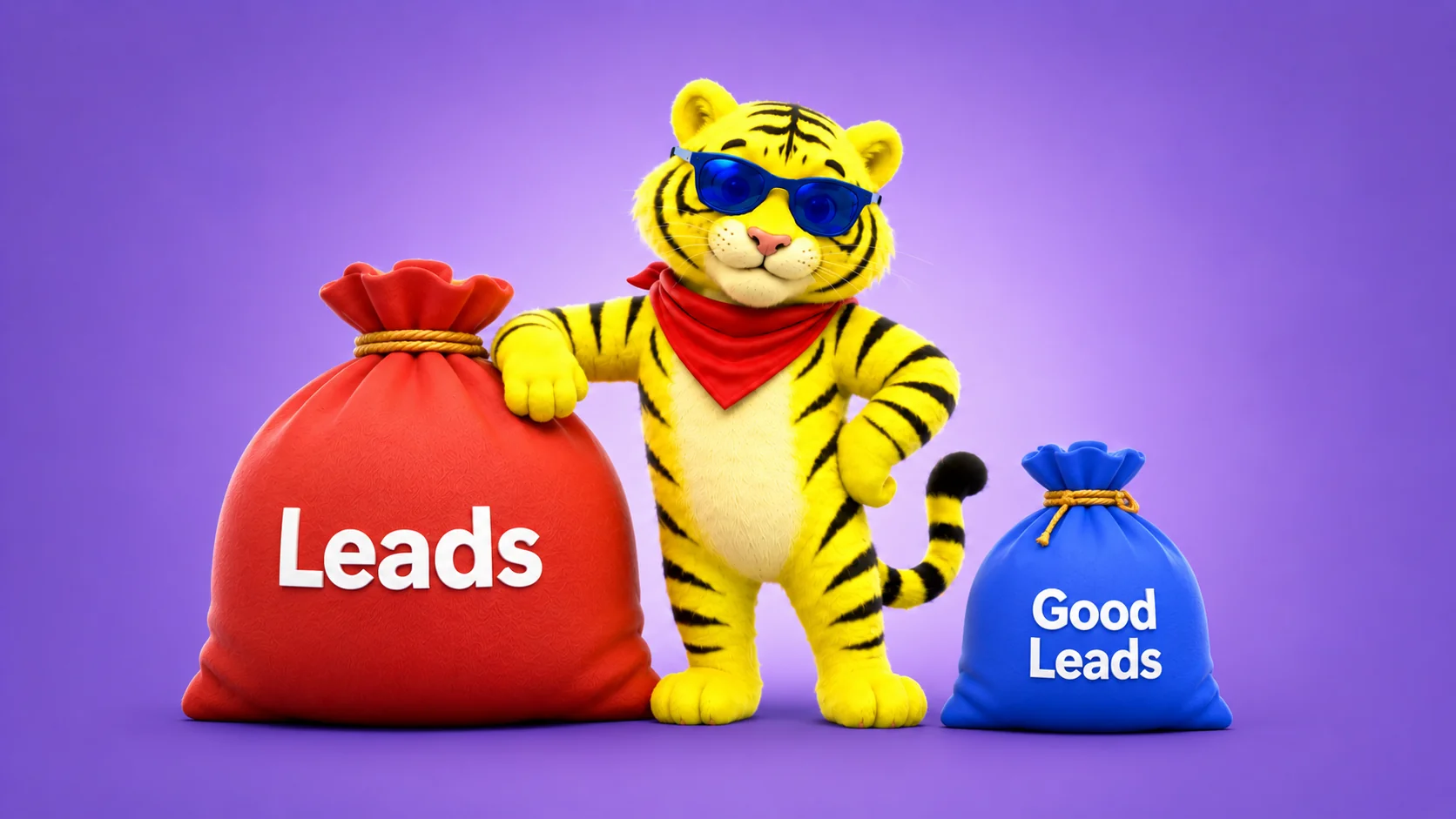
SaaS lead generation is often reduced to three numbers:
- lead volume
- cost per lead
- conversion rate
These metrics are easy to measure and easy to optimize.
They do not necessarily show whether the campaigns are creating commercial value.
A campaign can generate a large number of inexpensive leads and still perform poorly. Another can generate fewer and more expensive leads while creating significantly more customers or qualified opportunities.
The reason is simple:
Not every SaaS lead is equally valuable.
A good SaaS lead needs two things:
- Fit: The person and company could realistically become a valuable customer.
- Intent: Their behavior suggests meaningful interest in the product or buying process.
Lead volume and cost per lead are useful only when evaluated against these two dimensions.
What counts as a SaaS lead?
A lead is an identifiable person who has completed an action that allows the company to continue the communication.
That action might be:
- starting a free trial
- creating a freemium account
- booking a demo
- submitting a contact form
- requesting pricing
- accessing gated content
- registering for a webinar
- viewing a gated product demo
The person has moved from anonymous interest to an identifiable contact.
The company may now know:
- their email address
- their name
- their company
- their job title
- another identifying detail
This is the first de-anonymization point.
It makes the person a lead.
It does not automatically make them a good lead.
A conversion is not the same as commercial value
Advertising platforms optimize toward the conversion events they receive.
If the selected event is a form submission, the platform will try to generate more form submissions.
If it is a free-trial registration, it will try to generate more trials.
If it is a content download, it will try to generate more downloads.
The platform does not automatically understand whether those people:
- represent relevant companies
- use the product
- return after registering
- have sufficient buying power
- become opportunities
- become paying customers
- stay long enough to create value
It understands the event it was given.
This creates a common SaaS lead generation problem: campaigns become very good at producing the wrong conversion.
Cheap SaaS leads can be expensive
A campaign generating 100 cheap trials that never return may be less valuable than one generating 20 more expensive trials with strong product activity and paid conversion.
The first campaign may look better in the advertising dashboard.
The second may be commercially stronger.
The important question is therefore not:
Which campaign generated the cheapest leads?
It is:
Which campaign generated users, companies and opportunities with the greatest commercial value?
The two dimensions of SaaS lead quality
A useful lead-quality model should evaluate fit and intent separately.
Fit
Fit measures how closely the person and company match the type of customer the SaaS business can serve profitably.
This may include:
- company size
- company revenue
- industry
- geography
- company type
- use case
- job function
- seniority
- involvement in the buying process
A person can show strong interest and still be commercially irrelevant.
They may use the product regularly and interact with every piece of content. But if they represent a company that cannot afford the product or does not fit the use case, they may never become a valuable customer.
Intent
Intent measures how strongly the person's behavior suggests that they are interested in evaluating, adopting or purchasing the product.
Depending on the SaaS model, useful intent signals can include:
- searching for the product category
- starting a trial
- returning to the product
- remaining active
- using the product repeatedly
- viewing product information
- requesting pricing
- booking a sales conversation
Fit tells the company whether the lead could become valuable.
Intent indicates how likely the person is to move forward now.
Neither is sufficient alone.
The four types of SaaS leads
The fit-and-intent framework creates four broad lead groups.
High fit, high intent
These are the strongest leads.
The company is commercially relevant and the person's behavior suggests active evaluation.
Examples could include:
- a relevant decision-maker requesting a demo
- a target company repeatedly using the trial
- a relevant user returning to the product several times
- a qualified account requesting pricing
These leads usually deserve immediate attention.
High fit, low intent
These people or companies match the ideal customer profile but do not currently show strong buying behavior.
They may:
- belong to a target account
- engage occasionally with content
- visit the website
- see the company's advertising
- have no active project yet
They may be good candidates for:
- brand building
- educational communication
- retargeting
- account-level visibility
- future sales outreach
They should not automatically be treated as sales-ready.
Low fit, high intent
These people are interested but have limited commercial value.
They may use the product regularly while representing:
- companies that are too small
- unsupported industries
- lower-value markets
- individual users outside the buying model
The company may still serve them through a free or self-service plan.
They should not necessarily receive the same sales investment as high-fit accounts.
Low fit, low intent
These leads provide little immediate commercial value.
They may be inexpensive to generate and help campaign dashboards look active, but they should not drive the acquisition strategy.
The definition of fit depends on the business model
There is no universal definition of a qualified SaaS lead.
A product-led SaaS selling a low-cost monthly subscription may be able to serve freelancers, small teams, agencies and larger businesses.
A sales-led enterprise SaaS with a high annual contract value may only be relevant to:
- companies above a certain size
- specific industries
- businesses with a particular process
- organizations with sufficient budget
- companies with enough internal resources to implement the product
The same person can be an excellent lead for one SaaS company and a poor lead for another.
The ideal customer profile therefore needs to come from the real commercial model.
A B2B SaaS marketing agency can help structure and activate the ICP. It should not invent it without input from the company.
Sales, product, customer success and management should help define:
- which customers receive the greatest value
- which customers convert
- which customers stay
- which customers generate sufficient revenue
- which customers are difficult or expensive to serve
Marketing can then translate this information into targeting, qualification and campaign optimization.
Product-led SaaS produces many low-friction leads
With product-led SaaS, the first identifying conversion is often a free trial or account registration.
The barrier is relatively low.
The person does not need to:
- speak to sales
- explain their situation
- schedule a meeting
- enter a formal buying process
They can simply try the product.
This makes de-anonymization easier.
It can also create many weak leads.
Some users register because:
- the trial is free
- they are curious
- they want to test one feature
- they are researching the market
- the registration requires very little effort
The trial itself therefore provides limited information.
What happens after the trial begins is more important.
Product usage reveals stronger intent
Consider two users.
User A
- starts a free trial
- opens the product once
- leaves after a few minutes
- never returns
User B
- starts a free trial
- returns the following day
- uses the product repeatedly
- remains active during the trial
Both users generate the same advertising conversion.
They are not equally valuable.
User B shows stronger intent.
This is why product-led SaaS campaigns should not be evaluated only through registration volume.
Useful downstream signals include:
- whether the user returns
- how frequently they return
- whether they remain active
- whether they use the product repeatedly
- whether they convert from trial to paid
A campaign producing fewer but more active users can be more valuable than one producing many inactive trials.
Product data should feed back into advertising
When product usage is connected back to advertising data, the company can identify which campaigns generate stronger users.
The company may discover that:
- one country produces many cheap trials but few returning users
- another produces fewer trials but stronger paid conversion
- one keyword attracts active users
- another attracts registrations that never return
- one campaign attracts relevant companies
- another attracts users with little commercial value
This information can be used to:
- reallocate budget
- adjust campaign values
- change targeting
- evaluate countries differently
- distinguish trial volume from trial quality
Without these signals, every registration looks equally valuable to the advertising platform.
Sales-led SaaS produces fewer, higher-friction leads
With sales-led SaaS, the first identifying conversion is often a demo request or sales inquiry.
This is a higher-friction action.
The person needs to:
- provide their details
- accept a future conversation
- invest time
- explain their situation
- enter a sales process
Fewer people will complete this action than start a free trial.
Those who do usually show stronger intent.
However, a demo request is still not automatically a qualified opportunity.
The lead may:
- come from a company that is too small
- have no budget
- represent an irrelevant use case
- work outside the target market
- have no influence on the decision
- be researching for a future project
The higher-friction conversion improves average intent.
Fit still needs to be evaluated.
One qualified opportunity can be worth more than 100 weak leads
Sales-led SaaS usually depends more on lead value than lead volume.
A single relevant enterprise opportunity can represent tens or hundreds of thousands of euros in recurring revenue.
In this model, generating a large number of weak form submissions can create work without creating value.
Sales needs to:
- review the leads
- research the companies
- contact the people
- qualify their needs
- follow up
- maintain the CRM
Poor-quality leads create a hidden operational cost.
They consume sales capacity that could be used on relevant accounts.
For high-value SaaS, a campaign producing a small number of strong opportunities can be far better than one producing hundreds of weak leads.
More leads can reduce sales effectiveness
Lead volume is not always harmless.
When sales receives too many weak leads:
- response times can become slower
- relevant leads receive less attention
- sales stops trusting marketing
- qualification becomes inconsistent
- CRM data becomes less reliable
- strong opportunities may be missed
Marketing may report success because lead volume increased.
Sales may experience the opposite.
This often creates the familiar conflict:
Marketing says the leads are good. Sales says the leads are bad.
Usually, both teams are using different definitions.
Marketing is evaluating the initial conversion.
Sales is evaluating commercial potential.
A shared lead-quality model should connect the two.
Sales feedback should feed back into campaigns
For sales-led SaaS, marketing needs structured CRM and sales feedback.
The advertising team should know:
- whether the company was relevant
- whether the person had a useful role
- whether sales accepted the lead
- whether an opportunity was created
- why the lead was rejected
- whether the account progressed
- whether the opportunity became a customer
Without this information, marketing can optimize only toward form submissions.
It cannot distinguish between:
- an irrelevant inquiry
- an interesting but early-stage company
- a qualified opportunity
- a high-value target account
The CRM should connect the initial advertising conversion with the later commercial outcome.
Different conversions should have different values
SaaS campaigns often group several actions under the label "lead."
These might include:
- an ebook download
- a webinar registration
- a free trial
- a demo request
- a pricing request
They are not equally valuable.
A content download shows that the person wanted the content.
It does not prove that they want the product.
A trial shows product interest, but not necessarily buying intent.
A demo request shows stronger intent, but the company can still be a poor fit.
The company should assign different values to different conversions based on how closely they correlate with commercial outcomes.
This gives advertising platforms better signals than treating every conversion equally.
Content leads are usually earlier-stage leads
Educational content can play an important role in B2B SaaS acquisition.
It can:
- explain the problem
- educate the buyer
- communicate expertise
- build recognition
- support future demand capture
However, a content lead should not automatically be treated as a sales lead.
A person downloading a guide may only want:
- information
- a template
- a checklist
- research
- help with their current work
This still has value.
The company has identified a person interested in a relevant topic.
But the next step should depend on fit and subsequent behavior.
Passing every content lead immediately to sales creates unnecessary work and can produce a poor experience.
Job title alone does not determine lead quality
B2B SaaS purchases can involve:
- users
- internal champions
- managers
- technical evaluators
- decision-makers
- budget owners
A user may not have final purchasing authority but may strongly influence the decision.
A senior executive may have authority but little involvement in the product evaluation.
Job title is therefore a useful fit signal, but it does not fully describe commercial relevance.
The company should also consider:
- the person's role in the buying process
- their level of influence
- who experiences the pain
- who evaluates the product
- who controls the budget
The most senior person is not always the most useful lead.
A target account is not automatically an opportunity
Account-level fit matters in enterprise SaaS.
However, reaching someone at a target company does not automatically create commercial value.
The person may:
- work in an irrelevant department
- have no involvement in the process
- be too junior
- have no current need
- be researching for personal interest
- have no access to the buying group
Target-account status is one positive signal.
It still needs to be combined with role relevance and intent.
Lead quality can differ significantly by country
Global SaaS companies often see large differences in lead cost between countries.
A market producing leads at one-tenth of the cost is not automatically ten times better.
Countries can differ in:
- trial-to-paid conversion
- lead-to-customer conversion
- average contract value
- churn
- lifetime value
- sales-cycle length
A country with cheap registrations can still produce weak acquisition economics.
A global product-led SaaS should therefore evaluate markets through:
- customer acquisition cost
- lifetime value
- paid conversion
- retention
- product activity
Lead cost is only the first layer.
What if there are too few customers to optimize toward?
Many high-value B2B SaaS companies do not generate enough customers or opportunities for advertising platforms to optimize directly toward the final outcome.
There may be:
- only a few demos each month
- a long sales cycle
- very few new customers
- substantial delays between first click and purchase
The platform needs more frequent signals.
The company may therefore use proxy conversions.
A proxy is an earlier action that has a meaningful relationship with the commercial outcome.
Possible examples include:
- returning to the product
- viewing a product demonstration
- starting a trial
- requesting product information
- completing a qualification step
- returning repeatedly to relevant pages
The event should not be selected merely because it is easy to generate.
It should correlate as closely as possible with future opportunities or customers.
Avoid meaningless optimization signals
A platform can optimize toward almost any measurable action.
That does not mean every action is useful.
Weak primary signals can include:
- scrolling halfway down a page
- spending an arbitrary amount of time on the site
- opening a generic page
- clicking a navigation element
- watching a few seconds of a video
These events may help with analysis.
They should not automatically become primary campaign conversions.
If the signal is too far removed from commercial value, the platform may find people who are good at completing the event but unlikely to purchase.
A useful proxy should be frequent enough for optimization and meaningfully connected to the buying process.
Qualification friction needs to be balanced
One way to improve average lead quality is to make conversion more difficult.
The company can request:
- company size
- job role
- phone number
- budget
- implementation timeline
- detailed requirements
This may reduce weak leads.
It may also reduce strong ones.
A relevant buyer may leave because:
- the form is too long
- they do not want to provide a phone number
- they do not know the exact budget
- they are still researching
- the commitment feels too high
The company needs enough information to prioritize leads without creating unnecessary friction.
Additional information can often be collected later through:
- company-data enrichment
- product behavior
- sales qualification
- CRM research
The goal is not to make every lead prove its value before converting.
It is to collect enough information to make the next decision.
The landing page should attract and filter
A SaaS landing page should persuade relevant buyers.
It should also help irrelevant visitors understand whether the product is actually for them.
This can be achieved by communicating clearly:
- the target audience
- the use case
- the product category
- the type of company served
- the buying model
- the primary value
Broad claims such as "save time" or "increase productivity" can attract a large audience.
They may also attract many people who do not fit the product.
Clearer messaging may reduce the total conversion rate while improving commercial relevance.
That can be a positive result.
The goal is not to convert every visitor.
It is to convert the right visitors.
Different campaigns naturally produce different lead types
Not every campaign should be expected to produce the same level of intent.
Search campaigns
Search can reach people actively looking for a solution.
Intent may be strong, although the search itself can still be broad.
Competitor campaigns
These reach people evaluating another provider.
The category intent is relevant, but the buyer may strongly prefer the competitor.
Paid-social lead campaigns
These can identify relevant people before active search.
Fit may be strong while immediate intent is lower.
Educational content campaigns
These can build recognition and expertise.
The leads are usually earlier in the buying process.
Retargeting
This reaches people who have already interacted with the company.
Intent depends on the nature of the initial interaction.
Each campaign should be evaluated according to the role it plays.
A content lead and a direct demo request should not be reported as equivalent commercial outcomes.
Demand capture and lead generation are not identical
Demand capture reaches people already showing active interest.
Lead generation turns identifiable people into contacts.
The two can overlap, but they are not the same.
A person searching for enterprise software and booking a demo is both captured demand and a lead.
A person downloading a strategic guide through LinkedIn becomes a lead, but may not represent active demand.
This distinction matters because the buying stage and expected lead quality are different. Read more about how to combine both in B2B SaaS demand generation and demand capture.
Early-stage leads should not be judged by the same standard as demo requests.
They should also not be reported as if they were equivalent.
Lead scoring should influence marketing, not only sales
Lead scoring is often treated as a system for helping sales prioritize contacts.
It should also influence marketing decisions.
Campaigns can be compared through:
- average fit
- average intent
- percentage of qualified leads
- returning-user rate
- opportunity creation
- trial-to-paid conversion
- customer acquisition cost
- lifetime value
This can reveal that:
- one channel generates more leads but weaker companies
- another generates fewer leads but more opportunities
- one country produces low-cost trials with poor retention
- another produces expensive leads with strong lifetime value
- one message attracts users
- another attracts commercially relevant buyers
Marketing can then optimize toward business value rather than conversion volume.
Three SaaS lead-quality examples
Kontentino: evaluating trials beyond registration
Kontentino is a globally sold, product-led SaaS platform.
Free-trial volume alone could not show which campaigns created commercially relevant users.
Campaign evaluation also needed to consider country-level customer value, acquisition cost, trial-to-paid conversion and returning product activity.
Lead scoring and product-usage signals helped identify campaigns bringing users who returned and demonstrated stronger intent.
Pygmalios: opportunity value over lead volume
Pygmalios sells enterprise-level software to a very small number of relevant physical retail companies.
Generating a high number of leads was not the objective.
Marketing needed to reach and influence the right accounts and decision-makers before direct sales outreach.
One serious opportunity from the right company was more valuable than a large number of weak form submissions.
Perdoo: different conversions represent different buying stages
Perdoo sells OKR software globally through a free-trial model.
Search could capture people actively looking for an OKR tool.
LinkedIn and Meta distributed educational content about setting and managing OKRs.
These activities created different lead types: people actively searching for software and management-level audiences interested in the topic.
They contributed to the same acquisition system, but should not be treated as equivalent conversions.
What should a SaaS marketing agency optimize toward?
A SaaS marketing agency should not automatically optimize toward the easiest or cheapest lead.
It should first understand:
- how the product is sold
- what a valuable customer looks like
- which companies create sufficient lifetime value
- what the first meaningful conversion is
- which behaviors show stronger intent
- how much conversion volume is available
- which product and CRM data can be returned to the campaigns
The right optimization event may then be:
- an active free trial
- a returning product user
- a qualified demo
- an accepted sales lead
- a created opportunity
- a paying customer
- a value-weighted conversion
The correct event depends on the business model and the amount of available data.
The goal is not more leads
More leads can be useful.
They can also create the illusion of growth.
A SaaS lead generation strategy should not maximize the number of identifiable people independently from their value.
It should generate and identify people who:
- fit the market
- show meaningful intent
- have a realistic path to becoming customers
- can create sufficient commercial value
That requires connecting advertising with:
- product activity
- sales feedback
- CRM stages
- customer value
- retention
A lead is only the beginning of the acquisition process.
Its value depends on what happens next.
Related reading: SaaS demo optimization and why free sign-ups are not the same as demand.
Looking for a B2B SaaS lead generation agency?
Kraftvertising is a B2B SaaS marketing and advertising agency working across Google Ads, LinkedIn Ads, Meta, paid social, landing pages, creative and conversion tracking.
We evaluate SaaS lead generation beyond form submissions and cost per lead.
We connect paid campaigns with product usage, sales feedback and CRM outcomes to identify which channels and messages generate commercially relevant users and opportunities.
Discuss your SaaS lead generation strategy with Kraftvertising.
Frequently asked questions
What makes a good B2B SaaS lead?
A good SaaS lead has both fit and intent. Fit means the person and company could realistically become a valuable customer — right size, industry, use case, role and budget. Intent means their behavior suggests meaningful interest, such as returning to the product, requesting pricing or booking a demo. Lead volume and cost per lead are only useful when evaluated against these two dimensions.
Why can cheap SaaS leads be expensive?
Advertising platforms optimize toward the conversion event they receive. If that event is a form submission or a free-trial registration, they will produce more of those — regardless of company fit, product usage or paid conversion. A campaign generating many cheap trials that never return can be commercially weaker than one generating fewer, more expensive trials with strong product activity and paid conversion.
How should product-led SaaS evaluate lead quality?
Registration volume is not enough. Product-led SaaS should look at whether users return, how frequently they return, whether they remain active, and whether they convert from trial to paid. Product usage should feed back into advertising so campaigns can be evaluated by the strength of the users they generate — not only by trial count.
How should sales-led SaaS evaluate lead quality?
Sales-led SaaS should connect the advertising conversion to CRM outcomes: whether the account was relevant, whether sales accepted the lead, whether an opportunity was created, why leads were rejected and whether the account progressed to a customer. Without this feedback, marketing can only optimize toward form submissions and cannot distinguish a qualified opportunity from an irrelevant inquiry.
Should all conversions be treated as equal leads?
No. An ebook download, a webinar registration, a free trial, a demo request and a pricing request are not equally valuable. Content leads are usually earlier-stage leads. Demo and pricing requests show stronger intent. The company should assign different values to different conversions based on how closely they correlate with paying customers.
What should a SaaS marketing agency optimize toward?
Not the easiest or cheapest lead. A SaaS marketing agency should first understand how the product is sold, what a valuable customer looks like, which behaviors show real intent, and how much conversion volume is available. The right optimization event may be an active trial, a returning user, a qualified demo, an accepted sales lead or a value-weighted conversion — depending on the business model.
SaaS Positioning: What to Say When Every Product Looks the Same
In mature SaaS categories the products really are similar. How to choose an association, express it distinctively and repeat it long enough for the market to remember it as yours.
SaaS Market Analysis: What to Check Before Spending the First Advertising Budget
Advertising budget should follow market opportunity. What to check first: real demand, market size, customer value, geography, category direction and spending capacity.
SaaS Demo Optimization: Why “Book a Demo” Shouldn’t Be Your Only Conversion
Talk to sales or leave is a very large jump. How product walkthroughs, pricing context and intermediate signals improve demo quality and ad optimization.