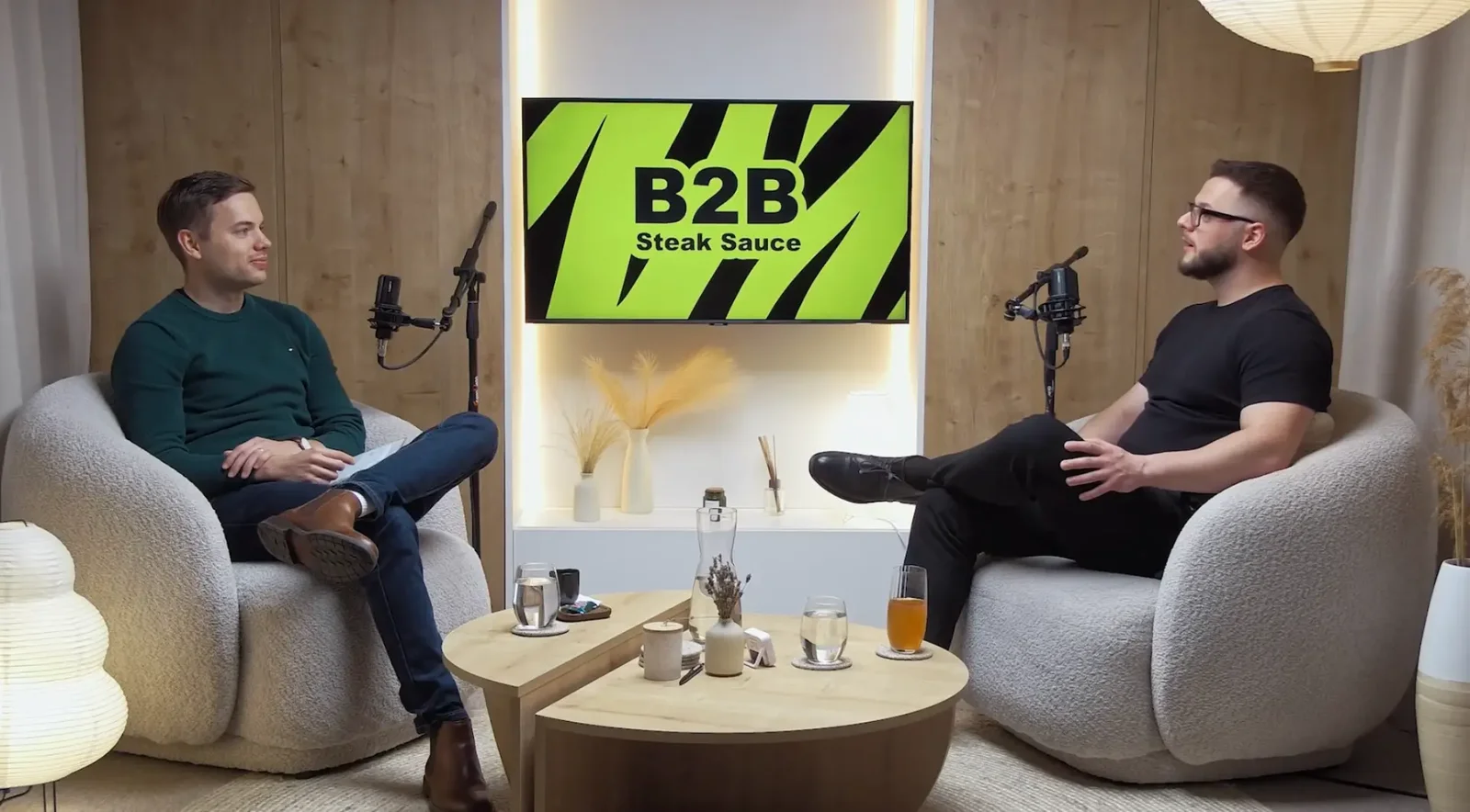
Full English transcript
The conversation was recorded in Slovak; this is the supplied English translation. The source marks the host as "Host"; those turns are credited to Martin Brath. Bracketed notes mark wording that was unclear or trailed off in the source. The episode was published on 6 February 2026 and runs 50 minutes.
From political science and PR to elv.ai
Martin Brath: Welcome, everyone, to another episode of B2B Tech Talks. With me is Jakub Šuster, a Forbes 30 Under 30 honoree, co-founder and former CEO of Elv.ai, who now works for CulturePulse. Welcome, Jakub.
Jakub Šuster: Hi, thanks for inviting me.
Martin Brath: I'd start with your beginnings. You went to university in Brno, then started working in PR, and eventually got to Elv.ai. Could you walk us through how that developed?
Jakub Šuster: It'll have to be a very quick version, or we'd be here all day.
Martin Brath: Please.
Jakub Šuster: As you said, it started in Brno, where I began studying political science and international relations at Masaryk University. Originally, I wanted to study psychology. It had fascinated and interested me for a long time, but I didn't get in. Eventually, it turned out that was how it was meant to be. I started studying political science and economics, which really captivated me. From political science, I began specializing in political marketing. That overlapped a little with psychology, because political campaigns have a psychological dimension. Then, for my master's, I studied political marketing itself. It was the first year they offered it as a separate program, so we were a bit like guinea pigs. But it was very good. I've always been the person asking a question that wasn't very popular even at secondary school: what will I use this for? At university, you may no longer ask the professors that out loud, but you keep asking yourself. I realized the best way to find out was through practice. I tried to test both political science and economics in the real world. During university, I did internships in various organizations, including the Institute of Political Marketing and later the European Parliament, on the political science and marketing side. I also worked in a bank to try out the economics side. Then, during my master's, after the European Parliament internship, a political party offered me part-time work. After three months, it became full-time. So I was studying political science while already working full-time in the field. Some lecturers and classmates found that unusual, because the usual path is to finish studying, then look for work and gain experience. But I wanted to see things in practice, so I started gaining experience during university, which turned out to be an advantage. By the time I finished political science and political marketing, I'd worked on several major national and regional campaigns. I thought: okay, I've seen it. I'd risen relatively high within the party even though it was a Czech political party and I was Slovak. I had to write press releases and prepare graphics in Czech, so there was learning involved there too.
Martin Brath: You could become prime minister.
Jakub Šuster: Sorry?
Martin Brath: You could become prime minister.
Jakub Šuster: Right. After that, I felt I couldn't grow further there. By coincidence, an offer came from an agency, then called Katedra komunikácie, now New School Communications. We began working together part-time on projects, and later I accepted a full-time offer and moved back to Bratislava. One of my projects happened to be elfovia.sk. That's where the startup and technology part of my life began. It was 2022, when the war in Ukraine started. The situation was unprecedented: a war just across our border, in a neighboring country, was something we hadn't experienced for a very long time. Society was mobilizing, but also polarizing. We saw communication agencies trying to help through fundraising or awareness campaigns. We wanted to help too, but in a way with real impact. We identified an enormous amount of hateful content and disinformation on social media, a particular problem for media outlets and public institutions. Specifically, the comments under articles, videos, and so on. That was the pain point we wanted to address. We started in a very agency-like way. People in B2B will know the various social-media management tools. We were using one at the agency. We asked: how do we solve this? There are pages with comments we want to analyze and clean up, removing what doesn't belong. We hired our first part-time moderators, connected the pages to community-management software, created a set of rules, and started. Our first client happened to be Aktuality. When the public and other media companies learned what we were doing for them, more media clients came. In three months, our seven part-timers became forty-eight. We thought: this isn't particularly scalable. But clearly there was demand. We enjoyed it, it made sense to us, and it had business potential. So we considered automation: how to make it more efficient and faster. This was just before ChatGPT. For those who remember, it launched in November 2022. We'd already been testing our first models. By the end of 2022, we'd tested and partly deployed our first model to help moderators handle the volume of comments. We began building a human-in-the-loop system, combining AI and people for content moderation. By the end of that year, we realized we couldn't keep treating it as a CSR activity alongside client work, coffee breaks, evenings, and weekends. It was taking too much time. We had a choice: close it, make a great case study about helping clean up the Slovak internet, or separate it out, find an investor, and build an independent startup. We discussed it a lot, and I was saying: let's do it. I'll stop there for now, because I could tell you much more. Should I continue?
Becoming CEO and finding product-market fit
Martin Brath: Let's continue. At this point, you weren't necessarily discussing it as an equal with decision-making power. What was your position?
Jakub Šuster: That's a great question. It wasn't like that at all. The people who are now my co-founders were my bosses then, so the dynamic was different. But our setup was very transparent. Since I was leading the project, I had a significant say in what happened next. Nobody knew the project as well as I did. At the end of 2022, we discussed the pros and cons: what we'd need to continue, or how we'd close it. Two major questions were who would lead it and how we'd finance it. I'd been thinking about leading it for a while. At the time, I had no mortgage, children, girlfriend, or anything like that, so I thought: who else, if not me? Ultimately, I had nothing to lose. That's what I said, and we agreed it made sense. That's how Jakub the employee became Jakub the co-founder and CEO. The second major question was financing. We'd bootstrapped the initial development, but building something larger and more scalable was different. It seems like ages ago, though it wasn't, but there were no vibe-coding platforms then. We agreed we needed an external investor to keep developing and scaling it. Milan Dubec entered the picture as our first angel investor. The first half of 2023 was focused on separating the business, rebranding, stabilizing it, and defining the first technology roadmap.
Martin Brath: So you're in a new company with prospects and an investor, and you're CEO. You've never done anything like it, and expectations are high. What happened next?
Jakub Šuster: Oh my God. I'd always wanted to lead something and be the boss, but life teaches you: be careful what you wish for, because you might get it. I got exactly what I wanted and suddenly discovered it wasn't as easy as you imagine. The responsibility and pressure, especially the external pressure once you have an investor, are significant. If it doesn't work, it isn't only about you anymore; there are financial expectations too. It took time to learn to live and work with that, but it's probably an inevitable part of the transformation. Personal transformation. Exactly. Another key moment was bringing in the second investor, the Crowdberry Esprit fund [fund name as transcribed], led by Miro Beblavý. That was different. With the angel investor, my co-founders had been very active, partly because of personal connections. It made sense to do that together. But I handled the next investor almost entirely myself, from the initial pitch through the subsequent stages. One particular moment remains very formative for me. We'd passed the initial rounds, the investment was becoming real, and we were getting into serious business. We were discussing half a million euros. I remember a meeting at the potential investor's office: their investment manager, the fund head, our existing investor's lawyer, their lawyer, our investor's CFO, and me. People with ten or fifteen years more experience, looking at you as if to say: well? You feel you might fall apart on the spot, but you have to hold it together. This is business; this is how it works. I understood several things then. First, being a leader and CEO is often lonely. You'll face situations you've never encountered, without a friend on the phone or someone beside you saying how to handle them. Second, it later gave me confidence that I could handle things I'd never done. The meeting went well, we closed the investment, and our relationships remain very good. But at the time, I was thinking: what am I doing here? These people have invested millions, and I'm a guy from Devínska sitting here pretending I know what we're talking about. Impostor syndrome. Absolutely. I think everyone has to go through that. When you're in a new environment, task, or role, you can't already have confidence. It's a new game. You gain confidence by playing it, progressing through levels, and realizing it's possible. Eventually, you've completed enough levels to understand the game. Then you decide to try another game and find yourself back at the beginning: what am I doing here? I know nothing about this. People gave me opportunities, and I don't want to disappoint them, but I'll make mistakes. Will that be okay? The more games like that you experience, the less afraid you are at the beginning, I think.
Martin Brath: Okay. How did you scale? What team did you have, and how did you reach product-market fit?
Jakub Šuster: Good question. Again, neither my co-founders nor I had practical experience with B2B SaaS startups. They had an agency, which is still B2B, but a completely different business. You learn a lot as you go. You can read about sales, marketing, operations, and development, but then realize you also need a product owner, a product-discovery process, and so on. Reading about it in theory and living it are different. I won't lie: a lot was trial and error. Fortunately, the errors and dead ends weren't destructive. We could always return or find another route. The team was built from the bottom up, including people who had been our content moderators. Part-timers? Part-timers at the time. Some people always stand out. From the start, we tried to develop them, gradually giving them more responsibility and tasks, and seeing how they responded. That's how our later COO, head of operations, began emerging. She started as a moderator and grew into someone capable of handling enormous responsibility. Without her, we probably wouldn't have closed those investment rounds, and it was her first time too. Our project manager developed that way as well. Then we recruited for missing roles, sales, later marketing, and so on.
Martin Brath: Did you also use mentors?
Jakub Šuster: Not initially, but after a while I realized that might be a good idea. I began looking into mentoring and seeing the value of finding experienced people. Yes, they're usually expensive, but once you've been down a few dead ends, you realize those cost money too. Sometimes it's better to pay someone who's already been there and can say: mate, that isn't worth doing. I also started finding mentors for other team members. Why not?
Martin Brath: How did people and the market respond to the product?
Jakub Šuster: At first, I think the response was excellent, because it solved a real problem, and people were willing to pay from the beginning, which was great. On the other hand later we had to face the fact that we hadn't gone through a truly thorough product-discovery process. That began holding us back when developing new features. We knew what the core should do and look like, but when you want to upsell clients and earn more, because you're a business rather than a nonprofit and there are expectations, we realized we didn't fully know what clients wanted. We knew they probably wanted what we were already giving them. But interestingly we hadn't collected structured feedback. We asked whether they were happy and needed anything else, the normal things you do when you care about customers, but not as part of a structured discovery process. That became evident after our second investment when we'd budgeted further development and new features. We asked: okay, what do you actually want? The feedback before that had been if it works, nobody contacts you; if it doesn't, they do. Improving models and accuracy was clearly essential and went without saying. But we had to discover what additional features would encourage clients to pay more or stay rather than switch to competitors. We realized we had to go back to the beginning. Unfortunately, we only learned that after developing a feature [the source wording may also mean a free feature] that made perfect sense in theory. We had some signals that clients wanted more analytics, so we built analytics. When we showed the first dashboards, they said: wow, that looks great. We thought: excellent
Martin Brath: And when it's free.
Jakub Šuster: We thought we were on track. We developed and delivered it: here it is! And they said: what's it for? We thought: okay, we've overshot. It made sense to us but clearly not to them. That was when we became much stricter about product focus. At least I stopped being in love with my own idea of what the product should look like and began understanding that unless it makes sense to the client and solves a problem, whether saving time or making money, they won't pay. The product has to rule. Fortunately, we reshaped the analytics into something they were and remain willing to pay for, something that adds value. But yes, we could have learned that more cheaply.
Hiring, underperformance and pressure
Martin Brath: You had little experience, lots of pressure, and you were a new CEO. At least you had no family or mortgage. How did you handle it? How does someone deal with that?
Jakub Šuster: You're asking about the personal experience, right?
Martin Brath: Even hiring is demanding for a CEO. I find it very difficult, so I assume it's similar when you aren't sure what you're hiring for or whether it's right.
Jakub Šuster: Absolutely. You know I'll admit openly that at first I had more luck than judgment. I managed to hire excellent people who fitted the team. Despite my considerable lack of leadership skills, we could cooperate, deliver, and move things forward.
Martin Brath: Mm-hmm.
Jakub Šuster: Later, of course, there were cases where we didn't find that fit. That's probably unavoidable. When you're hiring however extensive the selection process, I've heard of five rounds, which seems excessive, you still don't see someone's fully authentic self.
Martin Brath: Mm-hmm.
Jakub Šuster: You see what they show you in the interview, over coffee, or wherever you meet during recruitment.
Martin Brath: You can't have certainty. That's clear.
Jakub Šuster: Exactly. Only after hiring do you discover who they are, how things work or don't work, and where expectations, values, or something else aren't aligned. Then you have to decide: this isn't working, and we need to part ways. That's perfectly okay. One thing I learned, no, that's a badly formed sentence, not the only thing I learned, but one place my lack of experience showed was not making those decisions sooner. I didn't part ways quickly enough with people where it wasn't working. I kept believing I could give them another chance, try another approach, do it this way or that way.
Martin Brath: Did you feel their underperformance was your fault?
Jakub Šuster: Partly, at first. But later the team showed me that yes, some was my fault because I hadn't set clear expectations or organized certain things. Fair enough. But there also wasn't a fit in values or culture. People tell you that quickly. You're faced with an unpopular but necessary decision. People you care about, who deliver, tell you they're frustrated because someone doesn't fit or contribute. Then you have no choice.
Martin Brath: Was the pressure greater at the beginning, or did it grow over time?
Jakub Šuster: I think, looking back, most of the pressure is what you create yourself. As we progressed and I grew, the pressure changed too. At first, you need to perform and secure the investment. After two rounds, you're thinking been there, done that, it's possible. But other pressures appear, management, the product, then public pressure. Suddenly your name is out there, and people you haven't seen for fifteen years contact you: I always knew it, I believed in you. You realize that element exists too. Ultimately, though, you discover that the biggest pressure comes from yourself.
The public success story versus reality
Martin Brath: I'm interested in the public pressure. Elv.ai attracted attention in Slovakia even though the investment wasn't particularly large...
Jakub Šuster: Mm-hmm.
Martin Brath: ...and was seen as a promising company that grew from nothing. From outside, that looked like substantial pressure while you were still finding your way.
Jakub Šuster: Of course. But it's natural, and ultimately marketing's job, to show the good sides of a business and its people. I don't think there's anything wrong with that. But something started happening for me later. What stopped feeling right was that corporate and personal marketing were doing their job, showing the good sides, but that was becoming very different from my inner experience. That was part of the pressure, external but largely self-imposed. All the things being presented were true
Martin Brath: Mm-hmm.
Jakub Šuster: ...but I felt there was much more behind them: struggle, lessons, things that were incredibly difficult. At the time, I felt I couldn't talk about those. That created a split inside me: this is how things look...
Martin Brath: Mm-hmm.
Jakub Šuster: and that is part of reality, but there's another part nobody sees, which I keep to myself and struggle with alone. It started eating away at me.
Martin Brath: What kinds of things?
Jakub Šuster: Exactly what we're discussing today: setbacks, mistakes, things that failed or didn't go to plan. Looking back, if you only see...
Martin Brath: Mm-hmm.
Jakub Šuster: the milestones, successes, expansion, another country, another investment, more awards, they form a coherent picture: wow, it's going well! I'm not saying it wasn't. It was. But very few people saw everything behind it. I admit I didn't want to show that. I was afraid.
Martin Brath: Do you think you could have shown it at all?
Jakub Šuster: I think you can. Yes.
Martin Brath: Without harming the company and its image?
Jakub Šuster: That's a good question. I think you can. The longer I'm in this and the more people I speak to, the clearer that becomes. People who've achieved things I haven't yet achieved understand that the mistakes and experiences along the way usually the negative things, the failures, shape you far more than the successes marketing presents. So I think it's possible. Ultimately this conversation proves it. I'm telling you how it was and how it is, not just the nice parts.
Martin Brath: Of course.
Jakub Šuster: So...
Martin Brath: That's why I ask. On one hand, making mistakes and feeling pressure are completely normal. On the other, you may feel the company needs to project success for clients to perceive it positively. [One short phrase in the source is unclear.]
Jakub Šuster: Of course. But I think failure is a natural part of success. There's nothing wrong with it. People who've experienced real success understand that and won't judge it.
Stepping down as CEO
Martin Brath: What would you do differently if you could start again?
Jakub Šuster: This will sound like a terrible cliché, because it is a terrible cliché but I wouldn't do anything differently. Of course, if certain things had happened differently, today would look completely different. But many years ago I adopted the principle of trying to make the best possible decisions with all the information available to me. For one very practical reason: so I never regret something later and think I should have decided differently. If you think through a decision, evaluate it, consider all available information, then commit to it and later discover it was wrong you can't blame yourself, because you didn't have all that information. If you had, perhaps you'd have made a different decision. That's how I've approached life and business from the beginning, not life from the beginning, but business, specifically Elv.ai. Decisions that later proved wrong were lessons and information for the next decisions. And, here's the cliché, without those experiences, I wouldn't be where I am today. Of course, there were things I'd say were unnecessary suffering. They were unnecessary suffering and lasted longer than they needed to. Those are things I'd change, but I know I can't. Even the fact that they lasted so long and had consequences ultimately led me to an understanding or conviction I have today, which I carry with me in my little backpack of skills.
Martin Brath: When did you know you didn't want to keep doing it?
Jakub Šuster: You know, one of the most important moments in my Elv.ai journey was in 2024, when I went to America for a very prestigious entrepreneurship program called YTILI, the Young Transatlantic Innovation Leaders Initiative, sponsored by the U.S. government. In short, it's a program for entrepreneurs with six months of online study followed by two months in America where you're matched with an American counterpart doing something similar or complementary. You spend almost two months there. That happened to me, and I understood that life and business are much broader than the way I was seeing them. I started feeling more drawn to America. I'd always had that desire, whether to be in America or do business there. I started thinking: it's always been inside me, but I've never taken steps toward it. So let's do something about it. I began working on it and realizing that it probably wouldn't be possible with Elv.ai. That's a difficult realization, and it doesn't come overnight. It's a realization that touches all your fears: that you've failed, that you aren't good enough, and so on. At the time, in my personal life I wasn't fully at peace with myself. I felt very lost because I'd put so much time and energy into the company that I'd completely forgotten my own life. That caught up with me. I began feeling I couldn't keep being so unbalanced, putting ten or twelve hours a day into work, six or seven days a week. I asked myself: how long do you want to live like this? Is this the life you want? Does it fulfill you? Almost existential questions. It all started coming together, and I felt I should move on. It took time to realize, accept, and process it. But I think it happened exactly as it should have, and I wouldn't change it.
Martin Brath: Okay. When you posted the announcement on LinkedIn, it really blew up, because nobody expected it and there'd been no indication. How did people react? I know quite a lot of people...
Jakub Šuster: Yes, it was a surprise. And that's an important point I want to say out loud: it had nothing to do with the business doing badly. The company was growing year on year, gaining clients, all of that. But internally, I started feeling it no longer... how do I put it? aligned with what I wanted to do next. Looking back, that's the beautiful thing about startup life. You give it your all, and if something isn't working, you do something else. That's the pivoting everyone talks about. There's no point forcing something that isn't working. I realized I didn't want my state of mind to negatively affect the company and team I'd built and cared about. As a leader, I was partly burned out. I use that word because people can picture it; we could discuss burnout in a separate podcast. I was partly burned out and partly searching for meaning. I didn't know whether that would take a week, two weeks, a month, a year, two years, or ten. But at some point, I felt this was unsustainable for me. If I didn't want to bring down and destroy what I'd built, it was the right time to leave.
Martin Brath: Mm-hmm.
Jakub Šuster: And it was the best thing I could have done.
Mentoring and what comes next
Martin Brath: Good. What does the future hold for you? What would you like Jakub to be doing in ten or twenty years?
Jakub Šuster: Ten or twenty years? That's quite a question.
Martin Brath: I was going to say forty, but I'll be generous.
Jakub Šuster: Wow. I think Jakub would like to keep doing something he feels aligned with inside. Oh God, that sounds terrible, but something that resonates internally, you know?
Martin Brath: Okay.
Jakub Šuster: That's one thing. More practically, I've realized that what I really enjoy, and would probably do regardless of... [the sentence trails off in the source]
Martin Brath: Mm-hmm.
Jakub Šuster: is helping people. Guiding, mentoring, and sharing the experience and skills I've acquired with a younger generation of entrepreneurs who may also be finding their way, facing situations I've been through, and could benefit from what I've learned.
Martin Brath: Mm-hmm.
Jakub Šuster: That's something I've actively been doing for a while. I find it very meaningful, and it will definitely have a lasting place in my future. Whether I'll be working on AI, quantum computing, or
Martin Brath: Mm-hmm.
Jakub Šuster: social simulations in ten or twenty years, I can't say. But I can say I've always enjoyed intellectual challenges, something where I can learn and develop, something that can push the boundaries of what I think is possible.
Martin Brath: Of course. Do you have any benchmarks? In twenty years, would you like to have built a hundred-person company, managed fifty people, or have a company listed on Nasdaq?
Jakub Šuster: I'm not setting benchmarks like that at the moment. Perhaps if we spoke in a few months, there'd be one. You may not find that entirely satisfying, but I want to do something that solves real problems for people. My whole entrepreneurial journey shows that: doing something meaningful to me that addresses a real problem. I want to continue that. Actually, there is one benchmark: it will be international. That's always interested me, and I see value in it. In today's digital age if you're doing something purely local, unless it's hospitality or something like that, why not try playing on the global stage? Why not?
Martin Brath: Good. Jakub, thank you for the conversation. I hope you'll join us again next time.
Jakub Šuster: Thank you very much. If you invite me, I'll gladly come.