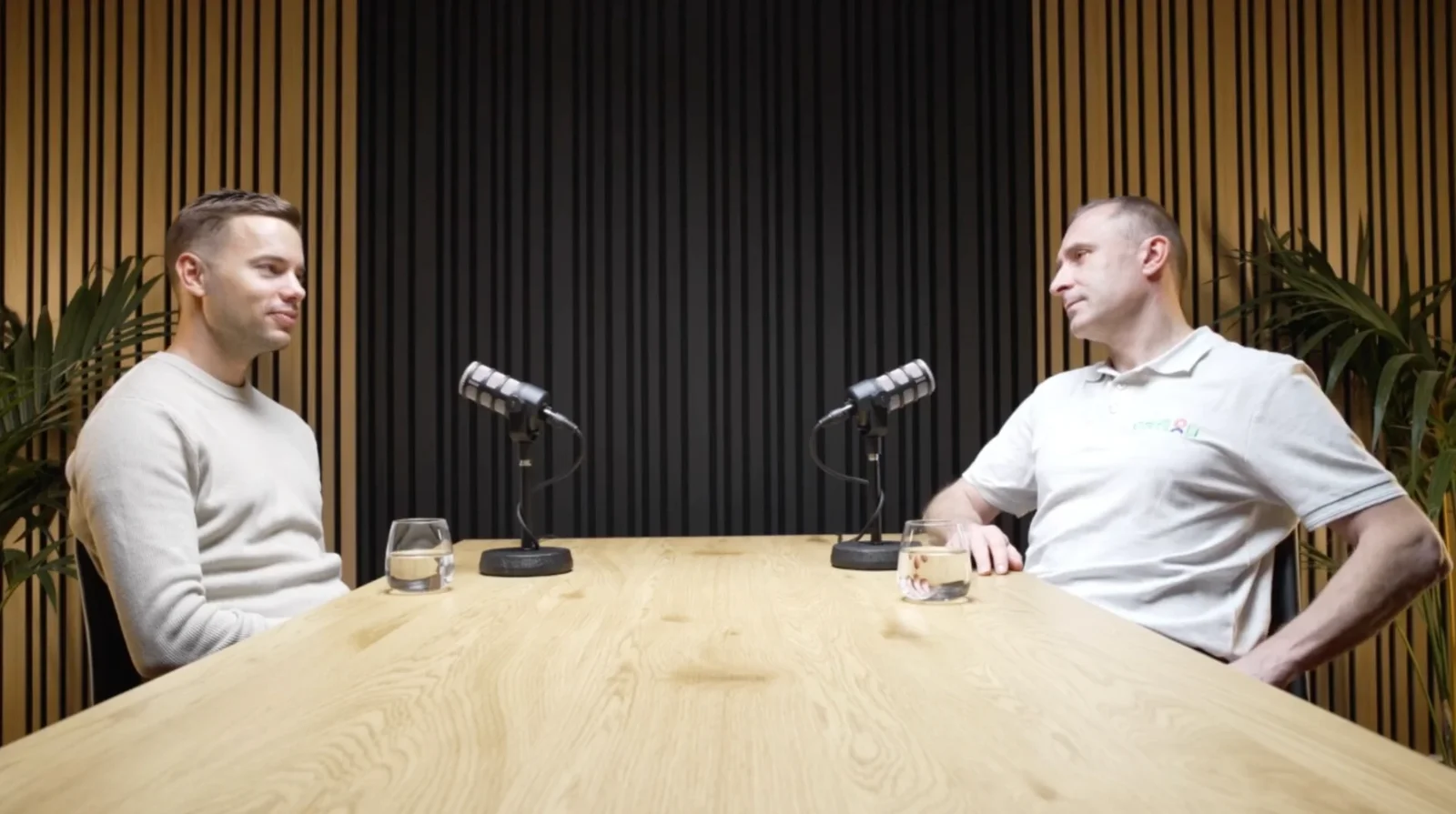
Full English transcript
The conversation was recorded in Slovak; this is the supplied English translation. The source labels both participants "Speaker 2", so speaker names were added based on context. Bracketed notes mark wording the source flags as unclear. The source is dated 12/03/2024, which appears to be the recording date; the episode was published on 12 December 2024 and runs 51 minutes.
From marketer to software founder
Martin Brath: Welcome, everyone, to another episode of our podcast. My guest is Petr Macek, the CEO and founder of Caflou. Caflou is a SaaS company—a software company focused on project and business management. It’s an all-in-one management system. Petr, welcome.
Petr Macek: Thank you, Martin. Hello to all our viewers and listeners.
Martin Brath: Let’s start with your beginnings. I’m interested in how you went from consulting for companies on digitalization and marketing to developing the Caflou software. How did you get there? What was your journey?
Petr Macek: The beginning was quite bumpy. I moved between Australia, Ireland, Russia, and Ukraine. I did various jobs, from banking and financial consulting until I eventually got into marketing. I took a course and became a marketer. That’s how it started. After about three or four years in marketing, I began to feel disorganized. There was more work, more clients, and various collaborations, so I was no longer really a solo entrepreneur. We were a group of perhaps three or four people working together. Keeping track of our customers, how much work we were doing for them, who we’d invoiced, and whether we’d have enough money began to become a problem. Everything was managed on paper, in Excel spreadsheets, or in specialized systems. That’s where the idea came from: there must be a better way to do it. I tried to create software for my own use that would cover all these processes, and that’s where the journey began.
Martin Brath: So you took an entrepreneurial risk and decided to invest in it and try it on the market. Were you still doing marketing work alongside it?
Petr Macek: For another four years after we started building Caflou, I was still working almost full time as a marketer to support the project financially. But the original idea was to create software for myself, for my own needs. However, I think after a month or two, we realized it was so demanding financially and operationally that building something just for a team of two or three people was unsustainable. That’s when our thinking shifted. If a business like mine has this need, there must be hundreds, if not thousands, of similar businesses on the market. Let’s make it a commercial project and sell the software. That’s how it became a commercial idea. But it took quite a long time for it to become self-sustaining. I funded it myself for the first four years, which meant I had to keep working in marketing.
Building it with a developer partner
Martin Brath: It’s interesting that, as a marketer, you reached a point where you said, “Okay, I’ll hire a software developer to help me with this project.” How did you approach that?
Petr Macek: My previous work experience wasn’t just in marketing. It also included developing software tools for large banks. So I had quite substantial experience with designing and testing software. I think that gave me a huge advantage over founders who don’t have that experience and have to hire someone for it. Apart from the actual development, I could handle almost everything myself: design it, test it, market it. I only needed the programming. From my marketing years, I already knew a developer who had built websites for me and was gradually moving into web applications, so that worked out well. For the first year, I simply paid him. From the second year, we agreed on a partnership: I would own one share and my colleague another. We went into it together as partners, which made it somewhat cheaper from that perspective. For a while, we kept it going between the two of us without anyone realizing that there were only two people behind it.
Martin Brath: Is he still at the company?
Petr Macek: He is. You could say he’s someone who may be even more important to the company than I am. He’s the software architect, responsible for the entire architecture and the operation of the system. Of course, there are now other people helping him develop it, but he’s still the heart of the system. I’m just the outer shell.
The market in 2015 and self-funding
Martin Brath: All right. Caflou started in 2015. What did the market look like? Looking back, international players were trying to enter the Czech market and many companies were already using some kind of solution. As a newcomer, how could you break into a market like that?
Petr Macek: We weren’t thinking in those terms at all back then. We had the idea, we knew there was a market, and we assumed there would be interest. The market also looked completely different from today. The global players we know now, such as ClickUp and Monday, covering the areas we cover, weren’t around then either. ClickUp started, I don’t know, maybe seven or eight years ago.
Martin Brath: So someone was copying us.
Petr Macek: Exactly. What we were offering a typical small company was a way to consolidate its business processes in one place: CRM, time tracking, project management, invoicing. At the time, small companies managed those things on paper, in Excel, or using specialized applications for the individual pieces. For projects, there was Basecamp. For invoicing, there were already tools like iDoklad and Fakturoid. Raynet CRM was already available in the Czech Republic; Pipedrive wasn’t around yet at that point. So there were individual tools, and if the companies we were interested in used software, they used four, five, or six different tools. But there wasn’t really a tool like ours that brought all of it together, including among foreign competitors. In a sense, the market was wide open to us. We simply weren’t ready for it. We were limited by funding it ourselves, by being a team of two, and by the system perhaps not being as polished at the beginning as it could have been. So we made mistakes that may have cost us a much larger market share or faster growth.
Martin Brath: Did you consider external funding?
Petr Macek: Not really. It didn’t even occur to me at the time. I’m someone who likes being comfortable with how things are going. Self-funding has clear disadvantages. It limits your growth, because if you don’t have the money, you can’t invest. But it’s your company and you move at your own pace, whereas outside money puts pressure on you. Even now, I’m happy with how things developed and that we’ve managed to fund it ourselves right up to today.
Why international expansion stalled
Martin Brath: And did you ever make a stronger push internationally?
Petr Macek: From the beginning, we built Caflou as an international tool, including the languages it could be used in. German, English, Italian, Spanish, and French were available, so anyone abroad could start using it. We did have some attempts, perhaps in the second or third year, to try international markets. But it was always more of a scattergun approach: “Let’s run a campaign across Europe and America, see where it catches on, and perhaps focus on that market.” Unfortunately, we got a little interest from everywhere, without a clear signal anywhere. Nothing said, “Spain is a great market for us,” for example. We weren’t getting those signals. At the same time, the strength that benefits us in the Czech Republic and Slovakia is our focus on financial management. We bring money into the processes we cover, such as projects and CRM. But that works slightly differently in every country, particularly invoicing. If we want to succeed in Hungary, for instance, we need to implement Hungarian invoicing practices. There are legal requirements and information that has to be submitted somewhere. Every market is different. Our biggest advantage also ran into the issue of accounting software. In the Czech Republic, we have Pohoda and Money; in Slovakia, you have KROS. Austria has its own five systems, Germany its own 15, and Poland its own 20. Unless we overcome those barriers, our advantage stops being an advantage and we become just another system. So we slowed those attempts down fairly quickly because they weren’t generating the return we wanted. We were also advised at the time that the market was already enormous for us in the Czech Republic and Slovakia, so why not focus there?
Educating a market that wasn’t ready
Martin Brath: You were an expert in digitalization and digital marketing. But in 2015, digitalization hadn’t really gathered momentum yet. You were trying to digitalize business management processes, and I assume many companies didn’t see the value in the same way. How did that change over time? I imagine the pandemic brought quite a big jump.
Petr Macek: From around our second year, for example, we focused heavily on financial aspects, such as cash flow management: every company should plan its cash flow. But that isn’t necessarily something a company feels it needs. A small company rarely… They either have money in the bank or they don’t, or they can see whether they’ll have money in the near future, perhaps in a month. [The time reference is inconsistent in the source.] We realized that our topics were difficult and that we needed to open people’s eyes. The approach had to be to educate the market systematically about why they should manage cash flow. Digitalization and automation are the same. Unless a small company sees the problem, really feels it, or sees the benefits of a solution, it isn’t interested. A large company is different. When a trend such as artificial intelligence arrives, large companies jump on it because they feel they should. Small companies don’t deal with it that way. So with digitalization and automation, we also had to educate the market, write lots of articles, and run awareness initiatives to help small companies understand that they had problems and that digitalization could bring benefits. We also had to point out the disadvantages of their existing solutions. If a company keeps its processes in Excel and on paper, there are clear disadvantages. The owner may be able to see the information, but the co-owner can’t, because the spreadsheet is on the first owner’s computer. Or if the team has to use seven different tools to do five things, there are problems with data transfer, security, and teaching people to use all those tools. We needed to explain that there was a reason to look for solutions that would make their work easier rather than add to it. Digitalization works the same way. In terms of timing, COVID was actually very helpful for us in that respect. It accelerated companies’ progress because they suddenly had to work out how to organize themselves outside the office and without paper. In an office, you can simply tell each other things. When you suddenly have 10 people in completely different places, they start looking for solutions. So, despite all its negatives, it was a godsend for us, if I can put it that way. It helped speed up the whole ecosystem. We weren’t the only ones to benefit; many other tools did too.
Martin Brath: And e-commerce. It’s an interesting entrepreneurial issue, when tools arrive on the market too early. [Opening wording unclear in the source.] Educating people isn’t easy. Writing blog posts doesn’t mean anyone will read them. So you were a little early, and the market wasn’t fully ready. You needed to wait for the so-called early adopters, because other people and companies often need to see businesses using something before they adopt it themselves. How did you get that education out to a broader audience? Simply writing blog posts as a small company, as you were at the beginning, wouldn’t have been enough.
Petr Macek: Our approach was that the content had to be expert content, teaching the right things in the right way. We didn’t overestimate our own abilities; we actually brought in experts. For cash flow management, for example, we worked for three years with Pavlína Vančurová, a specialist in corporate finance and cash flow management. She taught these subjects at university and has her own consulting agency. We didn’t take the route of superficial articles saying, “You need to manage cash flow, so look at your income and expenses.” It was a systematic process. We wrote 30 articles, perhaps one every two weeks, systematically teaching companies what cash flow is, why they should manage it, and what options they have. We weren’t using it primarily to promote our own system. We stayed in the background. We really needed to serve people this information: it isn’t that complicated, it needs to be done, these are the benefits, and these are your options. It was a long-distance run. We then added business process management in exactly the same way. Again, we brought in a business process expert and put it in their hands. Anyone can hire a copywriter to put something together, but that doesn’t necessarily create added value. Of course, we supported it with advertising as well. If an article was good, we promoted it. We ran webinars on cash flow management, for example. When COVID arrived, many companies’ sales suddenly went down the drain, to put it bluntly. We immediately started running webinars on how to survive it and producing content about managing cash flow in a crisis. So we adapted. We only really reaped the benefits later, because the market hadn’t been mature enough. COVID helped because companies suddenly felt that cash flow problems were real. It wasn’t simply, “Fine, I won’t buy a new phone; I’ll wait a month.” The losses could be enormous, and cutting back on a few things wasn’t enough.
Launching early, and four years of positioning mistakes
Martin Brath: All right, let’s go back to when you started Caflou. I assume it wasn’t an all-in-one management system yet. Where did you start, and which features did you add over time?
Petr Macek: At the beginning, we were learning too. There was a book—I can’t remember the title, something about startups [title unclear in the source]—about getting features onto the market quickly and validating them with users. That’s how we approached it. We launched the first production version in May or June 2016, I think. I remember it didn’t work on the first day: we launched it, and people couldn’t log in. We fixed that in a day. But at the time, it had some simple customer records. We relied on the market to validate it and tell us what was wrong. And that did happen. When we were marketing it, I remember we had enormous success on Facebook. Again, that was a time when advertising was cheap. One lead cost us perhaps 30 to 40 Czech crowns. We can only dream of that today. So we quickly gained lots of early users who helped shape the system. There was clearly demand for something like it, but our disadvantage was that the product may have been too immature. We put a lot of people off. We ran a huge campaign, a thousand new people registered, and we lost 998 of them because the product was imperfect. Perhaps we should have started with a smaller sample. We may have lost those people forever. But it also gave us lots of information about how to do things better, what to add, and what was missing. I remember we launched in June, and I think invoicing was already there by August, because users said, “You’re giving us a business application, but it doesn’t have invoicing.” Every third or fourth person said that, so we added it. That’s how the application took shape. As for its evolution, we may have started out as a business application because it was for entrepreneurs and small business owners could see themselves using it. Then we changed it into something else and kept trying to work out what we actually were. I think that was another major area where we made mistakes, besides launching the product a little too early or to too large an audience. For the first… perhaps as many as four years—two and a half, three, definitely three—we communicated what we were extremely badly. People didn’t understand what we were offering. “A business application” meant something slightly different to everyone. It also attracted a particular type of person who ultimately turned out not to be our right audience. After about two and a half years, we began communicating differently, saying that we managed a company’s finances and performance. People started to understand a little better what it could help them with. But then we discovered that many people saw us as accounting software or a financial system, which we weren’t either. So lots of people came to us thinking we were something else, and we had to explain that we weren’t what they wanted. Looking back, those first four years were really an enormous learning phase. We made lots of mistakes in pricing and communication. It was only after six years that I could say I was happy with how we explained what we were and whom we were reaching.
Martin Brath: How did it change? I’d like to go back to when you were getting people through Facebook for around 30 crowns, in those golden days. [Part of the question is unclear in the source.] What was your message? What were you saying that attracted those people?
Petr Macek: I was the marketer then, and I knew Facebook reasonably well. We targeted entrepreneurial audiences and said… I think the website described us as a “business application,” and the slogan was something like “Get rid of your worries.” That was part of the problem. It was appealing: “Of course I want to be a worry-free entrepreneur.” But at the end of the day, it was software. Lots of people registered, gave us a second of their time, and said, “That isn’t what we’re looking for.” But it was part of the journey. As I said, there were only two of us for several years. I did the branding as well. When a team of two is building such a robust system, you’re doing 10 things at once. Everything gets less attention than it needs. You don’t think it through properly, or you take the first idea that comes to mind. I saw myself as the prototype of the entrepreneur we were targeting. If I liked it, other people had to like it too. But just because I understand what I’m offering doesn’t mean the other person understands it. That changed when, perhaps in the second year, we brought in a branding expert and held sessions to work out what the entrepreneur wanted and how they should understand us. Things improved a little then. On the other hand, the problem was that we were targeting the wrong audience. We were communicating things well, but to the wrong group.
Pricing mistakes and how to approach pricing
Petr Macek: There’s something else I haven’t mentioned. On day one, we set a price of 250 to 500 crowns: 250 for an individual and 500 for a company. I think we kept that price for four years. That was a problem in itself. Small business owners came to us, and some signed up, but we still only earned 250 crowns from each of them. The price was static. Their numbers grew, but Caflou and the people working on it required more effort and resources. That didn’t work either. So we started too early, communicated badly, and priced it badly. We struggled with that for at least the first four years.
Martin Brath: How would you approach pricing if you could change it? You’re talking about the past.
Petr Macek: The standard advice was to do research into what companies were willing to pay. The disadvantage was that if we asked people outside the company, it might tell us something, but we’d still be asking the wrong audience: small business owners who wouldn’t pay more than two or three hundred crowns anyway. If we asked our existing customers—the advice was to contact them and ask these questions—we did that by the book. Of course, everyone immediately became suspicious: “They want to raise the price.” They either said they wouldn’t answer, said the price was fine as it was, or said it should ideally cost less. So that approach is good in theory but difficult to carry out in practice. Another approach is to compare similar systems. The textbooks say comparing yourself with others is the wrong approach. But from what I see in practice and in conversations with people, they really do compare tools: “Why do I pay 1,000 here and 1,500 there?” We can’t price ourselves wildly out of line. If we’re targeting the same audience, we need to be in a comparable range. If we offer a little less, we should be cheaper. If we offer more, we can be more expensive. Some research makes sense, but you need to ask the questions properly so people don’t immediately suspect you want to make it expensive for them. I’d definitely start with research, but it depends on designing it to get the right answers.
Who reaches a demo call today
Martin Brath: Regarding the demo calls you still take part in today, what percentage of people would you say still don’t understand what the product is or expect something else?
Petr Macek: Almost nobody now. Again, that comes down to rebranding and changing our messaging about two years ago. We now clearly say whom we want and whom we don’t. Before that, I probably had to deal with it in at least a third of cases: people were in the wrong place. Today, by the time someone gets onto a demo call with me… We’ve improved the process further by bringing in salespeople, although they’re really more like investigators asking, “Why are you here? What do you want?” So the people who reach a call with me are already a sensible fit. If they aren’t a fit, the team tells them that they’re probably in the wrong place. We’ve been doing that for about the last six months. [The beginning of this sentence is missing or unclear.] One person was completely wrong for us, thinking we were something entirely different. Another one in 10 expected us to do a little more or something slightly different and wasn’t a fit. The other seven or eight are suitable. They might choose a competitor for some reason, or they might not be ready yet, or our system might be too extensive for them. But they’re companies for which Caflou makes sense, with problems Caflou can solve. We’ve refined that enormously over the past two years, so we almost never deal with the wrong customers anymore.
Rapid fire
Martin Brath: Let’s move on to the next part of the podcast, which I mentioned to you. This section is called “Rapid Fire.” I’ll ask questions where your answer might normally be “It depends,” but try to give the first answer that comes to mind.
Petr Macek: All right.
Martin Brath: Marketing: fixed budget or flexible budget?
Petr Macek: Flexible.
Martin Brath: New employees: enthusiasm or experience?
Petr Macek: Enthusiasm.
Martin Brath: Email or online meeting?
Petr Macek: Online meeting.
Martin Brath: Business mentor or a book?
Petr Macek: A book.
Martin Brath: The CEO as the face of the company or in the background?
Petr Macek: The face of the company.
Martin Brath: Open-plan office or private office?
Petr Macek: Private office.
Martin Brath: Data or instinct?
Petr Macek: I’m an analytical person. Data.
Martin Brath: Work hard or work smart?
Petr Macek: Smart.
Martin Brath: Local market or global market?
Petr Macek: Local.
Martin Brath: Technical skills or people skills?
Petr Macek: I’m technically skilled, but I’d prefer people skills in my team.
Martin Brath: How do you define success now?
Petr Macek: Feeling fulfilled. I’ve never measured it by being rich or having lots of money. It’s about moving in the right direction and feeling good professionally and personally. I think I have that now.
Martin Brath: What’s the most important skill for an entrepreneur?
Petr Macek: Perseverance.
Martin Brath: Who’s your role model in business?
Petr Macek: If I gave the cliché answer, it would be Steve Jobs, but… I follow the founders of Basecamp—their names have slipped my mind—who have a similar approach. We learn a lot from them.
Martin Brath: What’s one piece of advice you’d give your younger self as an entrepreneur? [The age reference is unclear in the source.]
Petr Macek: Approach it with more thought and patience instead of just jumping in. Let me add something. When I started my business, I went freelance. I’d gone from being a business consultant to a marketer after what was essentially a three-week course. I started in June, when I went to Canada for the course, and imagined I’d be earning 100,000 crowns by September, after two or three months. Reality was completely different. I jumped into it and stuck with it… [Brief exchange unclear in the source.] I did get there after about a year, but it took a year. My idea that it would be so easy was incredibly naive. I was already 30, so at 30 I was extremely naive.
Martin Brath: All right.
Martin Brath: What’s the best business book you’ve read?
Petr Macek: One that caught my attention and that I learned a lot from was Napoleon on Project Management. It’s a book about project management through Napoleon’s life. It shows what a strategist he was, how he planned, and how he was already applying project management principles back then. That left an impression on me. And perhaps one more: Who Stole My Cheese? [Book title as transcribed in the source.] It deals with how people struggle when their status quo is disrupted. I’m quite conservative and have difficulty with change, and it helped me move forward a little and understand that change can be good.
Martin Brath: Caflou also disrupts the status quo, doesn’t it? You’re pushing companies out of their less digital ways of working?
Petr Macek: That’s right. We try to move companies that work on paper and in Excel into the digital world. Or, when companies have cobbled things together with various connections and methods, we try to help them do it better. Definitely.
All-in-one versus specialized tools
Martin Brath: Let’s return to the main interview. Caflou is an all-in-one system. That means there’s the option… of using specialized software for individual tasks. Caflou takes a completely different direction. How do you see that difference? Why do you think the other direction is wrong?
Petr Macek: It depends on the size of the company. For the very smallest companies, having four or five tools can make sense, because they can usually get them for free and connect them somehow. If I’m a small business owner with my first few clients, keeping track of those clients, a few time entries, and issuing a few invoices doesn’t have to be difficult. But then I suddenly have more clients or people working with me, and it starts becoming a problem. That’s when I begin to see the benefits of everything being connected. Separate systems may not talk to each other or share data. With an all-in-one system, the data is in one place and the processes communicate. As a salesperson, I know what’s happening with the project I sold. The project manager knows the basis on which the project was sold. The salesperson knows that something was invoiced at the end of the project. It’s all connected in one place. Then there’s data transfer. If I have five or seven systems, even if they’re integrated, one part can break and the whole thing stops working. Here, it’s all in one place. The user interface is another advantage. I have one interface for five or seven processes, so the user or employee is in a familiar environment. Security, too: I deal with security in one system rather than configuring it in multiple places. Those advantages become apparent when I have three, four, five, or seven employees and a lot of work. Then there’s the other extreme, where I’m a company of, say, 60 or 70 people. Specialized applications can make sense again, because the project team needs a powerhouse for project management and the sales team needs one for sales processes. That isn’t really what we are. We’re somewhere in the middle across all those areas. I always say honestly that there’s a better tool for every individual piece we cover. Pipedrive is better for sales because that’s all it does. Fakturoid is better for invoicing, and Asana is better for projects. But they live in their own silos. What we add—and I haven’t mentioned this yet—is context. The systems and processes talk to each other. I can see the whole ecosystem, and that’s the advantage. In a large company, that may no longer be necessary. The project team manages its project and the salespeople handle sales. So we’re ideal for companies with one or two people up to, say, 50, where the benefits of an all-in-one, consolidated system outweigh the disadvantages. You have to compromise somewhere: perhaps 20 percent of a specialist tool’s functionality won’t be there. But the benefits of everything communicating, information not getting lost, and people only having to learn one tool make sense.
When employees feel watched
Martin Brath: I have experience with Caflou through a former client, Pygmalios, whom I’d also like to say hello to. The founders couldn’t praise it enough because they could see everything, had control, and could see profitability. But employees lower down in the organization felt they were being monitored more closely and weren’t exactly enthusiastic. Is that something you deal with? Companies should work in the way the founders want them to, after all. [Final wording unclear in the source.]
Petr Macek: What I see is that every change hurts, and employees often find the change itself painful. They’ve used Asana for five years, so why change it when they know how to use it? That’s the most common issue, and it really comes down to management communicating the reasons, the benefits, and what employees will get out of it. We deal with that more often. We also often customize the application for employees. A manager needs to know everything; an employee doesn’t. If I give an employee the application as it comes, they have 27 things to click that are useless to them. That causes problems. We can now personalize the application—or the owner or account administrator can—for employees, including through templates, so they only see what they actually need. Those are the biggest issues we deal with. The additional oversight does have a purpose. We clearly provide more of it because we cover financial aspects. Every owner and manager wants to know how much the work costs, who is working and who isn’t, and whether people are fully booked next week. Of course, that can be uncomfortable for employees, because it starts showing that Pepa does more than Jirka even though they’re paid the same. I think that’s the issue. But it also creates a fair environment. It’s about the manager, owner, or person championing the system being able to explain it, because the benefits should outweigh the disadvantages. If someone has a problem with their work suddenly being more visible, I’d say that may tell us something about the person: perhaps they weren’t putting as much into it. Going back to COVID, a lot of online systems became more popular because everyone suddenly needed something like that. We tried to educate companies about these issues. One thing they need to consider is that you shouldn’t judge people by whether they work eight hours or 15, but by whether they do what they were supposed to do—what was agreed. That also applies from the top down. Even our users, the owners, still sometimes look at hours rather than performance. If we explain to employees that, as long as they do what they’re supposed to do, it doesn’t really matter which system they use, because this is what they need to deliver in a week… That’s another challenge for us: we need to educate companies that the time someone spends on something isn’t the most important thing. What matters is whether they do what they’re meant to do.
Where entrepreneurs still need education: automation
Martin Brath: Through this company, you’ve effectively also become a consultant on managing businesses. You’ve seen how companies operate, and you probably see gaps in the market. Where do you think entrepreneurs still most need education, and where is this heading?
Petr Macek: I think there’s still enormous room for automating work. Our typical customer is a company with around 10 employees. What I often see is that the boss is an autocrat, a delegator—or rather, not a delegator, a micromanager. That typical owner doesn’t like things happening without playing a role in them. If we have an automated process that approves something for them or moves something along without them, they don’t feel comfortable. A machine does something, they get a notification, and they immediately write to us: “Why did the machine do that?” Because you configured that process. That’s a problem I see particularly in small companies with 10 or 15 people. They’d rather click through everything manually than look for ways to automate routine tasks. It’s similar with extracting data from invoices. The systems are much more sophisticated now. I send in an invoice, the machine reads it, and I have a received invoice where I just check that the numbers are right. Many people don’t trust that. It takes 10, 15, 20, or 30 seconds, while entering it manually takes three or four minutes. “But what if the machine makes a mistake?” Of course it can. That’s why there’s a check, which takes 30 seconds in nine out of 10 cases. In the remaining case, I have to fill something in manually. That’s exactly it: they’re afraid of these things, and we need to encourage them to use them. Another huge advantage of ours is that Caflou has its own workflow engine. Even today, perhaps five percent of accounts use it very intensively and 10 percent use it actively. There are 90 percent—or perhaps 85 percent—of accounts that don’t use these features at all. Yet they could save a tremendous amount of time. Just as we had to push people toward cash flow management, we now need to educate them about this: look for areas where automation can help.
Martin Brath: As an entrepreneur myself—and as a younger entrepreneur—I try to automate whatever I can. But there are questions about what can and can’t be automated. In what order should I approach it? What should I automate first?
Petr Macek: Anything that happens repeatedly and is relatively simple. Re-entering data, for example: taking a string of text and moving it from point A to point B. Or I do something and need to let a colleague know I’ve done it. Let a robot do that. I just change the status, and a comment or notification is sent. Anything repetitive and simple that only moves information from A to B is a basic starting point. Of course, more complex things can follow. The system might create a quote for me because it knows the client and the project parameters. That’s more complicated: the system may need to pull information from three places. But those are also good candidates because they’re things I do regularly and frequently, and they take up time. Again, start with the simplest tasks, then look for things that consume time but are still relatively straightforward to automate. Things that don’t involve complicated formulas and so on, but simply consolidate data or collect it from several sources. Then it’s about return on investment: choose something that takes the most time overall while the automation itself isn’t too difficult. That’s a simple way to describe how to start.
Caflou, Petr and the market in five years
Martin Brath: Where do you see Caflou and yourself in five years? [Question reconstructed from garbled wording in the source.]
Petr Macek: I hope I’ll be involved in Caflou at a higher level, more as an adviser to the management team. To give it a grand title, perhaps chairman of the board, overseeing how the system operates and making sure it develops in the right direction. Not just financially, but above all conceptually: making sure we’re still what we want to be. Personally, I want more time for my children and basketball.
Martin Brath: Exactly, because both your daughters play basketball.
Petr Macek: That’s right. I’d like more of that ease in my personal life. But Caflou is my baby, so wherever it is in five years, I certainly won’t be indifferent to it. I want to remain part of the leadership team in some capacity.
Martin Brath: Right now, you still have your finger on the pulse of the company. You talk to customers and, as you said, still handle most of the demo calls. You have 20 people working on the project, but you still retain that control. When do you think you’ll be able to step back significantly? [Parts of the question are unclear in the source.]
Petr Macek: It’s a process in which I gradually take off the different hats I wear. I no longer do PPC myself. I don’t make the calls to leads anymore; someone else does that. I only test the application in particular cases now, with more complex features where I want to be sure we’re delivering something correctly. I’m gradually handing things over. For example, with those demo calls, from January, Kristýna, our consultant, will handle the simpler calls with smaller clients. Ideally, sometime next year I won’t do them at all, or I’ll only handle the biggest or most complicated clients. So we are gradually getting there. I can already feel it in how much free time I have. I have more than before because I no longer do things I used to do. That’s the ideal: I still have the deepest knowledge of the whole ecosystem, but instead of doing 10 things, I only need to do three. And in a year, perhaps I’ll only do two, and in five years I might not have any operational responsibilities at all.
Martin Brath: How many hours did you work at the beginning? How much effort does it take to build the company you’re now starting to enjoy? [Final wording unclear in the source.]
Petr Macek: In those first years, I combined it with marketing to have the money to support the project. Even before, I usually sat down at the computer by seven at the latest. These days, my dog wakes me up early, so I might be at the computer at six or half past six. At the beginning, there was a period when I worked until six in the evening: perhaps 12 hours a day, plus at least three or four hours a day every weekend. So I essentially had no time off. [The transition to his current weekend schedule is garbled in the source.] Now it’s the exception. An email comes in, I look at it, and if it needs dealing with, I deal with it. But on average, perhaps I work an hour a day at the weekend—or an hour over the whole weekend. During the working week, I start early [exact time unclear in the source], but I finish at three. Then I walk the dog and go to training. Of course, if something urgent comes up, I sit back down to deal with it. To simplify it, I start at seven, finish at three, and take two walks with the dog in between.
Martin Brath: Where do you see the market in five years? In which direction do you think it will develop?
Petr Macek: As we mentioned, automation and artificial intelligence will definitely influence tools like ours, whether they’re consolidated all-in-one systems, project management tools, or CRMs. AI will do a lot of work, decision-making, and planning. That’s one thing. In our business, I still believe in the strength of consolidation. Companies of the kind we serve will prefer one system, a business management system. Years ago, a business management system was the preserve of medium-sized and large companies. A small company didn’t have one. Today, even a small company can afford a system like ours, with that context, connectivity, and integration. I think that’s the right direction. We can also clearly see users becoming more demanding about how the application looks and how it works. Many people tell us, “We have to enjoy using the application.” You see lots of systems that have fallen behind the times and stayed the same for 10 or 15 years. When something changes, you can barely notice it. At least for us, that feels unsustainable. Every two or three years, we need to give the system a significant facelift to adapt to trends and to what people have become accustomed to and expect. User comfort and user experience will make it much harder for systems like ours to keep people happy. Security is another factor. There are many cyber threats, so every small company will need to pay much more attention to where its data is stored. That will influence which system it chooses. We hold customer data, and if it leaks, the party responsible for that data faces the fine. I think those are the main trends.
Martin Brath: Petr, thank you for the conversation, and I hope we’ll see you here again in the future.
Petr Macek: Martin, thank you very much. I hope it provided some value. And thank you to all our viewers and listeners.