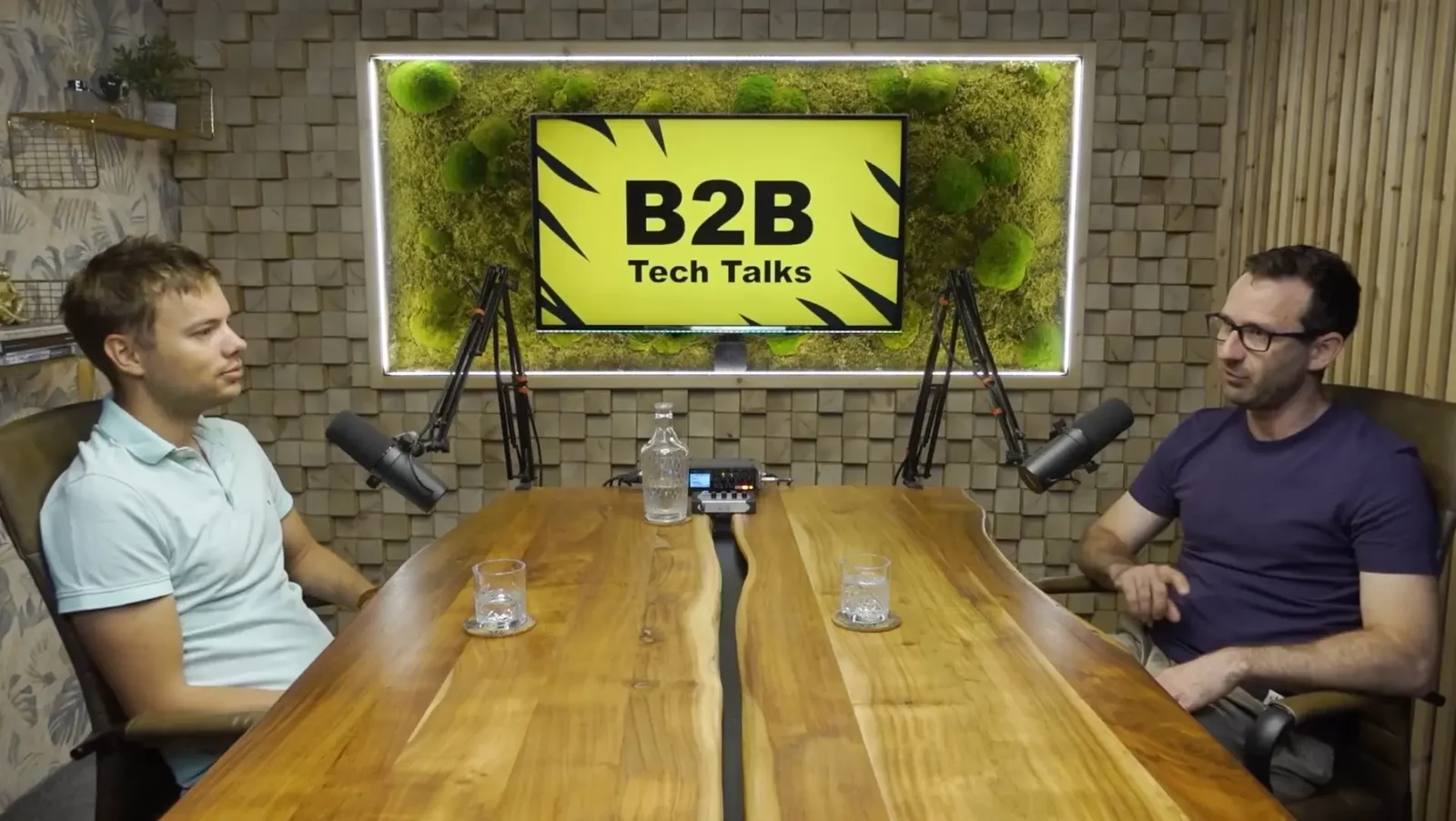
Full English transcript
The conversation was recorded in Slovak; this is the supplied English translation. The source labels the speakers, though it occasionally groups both under one label; bracketed notes mark wording and names the source flags as unclear. The guest's surname is spelled "Mrazík" in the source and has been corrected to Mrázik. The source is dated 06/13/2024, which appears to be the recording date; the episode was published on 17 June 2024 and runs 47 minutes.
Building Triad with a friend, from two people to a hundred
Martin Brath: Welcome, everyone, to another edition of B2B Tech Talks. With me is Marek Mrázik. Marek is the co-founder of Triad, one of the largest advertising agencies in Slovakia. He’s also a co-founder of technology companies such as Kontentino, Allfred, and Brackets. Kontentino has been one of the fastest-growing technology companies in recent years. Marek, welcome.
Marek Mrázik: Thanks for inviting me. Great to be here.
Martin Brath: Let’s start with your beginnings, particularly Triad. Triad is one of the largest and best-known agencies in Slovakia. You started as two people, and now almost 100 people work there. Tell us: how do you build a company like that with a friend?
Marek Mrázik: There are two questions there. The first is how you build a company like that, and the second is how you do it with a friend. With a friend is much better than without one—that’s the first thing. There were two of us at the beginning, but we very quickly became three. I wouldn’t change that, and I wouldn’t start a company alone. Building it is the more complicated part. The very short answer is: gradually. It always looks like an overnight success, but it actually took 19 years—or perhaps 10 years to reach 100 people. Every year was incredibly demanding, with growth of perhaps 150 or 250 percent. In the end, it looks like, “Wow, look how far we’ve come.” But 10 years is 3,650 days, which is quite a long time. So it’s actually perfectly doable.
How structure changes with growth
Martin Brath: People say that whenever the number of employees triples, all the existing structures break down, and you need to create a new structure to make things work. Do you see it the same way?
Marek Mrázik: We never tripled in six months like some extremely fast-growing companies. We were always going through some transformation, but it was gradual and iterative. One of the biggest changes I remember was when we grew from about 12 people to 16. My co-owner and co-founder Jaro [surname unclear in the source] came up with an idea based on Patagonia’s factories. When a factory reaches a certain number of people, instead of expanding it and introducing more structure and hierarchy, Patagonia creates a similar factory next door, divides the people between them, and suddenly has room to grow. Jaro suggested doing something similar with our creative teams. Instead of building a large hierarchical structure within Triad, we split people into two smaller agencies and gave them separate names. Those teams eventually developed slightly different cultures, still completely aligned with Triad’s culture and values. There was a little tension and competition between them. That gave teams of around six people room to grow toward 20. We used exactly the same mechanism at Triad in the Czech Republic, growing from one team to two, three, and four. At one point, we couldn’t fit into our office, so the fourth team worked somewhere else entirely, in a coworking space. It gave us much greater flexibility as we grew.
Why Triad grew: consistency and technological creativity
Martin Brath: I understand. What do you think is the main reason you were able to grow into such a large agency? Most agencies I personally know either stay small and want to stay small, or struggle to grow beyond a certain number of people. Why do you think that is?
Marek Mrázik: I’m proud of where we’ve got to, but most of the agencies I know are actually a similar size and have stayed in the market. They’re doing something similar in that respect. I think the key is consistency and perseverance. Every agency has its own secret sauce. Some are built explicitly around very strong creative work, with everything else supporting it. Others are built around strong business relationships, contacts, and client service, while still needing sufficiently good creative work. Every agency is known for something. In our case, we started as two maths and physics graduates. My co-owner Jaro had around six months of advertising experience. I had none. We had to learn everything from scratch. To some extent, that was an advantage because we didn’t have to repeat patterns we’d learned at other agencies. We could come up with things I think were quite interesting, such as those teams, which several other agencies later copied from us. The disadvantage was that we had to learn things the hard way, including established best practices. We had to arrive at them ourselves. If we’d discovered some of them earlier, we might have become successful sooner. I think our differentiator was technological creativity. Even after almost 20 years in the market, we still try to be at the top in that area. It’s very difficult because technology moves forward incredibly quickly and keeps changing. Now it’s AI. Five years ago, it was something else. Ten years ago, social media came along, and we were the first agency to hire a social media person. I remember sitting with Jaro on January 1 one year, talking about work on a public holiday—which was perfectly normal, of course, when you’re living and breathing the company you’re building. We thought, “Everyone wants to lose weight now because it’s January 1 and they’re making resolutions.” So that day, we created a Facebook page or group called something like “This Time I’m Really Losing Weight.” Social media was new then, and huge numbers of people joined in the first few days. We thought, “There’s marketing potential here.” Facebook was still in its very early days.
Martin Brath: How do you see the difference between a creative agency founded by two maths and physics graduates and a typical creative agency founded by a creative? What are the biggest differences?
Marek Mrázik: Lots of agencies weren’t founded by creatives; they were founded by account people. Every agency has its own DNA. Looking specifically at a technology-oriented agency versus a creative one, creatives tend to enjoy the creativity and the work itself, perhaps less so the processes. I was lucky that there were two of us from the beginning. Jaro enjoyed the creative work; I enjoyed the processes. We complemented each other very well. From day one, we decided to track our time so we could evaluate which projects were efficient and which weren’t. I don’t think that’s necessarily connected to technology so much as to a systematic way of working. When our first employee joined as the third person, we were already tracking time, so it was natural for them to do the same. It never became an issue. Eventually, we had 20 people, all diligently tracking their time, and people started asking how that was possible. Time tracking in creative agencies is a huge pain: for creatives who naturally hate doing it, and for the people trying to make them do it. They come up with schemes like withholding pay, or standing over people until they’ve done it. I’ve heard all sorts of stories. We never had that problem because it was there from the start. That shows how difficult it is to introduce something into an existing setup. Changing how things work is much harder than doing them properly from the beginning.
Building their own tools
Martin Brath: Time tracking is difficult for agencies generally. But beyond that, there’s also the structure of how people work and the systems supporting it. I assume you dealt with those as well.
Marek Mrázik: I think perhaps 50 percent of agencies had their own systems at some point, and we were one of them. When we wanted to track time, there weren’t many SaaS tools that did it, or did it well—perhaps none at all. So we began making our own tools. About 15 years ago, we created a tool called Simple Report for straightforward time tracking. We even wanted to sell it, and one agency actually implemented it. They kept using it much longer than we did, perhaps for another 10 years. [Exact duration unclear in the source.] It stopped meeting our needs, and I found a tool on the market that did the same thing better, so we discontinued ours. But that agency continued using it. That reflected the fact that we were a technologically capable advertising agency. Our first employees were more programmers than creatives. We then changed direction. In our first years, we were actually a website development company, looking back. We had to build our creative capabilities over time. Having programmers in-house made it much easier to create these little tools. And it wasn’t just coming from us; the drive came from all sides. When someone asks what problems we have or how we managed to achieve something, the answer is that many of those problems never arose. We were building tools to help deal with issues as we identified them along the way.
Martin Brath: What kinds of problems?
Marek Mrázik: For example, having a knowledge base and keeping track of processes. We have an internal system called “The Triad Manual.” It started as a four-page PDF. The second version was 16 pages. Then we realized updating a PDF didn’t make sense, so we built our own wiki. There are a thousand good tools for that now, but there weren’t when we were doing it. It goes all the way down to trivial things like ordering lunch. We had an office manager who ordered everyone’s lunches, and it took her an hour every day. People would say, “Can you add an order for me?” or “I’m not coming into work after all.” Some programmers put together a very simple tool that sends you the menu a week in advance. If you haven’t ordered, it asks the day before, “Are you sure you don’t want lunch tomorrow?” You can only change your order until three o’clock the previous day. Suddenly, the office manager had an hour less work a day, effectively increasing her capacity by 30 percent. From really important things down to completely trivial ones, I feel we’ve always been technologically well equipped.
Martin Brath: Is it common for a creative agency, or an agency generally, to have a programmer?
Marek Mrázik: I think so. Every agency could have one, but it depends enormously. There are so many types of agencies. Now that I’m working on Allfred, I’ve been in London and speak to around 100 agencies a year. I’m discovering how many different businesses are called agencies, even though each one is completely different. For the type of agency Triad is, I think there should be some technological capability. When digital agencies appeared, you could see established advertising agencies hiring programmers without knowing how to work with them, how to brief them, or what good work looked like. There was a period when all agencies had programmers. Then I gradually saw them letting those programmers go and outsourcing to specialist companies instead, which I think was the right approach. Today, perhaps a fifth or a quarter of our competing agencies actually have programmers on staff, because they aren’t as necessary anymore. The question now is how AI changes that. A lot of things are becoming possible, so programmers may be needed again for a while, and perhaps in two years they won’t be. There isn’t a clear-cut answer. It depends on the agency and its DNA. Some agencies are built purely around creativity and produce beautiful television commercials. A programmer isn’t as necessary there.
Stepping out of operations
Martin Brath: You’re no longer active at Triad or part of the operational team.
Marek Mrázik: Yes. For three or four years, I’ve spent perhaps an hour a month on Triad—or, more accurately, a quarterly board meeting lasting one to three hours. I’ve been fortunate to surround myself with capable people, and that applies to the other companies we run too. Devin has six or seven companies under it, each with a managing director who is usually also a co-owner. Those people are very independent. The companies started with us or with me, and at the beginning they needed more guidance and support to get going. Most have now reached a stage where… I wouldn’t say I only provide supervision, because that isn’t entirely true, but I don’t need to be involved in day-to-day operations. The Slovak Triad is probably furthest along in that respect. A long time ago, I brought in a very capable person, Maru [surname unclear in the source], who’s now also a co-owner. Her skills were very similar to mine: systematizing and scaling processes. If I had to identify two capabilities an agency needs to succeed, the first is product quality: the creative work and strategy. The second is the quality of its processes and operations. No matter how good your product is, how creative you are, or how good the campaigns are, if you lose money on them, the agency will disappear. However good your processes are, if the work is average or below average, you’re out of business. Both legs need to be very strong.
What good operations actually means
Martin Brath: What are those processes?
Marek Mrázik: Good question. My automatic answer was “everything.” It means having your finances and HR in order and making sure people know what they should do. To me, operations means preventing unnecessary inefficiencies within the agency. For example, when a creative comes to work, they should know what to do. If something is scheduled, they should have the brief in their inbox so they can get on with it. If they arrive and don’t know what they should do, they lose half an hour. That might not seem like a big problem for them, but financially, they’ve just wasted 10 percent of their capacity. Many agencies operate on a 10 percent profit margin, so that person has effectively earned nothing for the agency that day instead of generating the usual profit. Half an hour disappears very quickly. If, during the next half hour, they know what to do but someone is still writing the brief, another half hour is lost. Now they aren’t breaking even; they’re making a 10 percent loss. You need to get that under control without making people feel controlled. It’s like a good restaurant. You watch the waiters moving around, and everything works like a well-oiled machine. They aren’t stressed. When it works like that, you can make a healthy or even above-average profit. But if there are bottlenecks and a waiter keeps running up to the kitchen and back with a single plate, they’re exhausted and unhappy. They say they can’t keep up, and you tell them they’re inefficient. You probably replace them and have to hire someone else, which costs more time, including leadership time. Onboarding takes a long time. The new person spends the first month finding their feet and only becomes efficient once they know the processes. When I see agencies with constant staff turnover, I suspect their processes are poorly designed or managed. This is difficult for creatives because many agencies grew out of creative teams: a few creatives got together and started an agency. I’m speaking generally, not specifically about Slovakia. What I see them missing most is exactly this operational side. The successful ones tend to combine someone who delivers a genuinely good product with someone who holds the agency together through its processes.
Handing over the agency as a founder
Martin Brath: Regarding handing over an agency as a founder, you mentioned that it depends on the people, but I assume there’s more to it. It can’t be that simple. If you’d done certain things earlier, could you have handed it over sooner? How do you see that?
Marek Mrázik: I can’t say whether it could have happened sooner. It’s probably not a useful question for me, because I think I managed it early enough. But I never had the goal of getting out of the agency. I saw that I had capable people who would stop enjoying their work unless I gave them new challenges. I wouldn’t say it simply happened to me, but I went with the flow. When I saw someone capable, I promoted them. As I promoted people from below, I needed to create positions for them to move into, which automatically meant moving up myself.
Martin Brath: At least among the agency owners I know, we all want to step out of operations at some point. How do you think I should approach that?
Marek Mrázik: That’s a very good point. People who start agencies love it at the beginning. But I think the dream is to be able to be there without having to be there. That’s fundamental. Founders are usually experts in the creative side—that’s one leg. What they tend to lack is the operational side. If I were doing it again, I’d make sure both capabilities were covered by people who know what they’re doing. But you can’t do it all at once just by hiring someone from outside. An outsider won’t understand how the agency works or its DNA. Even with plenty of skills, I think it takes three years to understand what’s happening well enough. Ideally, you do it gradually and build a leadership team that can take over in time. That’s legitimate advice, but it’s difficult to execute. Everyone knows it; doing it is the hard part. It’s much easier when the agency has good processes and systems. If the leadership of any of our companies left now, those systems are documented and established. Handing over the agency is much easier, and there’s less chance of discovering something nobody considered that causes it to fall apart. That brings me back to the tools that help with this. It doesn’t only apply to agency leadership. When an account person leaves and hands over to another, if everyone has their own way of working and their own system, a huge amount of information can get lost. That can easily cost an agency a client, because from the client’s perspective, it looks like you don’t have things under control. In our agencies, we keep everything in Allfred. Information can’t get lost in the same way, because everything, from finances to projects, is in one place and entered consistently. Besides saving an enormous amount of time searching for things, you can be confident that the data is correct.
Advice for a 10-person agency: specialize
Martin Brath: What advice would you give a creative agency with 10 people? What are the main things they should do to grow to 80 or 50 people?
Marek Mrázik: What would I do now if I had an agency of 10 people? The situation is completely different from when we had 10 people. I’d think about the agency’s positioning. When we started, it was enough to be a digital agency in a small market and simply do good work. Today, that’s much harder. You can see it in your own agency. I really like that you specialize narrowly in SaaS or B2B. That’s very necessary. Many agencies just say, “We’re an agency.” Yes, it’s important to deliver a good product and be a good agency, but with a niche, clients find you much more easily. You can also do the work better because you’re specialized. One insight from the UK is that there are 24,000 agencies there. They specialize much more narrowly than in our region, where we say we’re a performance agency, a content agency, or a creative agency. There are performance agencies in the UK that specialize exclusively in accounting firms and bring in several million a year. I understand that our region doesn’t quite work that way. But today, you can run an agency from Slovakia and serve international markets. Even within Slovakia, there are quite a lot of agencies, so specialization is extremely important.
Rapid fire
Martin Brath: Let’s move on to the rapid-fire questions. These need quick answers: the first thing that comes to mind. Sometimes you’ll feel the answer is “It depends,” but try to give your first instinct within about five seconds, if you can.
Marek Mrázik: Let’s do it.
Martin Brath: First: early bird or night owl?
Marek Mrázik: Definitely not mornings.
Martin Brath: Office or working from home?
Marek Mrázik: Both.
Martin Brath: Solo founder or co-founder?
Marek Mrázik: Co-founder, without hesitation.
Martin Brath: Bootstrapping or venture capital?
Marek Mrázik: Bootstrapping.
Martin Brath: Hands-on or delegation?
Marek Mrázik: Those aren’t mutually exclusive.
Martin Brath: Growth or stability?
Marek Mrázik: Ah…
Martin Brath: Product or service?
Marek Mrázik: A product that’s a service. This is terrible. Sorry, let’s come back to the other questions, because this is funny. The great thing about a product is that you can scale it. But products themselves feel quite distant to me. That’s why I really like SaaS: Software as a Service. It’s a product that is a service, and you deliver a service to people through the product. I understand there are products like glasses and cars, but that’s different. If you ask me “product or service,” I think this is the ideal niche. It’s similar when you have an agency—and I’ll come back to the rapid-fire questions afterward, sorry. Many agencies try to create a product and systematize what they do. An enormous number of globally successful SaaS products came out of agencies. Even in Slovakia: Staffino came from an agency, Kontentino came from an agency, HubSpot came from an agency, Allfred came from an agency, Basecamp came from an agency. I’d guess that 50 percent of established SaaS products on the market today originated in agencies, because agencies have lots of problems you want to solve systematically. You build a system for that, and once you have it, you think, “The agency next door could use this too.” That’s how Kontentino came about. But let’s get back to the questions. We have a few left.
Martin Brath: Data or instinct?
Marek Mrázik: Instinct.
Martin Brath: Work hard or work smart?
Marek Mrázik: Both. There’s a great video about this. I don’t know where this will be published, but I’ll put it in the comments afterward. It illustrates this beautifully.
Martin Brath: Local market or global market?
Marek Mrázik: Global.
Martin Brath: Technical skills or people skills?
Marek Mrázik: Technical skills.
Martin Brath: Big picture or details?
Marek Mrázik: Details.
Martin Brath: Marketing or product development?
Marek Mrázik: Product.
Martin Brath: Rapid scaling or steady growth?
Marek Mrázik: Steady growth.
Martin Brath: Thank you. Those are all the questions I have. Let’s move on to Allfred, where you’re currently CEO and very hands-on operationally. My first question is: why are you so active in Allfred? It’s probably fair to say that financially, you wouldn’t have to work anymore if you didn’t want to. So it’s interesting that you work so much. Anyone who’s seen your calendar knows it isn’t easy to find a time with you these days. You clearly have your hands full.
Why he went all-in on Allfred
Marek Mrázik: Thanks for that feedback. A full calendar isn’t a virtue. But honestly, I enjoy it. When I decided we would build Allfred, all the other companies had reached a level of delegation where they were running very well, and I really had the space for it. There was also an internal need at the agency. We had three or four very good little systems. Altogether, I think Triad has about 10 small tools of its own for different problems. Three or four of them looked like they could become one good solution usable by other agencies. Honestly, I think this will be the last SaaS product I build. It’s an almost impossible problem—really difficult to solve. Building a tool for one problem is one thing. Building an enterprise tool to solve all an agency’s problems is another. It was a huge challenge for me, and also exactly what I’ve always enjoyed. When we were building the agencies, I enjoyed creativity and strategy, and I understand those areas reasonably well. But over time, particularly with Kontentino, I discovered that what interests me much more is how an agency works internally. How do you systematize processes so you don’t waste people’s capacity or their time? When an account person does repetitive work, it isn’t only wasted capacity and a missed opportunity for the agency to be more profitable. It’s simply a shame. People aren’t meant to do manual work that could be automated. When I tried to combine those tools, they all revolved around account work, which is closest to my own experience. When we started the agency, there were two of us: I naturally became the account person, and Jaro was the creative. I then went through all those account roles: account manager, account director with several people reporting to me, agency director, and eventually even a non-executive CEO role, outside operations but still able to see the agency as a whole. Account people have an incredibly difficult job. They work with everyone around them; they’re the center of the octopus. They work with clients and are responsible for client satisfaction, for the creative quality of the finished project, for organizing it well, and for its financial outcome. They make sure creatives have work and aren’t overbooked or underbooked. I realized this while preparing Allfred’s investor pitch. I started writing a list of what an ordinary account person is responsible for, and I stopped at 20. There are so many responsibilities. At the same time, it’s some of the least visible work. When it’s done well, nobody notices it happening. From my experience across all those account roles, there’s enormous room for optimization. A lot of things are done twice when they don’t need to be. My rough estimate, even before AI came along, was that 30 to 50 percent of an account person’s time spent on basic repetitive tasks could be saved. [The verb is missing in the source; the intended meaning is inferred from context.] For example, when you prepare a quote in Excel, the account person then has to recreate the same project structure in whatever project management tool the agency uses. If I’ve sold or estimated 100 hours for a project, I want those 100 hours reflected in the project management tool where creatives track time. And when I invoice it at the end, I want 100 hours on the invoice. Naturally, the project changes seven times along the way. Suddenly, it’s 120 hours because something has been added. Then it’s 112 because there isn’t enough budget. It keeps changing. Alongside all my other account responsibilities, I have to update that information in the other systems. Or I don’t, and it’s perfectly possible that I sold 120 hours but invoice only 80, losing 30 percent of the business. Or the opposite: I sell 80 hours and the team logs 120, because I forgot to update the reduced budget. Then the finance director typically comes to the account person and asks what happened. They don’t really have an explanation beyond, “I forgot to update it because I have too much to do.” Everything I’ve just described at length is very easy to automate. It’s simply about having the same data in one tool and keeping it automatically synchronized. That’s how I imagined it, and that’s why Allfred is called Allfred. Batman has his butler Alfred so he can focus on what he’s supposed to do. Account people don’t go into advertising to fill in spreadsheets. They want to make advertising, organize the work, and be marketing experts, but they have desperately little time for that. I think they should have a butler who handles the things that can be automated, someone to deal with those tasks for them so they can do what they came into advertising to do.
The three biggest agency pain points
Martin Brath: If you could pick the three biggest agency problems or pain points Allfred solves, what would they be?
Marek Mrázik: I’d call these the three biggest pain points advertising agencies have. Yes, Allfred solves them, but they come from what I’ve heard from practically every agency: small or large, east or west, specialized or general. First, problems are identified too late. For example, a project is going over budget, but most agencies only discover it when the 101st hour is logged against a 100-hour project. By then, the project has usually been delivered. If you ask the client to pay more at that point, the natural response is, “Why? You’ve already delivered it.” So problems are identified too late. Second, creatives and time tracking. Whenever I mention that, I get exactly that smile from everyone. Yet I think it’s largely solvable. Third, I’d call it fragmented data for decision-making. In plain language, I have all the data, but each piece is somewhere else, and none of it is brought together. If I want to know whether a project is profitable, it takes me half an hour in Excel to work it out. But I’ll never do that for a project whose entire scope was only 10 hours. So I might be doing inefficient projects. I may have a feeling that a project is inefficient, but I can’t see it in the data. Agencies are different from other companies in this respect because their business model is more complicated. I only realized many things after stepping out of the agency and trying to explain to investors how advertising agencies work so they would invest in Allfred. One realization was that an agency has two different business streams. It isn’t just a service business. [A short phrase is garbled in the source.] Unlike software development companies, for example, which sell their time or intellectual property, advertising agencies sell that and also act as trading businesses. They buy media space and resell it with a commission, or buy production services or products and resell those with a commission. Normally, you have trading companies that buy and sell, and service companies that sell time. An advertising agency does both. Many agencies use general-purpose systems that only support one side of that process. The other side isn’t there at all. A client might be difficult and unprofitable in terms of the work, but generate substantial commission income, making the relationship worthwhile overall. The agency can’t establish that unless those things are in one place.
Martin Brath: Can I find that out quickly in Allfred?
Marek Mrázik: Yes. Unlike general-purpose tools, Allfred connects project management—the work people do—with the financial system, including third-party expenses and invoicing. All the data is together. For a particular project, you can see your profitability on labor, production, and media. You can see those three figures separately and also one figure showing the project’s overall profit. Honestly, I hadn’t seen that in any other tool. It was one of the reasons we decided to build Allfred. The other tools were extremely general and couldn’t bring those two concepts together.
Planning creatives’ capacity and the “done list”
Martin Brath: One benefit Allfred promotes concerns creative teams’ capacity. How do you address that? How can it be solved, if at all?
Marek Mrázik: Despite those third-party expenses, people’s work accounts for around 90 percent of an agency’s costs and ultimately its profits. The question is how well you manage it. Good planning benefits everyone. Of course, the agency is profitable, but people are also less stressed. If a creative arrives and doesn’t have to think about things that don’t come naturally to them—what to do, when to do it, how to organize their work—because it’s already organized, they’ll come up with better ideas. They can focus on what they’re supposed to do. You also avoid discovering at the end of the day that there are two more things that should have been done but weren’t visible, and saying, “Sorry, you’ll have to stay late.” Creatives get frustrated because tasks take a long time, and because they wouldn’t have taken so long if they’d been briefed properly. That’s where I see the biggest opportunity when we talk to other agencies about where to start. The biggest opportunity to optimize an agency and make it more efficient is to start planning creatives’ time sensibly. And the nice thing is, it’s essentially an ordinary calendar. Creatives see what they should do that day, in what order, and roughly how long it should take. The best part is that this is also probably the simplest solution to the time tracking problem. I try to make sure I track my own time, and it’s incredibly difficult—even though I’m a systematic person. I completely understand that creatives find it much harder. If I ask a creative at the end of the day what they worked on, they can’t remember what they did that morning. Neither can I. Yet many agencies ask people at the end of the week. At best, they make the data up. Or they say, “Sorry, you’re not getting it from me.” Our simple trick is that when you can see what you were supposed to do that day, you can look back and say, “Right, I was supposed to spend two hours this morning on that client’s campaign, and it took twice as long.” Suddenly, you can remember. Or, even more simply, when you finish an assignment, you just check it off. The system immediately asks, “You spent about 15 minutes longer on this than planned?” You click yes. You’ve logged your time instantly, but it doesn’t feel like time tracking. You’re checking things off your to-do list, and nothing is more satisfying than that. I call it a “done list.” There’s even a philosophical idea that some people keep to-do lists and others keep done lists, listing everything they managed to accomplish that day. It’s precisely because it’s so psychologically satisfying.
The response to Allfred, and whether agencies are innovative
Martin Brath: What has the response to Allfred been like so far? How do agencies feel about it, and what benefits do they see? Do they see it the same way as you, the people who built the product for them?
Marek Mrázik: Even if they didn’t, I’d probably tell you they did. But no, they really do. We even have recordings of people’s reactions when they see it for the first time, from the period of online calls around COVID. [The time reference is unclear in the source.] For example, that time tracking and calendar feature creates exactly that positive feeling: “Yes, this is exactly what the advertising industry needed. This is how it should work.” We hear it every month, including from people like the head of strategy at BBDO in Brazil, with 500 people there: “This is exactly it. We have these old systems…” Many agencies operate on systems built by finance people for finance people, and the poor creatives have to use them. They hate them, which is completely natural. The decision about how the agency operates comes from operations: the finance department proposes the system. Nobody addresses the fact that creatives hate it. They don’t actually use it, but everyone feels good that something is supposedly working. It’s a complete Potemkin village. It’s much harder to build a system or tool that suits both people who love processes and order and people who love freedom. When we started, I knew it would be difficult, but it’s much harder than I thought because everyone has completely different needs. I’m genuinely proud of how far we’ve managed to get—of myself, but above all of the whole team. These are things we have to keep improving so creatives get value while the data stays accurate.
Martin Brath: Some industries innovate or adopt innovations more easily than others. From an outsider’s perspective, I’d say creative agencies tend to stick to what they’ve always done and aren’t entirely ready for innovation. How do you see it? Do you notice a difference between companies that try new things and those that have done things the same way for five years, are happy with that, and have no interest in new tools?
Marek Mrázik: That’s a great question. I thought you were going to frame it completely differently, because advertising agencies and the creative advertising industry are extremely up to date with innovation in certain areas. Facebook and social media keep changing. Agencies know they constantly have to improve, and compared with corporations, they’re much more adaptable. But internally, in operations, it’s different. Because they innovate in their product, they feel they’re also innovating in how the agency works. They see themselves as innovative, and honestly, that isn’t always true. Many agencies don’t have any project management tool. They use Excel for things that no longer need Excel because much better tools exist. They use email for project management and still think they’re innovative. What surprises me is that their clients, which are much more rigid corporations, often innovate faster than those small, agile agencies with 10 or 20 people. I think that’s because the part they enjoy is the product, and that’s where they innovate. That’s why every agency should have an operations person who handles the internal side and also has an innovative mindset. Often, an agency relies on an operations person whose main priority is keeping things orderly. That side then becomes completely stagnant, which affects the whole agency. Why do agencies lose people to startups? Because everything there is innovative, including how the company works internally. If I join an agency and do things on paper that should have been digital long ago, I think, “This industry is old-fashioned.” Then agency CEOs wonder why people leave and say advertising is boring or outdated. It’s because the way the industry operates is outdated. It’s great that campaigns keep moving forward, but there’s enormous room to make the way agencies work genuinely modern. That brings me back to account people and copying data. If someone hires me as an account person and makes me do manual work that tools could easily handle, it’s only a matter of time before I look for a job where I don’t have to do those repetitive, basic tasks.
Martin Brath: Marek, thank you for the conversation. It was a pleasure, and I hope we’ll see each other again next time.
Marek Mrázik: Thank you very much for inviting me. Thanks.