Full English transcript
The conversation was recorded in Slovak; this is the supplied English translation. The firm name, transcribed as "EKEJS" and "EKS", has been corrected to Accace. Bracketed notes mark wording or names that were unclear in the source. In the rapid-fire round the source merged a few questions and answers, so those have been separated from context. The episode was published on 18 February 2025 and runs 53 minutes.
From junior tax adviser to managing director
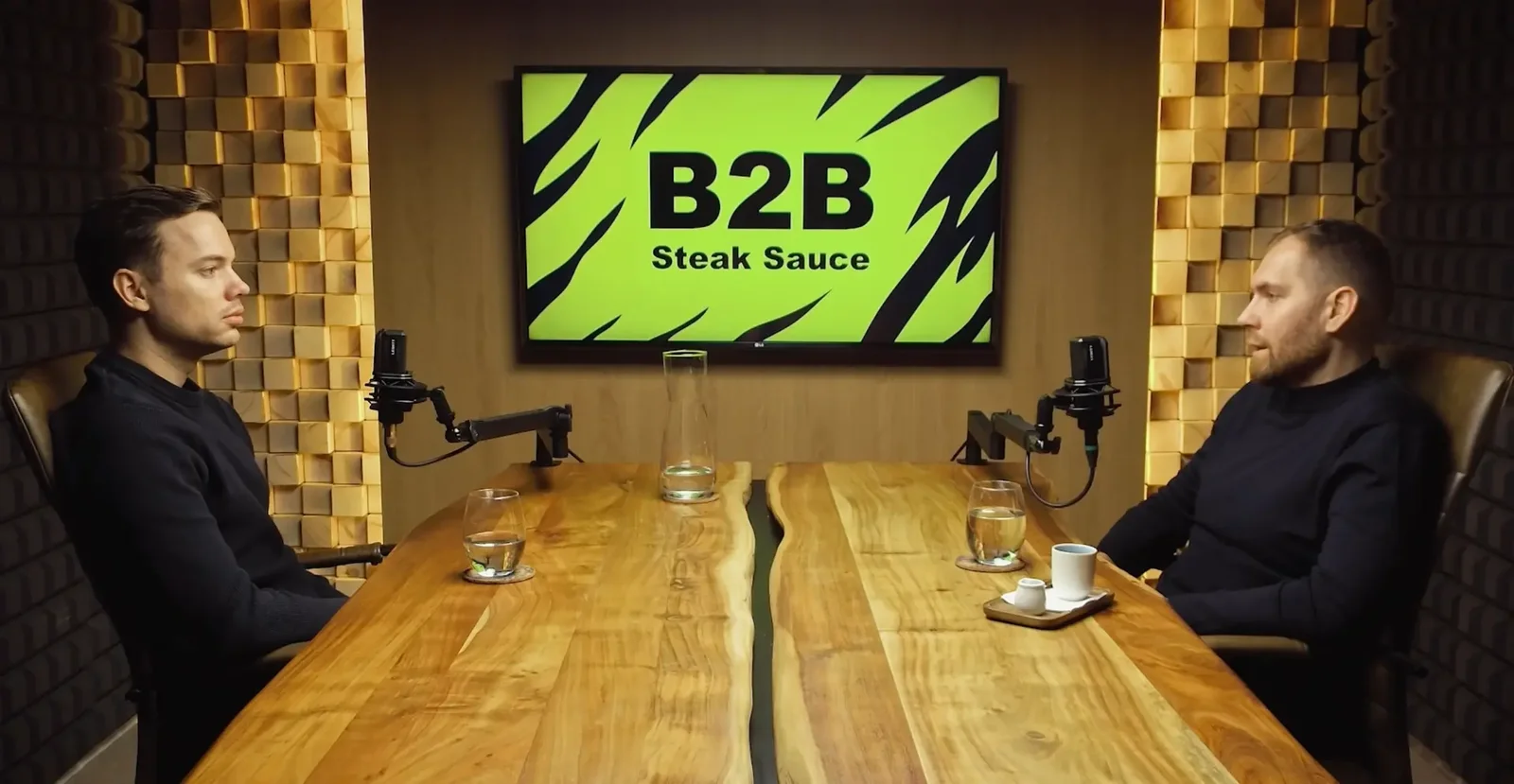
Martin Brath: I welcome everyone to our new episode of B2B Steak Sauce. With me is Peter Pašek, who is the managing director of Accace. Peťo, welcome.
Peter Pašek: Thanks for having me, hi.
Martin Brath: Peťo, you've been part of Accace since 2006, which is an advisory firm [transcribed as "projedeňská"]. Could you walk us through your journey a bit, and how you started – the firm already had some size, you started there as a junior and basically worked your way up to managing director, and you're a relatively large firm now. How did that go?
Peter Pašek: Well, it was by coincidence, I'd say, always kind of by chance. I'll put it this way: I was still working alongside university at a smaller advisory firm, and by coincidence I saw an ad somewhere that they were looking for a junior tax person. I was at a smaller advisory firm doing accounting there. I was happy there, I've always enjoyed accounting. And I basically came to the interview, and sitting there at the time was the founder of Accace, Jirko Majer, together with my former first tax boss. And the whole interview was mainly about [unclear] who I was and so on, and the only condition I had was that I always wanted to do transaction work. I was always fascinated by accounting, I was fascinated by shares, securities, and in that other advisory firm, which was simply a small advisory firm, there was no chance of anything like that happening. So I came to the interview, told them [unclear] and asked whether they did any transactions and whether they would let me do them.
At that time I was, and this is the paradox, about 23, 24 years old. And they answered that yes. I don't know whether it was true, nobody will be able to say now whether it was true, but the truth was that this is what convinced me: okay, they do transaction work and they'll let me do it. And the truth is that two months after I joined Accace – so two months, it was somewhere in September, I joined in October, November – I got my first corporate transaction, it was a sale of a business, or part of a business, at that time, some German client showed up, and the whole thing just rolled along. But it was really a matter of chance, that I wanted to do transaction work and I got it basically two months after I joined the firm. And then it went fast. I joke that it was a golden age, I'd say, because back then everything was growing. So if a person wanted to work and worked a lot, then in that business anybody could grow.
And I think we were a really small group of people who worked incredibly hard and enjoyed it. A few colleagues have basically stayed from that era. And I remember my parents asking me, listen, why are you going to work on Saturday? And I basically didn't know why I was going to work on Saturday. That was the paradox: we went to work Monday to Friday, and Saturday too. We went to work, we ate, Saturday ended, we went home and nobody knew why. Nobody forced us, nobody logged it as overtime. And the times were such that, once we joined the European Union and so on, a large number of companies simply poured in here, and large advisory firms, mid-sized advisory firms were growing, and we grew the same way. That means it really was about someone picking up the phone, saying they wanted to do it, signing the contract, and doing it. So those were the golden times and the whole thing grew out of that.
And then the biggest effect, or the biggest leap, was in my view during what I call the first financial crisis, 2008–2009, where I basically managed to win big clients, and from there it kept growing, like a snowball. And I went through exactly the classic path: I started doing taxes. In a relatively short time I moved up to head of the tax department, I started to head the tax advisory, then my whole advisory side, and then I moved into the MD position, so someone who is in charge of the whole branch. Gradually I became a partner, both at the local level and the global level, and it kind of stretched on from there. So the genesis was that: in the golden era, and we also had luck, we were prepared, and the generation at that time was different, the motivation was different, it's hard to describe and people today can't understand it. That's how I'd put it today, well. Okay, but you moved up through the ranks basically because you worked hard and you were an excellent tax person, I assume.
Probably yes. I'm not saying about myself that I'm bad, and I don't think now that I'm a bad tax person either, but it was always about, and maybe there's a parallel with the sport that I did, that I was probably willing to go further beyond the limit of what a person can do. That means I never had a problem, I never complained, and I took every one of those things more as a challenge, not as something like "now I have to do this", but rather I enjoyed those things, and I'll admit I still do, though it's not like it used to be, but I absolutely loved it when some new complicated client came in. So for me, a new complicated client, I wanted to get my hands on it, I wanted to try it out, I wanted to work those things out, and then I would pass it on. So that's what I enjoyed most about it, and at the beginning everything was new. That means it was great from that point of view, that it was all new and there was a lot of it, but I didn't mind that there was a lot of it.
So that's probably the difference, that after some time many people get the sense and say it's not worth it. Somehow it didn't bother me, I was used to it, and that grind – I'm talking about the sport – I played hockey, and in hockey it was a grind, it was simply a grind, and when a person has been through that grind, you think that in the business world the grind is incomparably easier than the sports one, so that's maybe the difference.
Martin Brath: In any case, the skillset needed for a managing director is a bit different from what you need to be an excellent tax person, so I assume you moved up through the ranks because you were good at what you were doing, but eventually you got to a position that required a completely different skillset. How do you handle that, how do you improve as a manager, how do you run such a firm?
Peter Pašek: My colleagues will definitely laugh if they listen to this. I don't think I'm a good manager, and I admit that. I think my strength is that I'm more immersed in the expertise and the professional matters. I think that's my strength. On the other hand, there's a saying that applies to me, I even have it patented, I have a trademark on it, and that's the phrase "fine by me." "Fine by me" means that when I choose a colleague I want to work with, I trust them fully. And that person basically has absolute freedom and the authority to make decisions in the whole area they're responsible for. That means I'm lucky to have colleagues in the individual areas, whether they're managers of the tax departments or people in charge of some support departments, support functions, that they have full trust and authority. And now they make those decisions, and some things of course they have approved, or they consult them with me, but in those matters they have absolute freedom.
That means I don't see myself at all as a person who would, absolutely not, run it with an iron hand, rather I let things take their course, and I don't consider myself a good manager either; I rather enjoy things that are really at the beginning, at the complicated starts. There I can roll up my sleeves, I'd rather do things myself than delegate them, but that's exactly the skillset a good manager doesn't have. But I'm lucky that I'm now in the position where I can choose the things I enjoy and do what I enjoy. And the things I don't enjoy I can delegate, but to people who, paradoxically, enjoy them, so we have it well distributed. But I don't think I'm a good manager, I never was, and I don't think I will be, and the paradox is this, that what I studied – I studied business management – and it's what I think I'm worst at out of all of it, the worst of all.
Martin Brath: And the studies probably had little to do with what you'd do in reality. In any case, the firm is growing very successfully and you're big, so the management system you have obviously works?
Peter Pašek: I hope so, I hope so, I mean, yes, it works, and I'm glad for my colleagues, mainly, that's really the thing.
Why he co-founded the startup accelerator
Martin Brath: Okay, ASON, the accelerator, where you're also a founding partner [transcribed as "Ola Dom, Ace On"]. Why did you found it?
Peter Pašek: Actually it's a story that comes from two sides. One thing is that we did a large amount of advisory work for various funds that invested in our region, so we represented them, whether in various DDs, due diligences, when they were trying to invest in startups, or we represented them in various advisory parts and areas. And there we basically came into contact with a large number of founders from our region, where we saw that the knowledge about startups was terribly poor. And we often told each other, well, if you sign this, that's really bad, to put it politely. So at that time an idea somehow arose: let's set up something like a program. It was called an accelerator, it wasn't ASON then, it was Accace LIFE, which was something like our CSR activity, so helping young starting entrepreneurs, mainly at that time from Slovakia, and then rather from Czechoslovakia, and helping them create some program where we would educate them, help, and we went basically so far that we, and this still holds, we help startups until they raise some money, free of charge, we give them advice, help them, and try to build the community so that something comes out of it here.
And on the other hand there was Janko Kasper from Ozaki [as transcribed; later "ZAKA"], who had a family office at that time and now, you could say, has a successful fund of their own, where they were raising some capital from external investors, and he was looking for something like an accelerator that would fit into his puzzle, meaning they are like a VC, but, being in our Czechoslovak space, even though ZAKA is no longer Czechoslovak at all, I must say, nor is our accelerator, but at that time, to compete with the big funds you simply need to look for startups at the pre-seed and seed stages, so really at the early stages, and an accelerator is really good for that. It can attract talent, filter it and so on. So Janko actually came with the idea: why not do something together and give it some structured culture, give it some professional framework and the like, and that's how ASON was born, and I can say that ASON is currently a normally functioning company, the way it should be, with an absolute reach beyond Czechia and Slovakia.
We have hundreds of applications in every batch. The applicants are basically from Uzbekistan, Georgia, Azerbaijan, through Poland, Portugal, we've even had American startups, but mostly it's the region of Europe, North Africa, maybe some of the Near East and Central Asia. Czechoslovakia is the minimum, paradoxically, since the promotion in Czechoslovakia isn't all that strong either. And the goal is to build, you could say, if not the largest, then one of the largest European accelerators, that's our goal, where we want to do it basically the way Y Combinator does it abroad, in the US, so get a large number of applications, filter them, get a group of talent we want to work with, give each of them an investment, and at the final demo day invite various funds, but not funds from our region, of course ours too, but mainly from abroad, and let them possibly invest. So it's a normal company with everything it should have.
And so the goal is basically to attract talent to us, find it, discover it, work with it, and then we'll see what happens. So it's a combination of our Accace LIFE, the CSR activity, Janko Kasper, ZAKA, we got together, and now I think that so far it's going relatively according to the ideas we had.
Martin Brath: So it also has a financial incentive, and it's not just a charity action, as it sounded at the beginning, that Slovak entrepreneurs, I'm outside it, they don't know what to sign.
Peter Pašek: Well, we still position ourselves as Accace, so let me separate it: ASON is explicitly a business like any other, which means there's an incentive, we want to invest in a startup that later exits and we'll get some reward from it, that's the mission of ASON. On the other hand, we do a great deal of activities, both as ASON and as Accace, where, paradoxically, compared to ASON, we do a large number of things that are free of charge, and we keep educating, and we don't avoid that. And that education is directed precisely at the startup people in our region, because we want to help this region. So ASON is explicitly a business that is not only Czechoslovak, so its interest is to find talent in the wider region, more than European. And then the activities that run alongside it also have an incentive, or the point that we want to help somehow, and we do that for free and it works to this day, so the two don't exclude each other.
Startups' biggest financial mistakes and building value
Martin Brath: Okay. Since you provide advisory to those startups, what are the biggest mistakes you see financially?
Peter Pašek: The biggest mistakes? First of all, the biggest mistake is that people sometimes consider themselves a startup and aren't a startup at all. That the first, the very first – and now I'll explain what the wrong understanding is – very often someone comes to us who describes themselves as a startup, and I consider a startup to be something a VC would invest in, which means there are loads of definitions of what is considered a startup, but for me a startup is something, or a project, an idea, or a group of people, or a company, that a VC would be willing to invest in. And first of all we try to explain to those startup people how VCs work, what the logic of their investing is, what they expect, what returns they expect, and whether their project even has the ambition to meet something like that. Once a person understands that from this point of view it's not a startup, that doesn't mean it's a bad business, it's just that the path they should take is different.
So the purpose of a startup is to raise capital, because without that capital it can't scale, can't grow, but it doesn't mean that if I set up a business, say I come up with a restaurant business, even if it's maybe a very bad decision, but someone has it, then that isn't a startup, but it doesn't mean it can't work out, only the path along which that business should be led should be completely different. So at the start we try to explain to them what a startup is and what it isn't, because a large number of those entrepreneurs waste a lot of time unnecessarily looking for an investor, contacting investors, and burn money and time on something that isn't needed at all. And there are far more steps after that, but at the start the very basic problem is that the word "startup", that buzzword, is applied to almost everything, but only a small group of those projects or those people can be called a startup at all.
So that's the first one. And then, of course, the financial ones, that they can't plan at all how much money they actually have until they get from one stage to the next. That kind of cash-flow management and so on, that's another topic. But really at the start it's about this. And then there's this financial question of mine, my favorite, that someone should describe to me what their endgame is, what they expect from it. And now you try to steer these people, they start to tell you they're doing it because they want to change the world and so on, and I say, of course everyone wants to change the world, everyone wants to do good and so on, but from the financial point of view, look, there are just two scenarios: either you want to set up a company that you want to sell, or you want to set up a company that generates such an amount of money in the form of dividends that it feeds you. So those are the two endgames a person can choose, and what they both have in common is that you're trying to maximize the value of the company, and then in the next step we try to explain to them what the value of a company is, which parameters they perceive in that value, and now I'm not talking about price, because price is something different from value.
And now you try to guide them on how to increase the value of the company and what to do and so on, but those are all the further phases. At the start it's really just about telling them whether it's a startup or not, and if it isn't, then what the path is, what to do.
Martin Brath: And in the simplest terms, how can I increase the value of my business?
Peter Pašek: Most importantly, say what the difference between value and price is, because these two words are often interchanged. Price is what someone is willing to pay for something. So I can sell a company and buy a company, and what I buy and sell for is the price. That's an agreed multiple of something, or some fixed sum. Value is always given by, that's a technical term, discounted cash flow, but in practice it means that the asset class, or the company, if we're talking about a company, must generate some cash flow in the future, so what's important is that it generates cash flow, it's important that it grows, meaning that the cash flow grows over some horizon, it's important that the growth lasts as long as possible, so that my cash flow doesn't grow for 5–6 years and then stay stable, that the growth phase is as long as possible, so that the risk is minimized. So those are the components of what actually increases value.
And now component by component we go through it, we try to clarify what free cash flow actually is. Free cash flow is not profit. So a company can be profitable and still generate no free cash flow. Free cash flow is what's left to the company after it pays everything it needs. So, by paying I mean if it pays capex, all the investments it needs. Now every company invests in some working capital. It has some receivables, some payables, some inventory, it invests in some additional inventory it needs for the next round. And people have to realize what cash flow is and how their decisions can influence each component of that free cash flow. So that's a bit of the longest discussion, but it's nothing so complicated, people understand it after some time, that for every decision they make in the company, they should look at what impact it will have on cash flow, what impact it will have on how the company grows and by how much.
So if this decision extends my growth phase to a longer period, then it's great, because when a company grows for longer than the market grows, the value increases. If a company gradually stops, so the growth shrinks, and those are the mature companies, when a company grows at the level of the economy, then the company basically reaches some phase where it doesn't stop generating cash flow, but the value then won't be significantly increasing anymore, and that's already for another, deeper debate, so that's what it's always about.
What makes a good business, and which industries have higher margins
Martin Brath: Thank you. You see the financial statements of thousands of companies. For you, what is a good business, or what are some common indicators of a good business, whether it's the industry or the asset structure or whatever.
Peter Pašek: Personally, I always like businesses that are not capital-intensive, meaning that whenever something can be set up without a person having to put a lot of capital into it, then I'm not saying that...
Martin Brath: An advisory firm.
Peter Pašek: An advisory firm is completely... I admit I started doing accounting, and to go back to that, back when I wasn't even 18, and I basically did it as far as it could be done, and then I set up a sole-proprietor trade license, which I still have, and for accounting a person really needs just a simple computer, one accounting software, and they can do the accounting, meaning it wasn't demanding. It's certainly a business that doesn't require, or where the client's consumption can't be postponed, so it's something that's needed. That means, again, when I look at it, it's something the client needs relatively regularly, so that's great, and if they don't need it, I'd rather give it up. And again, going back to accounting, accounting is maybe at first glance something that is a business that people need. They can't postpone it, because you have to do the accounting regularly. But in comparison with consulting, consulting is something a person can cut, because if they get into a bad situation, it's the first thing the consulting will be cut, or the 100 costs they might need but can live without, because they simply need to save costs.
So that's also a comparison of those businesses, that for me accounting is something that's maybe boring, so the upside is that potential competition won't come in, so that's great. The barrier is that it isn't a sexy business that someone wants to go into. The second thing is that it's something that companies or people need, so they're obliged to pay for it, because in this case it's mandated by law. And the third is that the possibility of postponement basically doesn't exist. So, for example, just to compare. And I'm not saying consulting is bad, but that's how I look at every business, and then of course the intensity of investing in some capex, so that it's as low as possible, so that it's not capital-intensive. And then of course, the more businesses have a higher margin, that's of course always better, well, that applies to software and so on, but it's not as people think, that every piece of software is successful, a person has to be able to sell it.
I, for example, admit that I prefer, and I personally get involved in, businesses that are based on services rather than on a product. I think I'm good at selling a service, and that doesn't mean, maybe I can't even do it, I don't even try, because I think I'm good at selling a service. And there are people who are good at selling a product. And the margin a person achieves in software products is great, but that doesn't mean I would go into that business, because I think I don't know how to do it. It means that, for example, I like businesses that don't have to have anything in common with startups, they can be small businesses that generate 200, 300, 400 thousand in revenue a year. And I'm in them with a partner 50/50 or 51/49 and so on. If it doesn't require some intensive allocation of my time, it goes by something and I understand it, then it's a good business. So I'm not the type of person who will now invest in startups with all my might in order to exit them.
We also have businesses that generate revenues of hundreds of thousands of euros. If it has a good margin, 10, 20, 30%, 10% higher, why not?
Martin Brath: Okay. Are there industries where you see the margin is consistently higher than in others? I assume e-commerce margins are lower.
Peter Pašek: E-commerce is lower, definitely. Well, everything related to IT, now I don't mean services, but, as in, the scalability is clear, so a person creates one product or one program and can scale it, only the problem is that it's nice on paper, it looks good, but there a person has to be able to sell it, so I personally prefer services. Services that are tied to some knowledge, I'll say it openly, that's for me. But I'm not saying I don't invest in startups, or in companies that have technology, but I expect that there must be someone in that company who understands the technology, and I must have the drive for the sales to be done, because sales is, in my view, the alpha and omega of everything.
When to sell, and price versus value
Martin Brath: Okay, if I wanted to sell a company, how do I know when it's the right time, or what would you recommend, when, what indicators should tell me that now I could sell?
Peter Pašek: Good question. Most people sell a company when they're already burned out, that is the situation where they already want to get rid of the business, they're not enjoying it, and I don't think that's the right moment. The most right moment is to sell a company at the time when the company is doing best. That means when it's still on the way up, and when the person already feels that the next growth will be very limited and they can't give it any more, then I'd already be considering that this is the right moment, because the best time to sell a company is when you don't need to sell it, and when it has probably its best results. Now, the best results of course, it has to have some revenues, but I always look at whether it has that optimal margin, so that optimum depends on the competition, whether the gross margin is sufficient, as it should be and so on, whether the operating profit is reached and the margin is such and such.
So for me, I don't think you can say exactly when the right moment is. The right moment is when you don't need to sell, meaning that at the moment a person is forced to sell, the buyer usually somehow picks up on it, and then the multiples they offer for the company are far, far worse. And that's also the paradox, that most people, when they're selling part of their business, try to sell the parts that are already bad. Paradoxically, you should always sell what is good. What is good, a person can sell for a better price than what is bad, and maybe then either fix what is bad, or understand that it simply has to be closed. So that's probably my advice, well.
Martin Brath: Okay, you mentioned that difference between price and value, do you also see it as, when the biggest discrepancy is between the current price and the real intrinsic value of the company, that that's when, possibly?
Peter Pašek: Well, that's hard. The value should serve for me just as a feeling that when I buy something below that value, I have the feeling that I bought it at a discount. But the fact that I have some opinion about value doesn't mean that the whole market has the same opinion as I do. That's why, when you do, and let's say this openly, when you do some M&A, then no M&A, or rather no, the majority, the overwhelming majority, more than 90% of M&A isn't done on the basis of someone coming and calculating the value of the company by the discounted method. Most transactions, when it's determined, and now I'm talking about price, not value, what something will be bought and sold for, are bought on the basis of some multiples, so you take some EBITDA, some EBIT, or some sales, if the company isn't profitable, and you take some benchmarks of the industry and say what the multiple should be, what the company is bought and sold for.
Why is that so? Because multiples are easy to understand, and that's paradoxical, it's understandable for the one who buys and sells and also for those advisors, I simply easily find a multiple of something comparable. Value is hard to determine, because, although I said there are 4 parameters, determining the value of a company isn't easy, because I have to forecast some cash flow into the future, there are loads of things and I have to make explicit decisions, so it doesn't mean that if I calculate some value, the price will reflect it. The price can be completely different from the intrinsic value. It's just that for me, as a person who believes in value, I have the feeling that if I bought it cheaper, then I know there's some value there and I have to believe in it. And it's nice to see, for example, that kind of discrepancy on the market, you can see it, for example, when you trade shares, that I can calculate the value of some company and if I believe that the price on the market is lower than the value, then I buy the share.
And when I buy it, I have the right, I can hold that share for a month, two, a year, two years, three years, five years, I can wait infinitely, or not infinitely, but a long period, until the market catches up with my expectation. On the other hand, a situation can occur where I think the value of the company is currently far lower than the price on the market, and on the market I can somehow, through derivatives or similar, do a short. That means I de facto sell something I don't own and then in the future I buy it back. And that's, for example, the paradox of that situation, that in practice it can be done, but only for a time-limited period. Nobody will lend me money for 10–15 years for such a transaction. I can maybe do it for a year, or I can buy a derivative for one year. But that doesn't mean that in one year the market will come to its senses and notice what I see, that the value is lower than the price.
So those are the discrepancies on the market, that the fact that I still think this is the right value doesn't mean the market will appreciate and understand that value. So when I determine the value of a company, I determine it for myself, but that doesn't mean I don't look at prices, and I look at multiples and so on, I look at how the market perceives it, but the value is something I just start from, and it's that value for my own peace of mind and reassurance, that okay, when I work it out, there's always some kind of story behind it. Because behind every company value you have to look for a story. That means when I estimate cash flow, I'm estimating with that cash flow something that should happen in the company in the future. When I estimate some discount rate with which I discount that cash flow, I'm estimating some risk. So for each one I probably have to create a story. And when the story changes, the value changes too.
Now, for example, it was beautiful to see with NVIDIA and with that Chinese startup that came out with its own AI model too. So suddenly there was NVIDIA, which was claimed to be the only and main supplier of the hardware you need for that AI to run. And now someone... And now the question is whether it's true or not true. It's not important at all whether... How much it cost, how much it cost. But suddenly someone changed the story, that there's perhaps a theoretical chance that AI will be run on something other than NVIDIA. It doesn't have to be that perfect. And now, when I was creating the value of NVIDIA at some moment, I had some story, and that story changed, so the value changed, it doesn't mean the price changed, of course the price changed, because the opinion changed, and that applies also to ordinary mergers of small companies, purchases of small companies, that the value doesn't have to have anything to do with the price at all, they're different worlds.
Martin Brath: Is that something you carry over into your personal life? Do you look at the car you're buying, at some pleasure, whether it's worth it?
Peter Pašek: Hard to say, I do try, of course, well, in personal life, I understand how money works. I dare to claim that I'm quite good at that, from the moment of who issues it, how they issue it, so it's not only about central banks, it's about commercial banks. I understand how interest rates work, what's behind the interest rates, what inflation is and so on. I understand the advantage of debt and so on. So I rather try, yes, to somehow carry that understanding into life, into any investment I make. And now I'm talking about investment not only in the sense that you buy a company, small company, large company, but into every asset class you invest in. Whether it's an apartment, a house, a plot of land, or some shares or bonds and so on. Some values and so on, I don't think I bring it into private life in some way like that. I also don't think it's unnecessary at all. It's rather that whole logic of how the financial world and money as such work.
Red flags when buying or selling a company
Martin Brath: Okay, what are the biggest red flags in buying or selling, when I'm a buyer and I see some company, what should put me off, what puts off companies, so that I wouldn't buy?
Peter Pašek: Well, there are of course a lot of red flags. First of all, a DD is always done, and in the financial part of the DD you always look first at revenues, of course. You see how many customers the seller has. If there's a small number of customers, high concentration, that's a potential risk. Then of course you find out whether those customers are tied to the seller personally, if we're talking about some small businesses. Then the personal involvement of the seller himself. It often happens that the business runs only because of him, and now you're going to buy it and a person finds out that without the seller the company doesn't work. Then of course there are various things like that, things that are shoved into those companies from personal and from personal assets and similar things, which need to be cleaned out of it. But I don't think that's it. The biggest, biggest red flags for me are.
For me as an investor it's a red flag if I'm going to buy a company where I'm also buying a job. Meaning that if I'm an investor and I'm going to buy a company, that company should be able to work without me after I buy it. So that's the red flag, to think about the purchase of that company. I'm entering it as an investor, which now doesn't mean that I should keep my hands completely off it, that I take my hands off and now only wait to see what the company does or doesn't do, but at the moment when I have to buy a job along with the company, then it's not an investment, I'm buying a job. So for me, that first one, for me personally the red flag is to think about whether after the purchase of that company and the seller's departure the company has a system of people, a management, that can keep functioning and generating precisely the cash flow I expect. Some return, so I expect some return and for me not to have to step in and get involved.
That's the first one. And then that red flag, the financial one, that I put into it, that's the return. When I invest in something, I always look at what the return is, so I look at how much operating profit after tax the company can generate, for example, versus the capital that is put into the company, so I look at the equity, I look at the interest-bearing debts without cash, and I look at how much the company can generate. And I put that in a ratio with what I expect, how much I would expect on every euro invested in that company. And if that return is lower than what I expect, then for me that's a red flag that it makes no sense to invest in it. Or then I deal with the question of whether after that purchase the company can increase profitability so that the return can be achieved there. But that's my personal thinking. So not buying a job, that's the first thing, and the second thing, it should generate a higher return than what I expect, and the question then is what a person expects from each investment, that percentage is important.
Martin Brath: That expectation depends on the stock, or leverage, so on the alternative, what an investment in ETFs would bring you?
Peter Pašek: Well, that's exactly it, every investment should be considered, or should be analyzed, from the point of view of what I'm investing in. So if I now buy, as often mentioned, government bonds, then of course when I make an investment, I compare that return with the risk I have to take. So it's a different risk when I buy a government bond, a government bond of Germany, a government bond of the Slovak Republic, different from when I buy an ETF on the S&P 500, different when I buy a specific individual share, and different when I buy a company that does business in Slovakia, in the Czechoslovak region. So it's called the cost of capital. And basically, in that ladder, the cost of capital increases. If I invest money in, say, an individual company, so I'm not saying a publicly traded company, then my expectations can be somewhere around 15, 16, 17, 20, maybe even 30%, it's given on the one hand by the industry, each industry has a different level of risk, and it's given by how much capital I, as a person, invest in it.
Because it's different if, let me give an example, I make up that I have 10 million at my disposal to invest, then it's different if I invest 50 thousand in a company, because for me that's an affordable amount and I'm not fully allocated into it, so my required return will be far lower than if I take 10 million and all my savings and slam them into one company, then I'll expect a higher return from that company. So it's also an individual thing, because every person is different, every person has different possibilities and different investments, is diversified differently in different things, and that has an impact on the expected percentage.
Rapid-fire round
Martin Brath: Okay, now comes a round of quick questions, so I'll ask a series of questions and try to answer as quickly as you can, and whatever the answer depends on, basically try one. So bootstrapping or VC funding?
Peter Pašek: Both.
Martin Brath: Profitability or fast growth?
Peter Pašek: Profitability.
Martin Brath: Buying a profitable company or a fast-growing startup?
Peter Pašek: A profitable company.
Martin Brath: Buying real estate or shares?
Peter Pašek: Both.
Martin Brath: Higher salaries or more employee shares?
Peter Pašek: Employee shares.
Martin Brath: Consulting or e-commerce? [transcribed as "Spoločnosť alebo e-commerce", literally "company or e-commerce"]
Peter Pašek: Currently e-commerce already. [unclear]
Martin Brath: Quick exit or long-term holding?
Peter Pašek: For me, long-term holding.
Martin Brath: Work in an office or home office?
Peter Pašek: Wow, my colleagues will know. Home office work, but I mean both, but I mean, I, I, both.
Martin Brath: Hands-on or delegating?
Peter Pašek: It depends on what kind of project it is.
Martin Brath: Work hard or smart?
Peter Pašek: I work hard, unfortunately, unfortunately.
Martin Brath: The best business book you've read?
Peter Pašek: Wow, right now I don't know, the book is called, it's by Netflix, I liked that one a lot. It was very good, but right now I can't think of its name.
Martin Brath: Yes, I know which one you mean. Well, Deal of Deals, something like that.
Peter Pašek: Well, that Netflix one. That was excellent.
Debt financing for business owners
Martin Brath: Okay, what do you think about debt financing for a business owner?
Peter Pašek: Or debt financing. Well. I still think that, again, when we look at it from the capital point of view, the cheapest form of capital a company can get is debt financing. Why? Because an investor, so someone who goes in through equity, requires more from the company than a lender. That's completely normal. A lender requires some interest, and that interest reflects some risk of the country and the risk of the entity, and then some risk-free rate, as components of these. When I'm an investor, I have to require more, because I'm subordinated in the queue when something happens. That means I have the right to a dividend only after the company makes a profit and has the money to pay out that dividend. So I as an investor am behind in the queue, which is why, paradoxically, investors or partners should all require more than a lender. So when I go to look for capital for my project, debt should be my first alternative.
And now the question is whether it should be debt in the form of a loan or debt in the form of bonds and so on. But debt is the first alternative. Only when I've exhausted the option, when I have no chance to get a loan, no chance to issue a bond, then I should try to raise capital through equity. But in practice it actually works like that. Companies raise capital, when they're startups, from investors, because nobody would lend to them. So they don't raise capital for any other reason. No bank would give money to a startup, no lender would give them money, so that's why they go to raise capital, that's why it's risk capital, connected with equity. So that's the thing, I also wrote about it once, about Pilulka [transcribed as "Piluka"; likely Pilulka], when there was talk of a second issuance of shares, that when they already couldn't issue bonds, it's a sign that it's very bad. When they already couldn't get a loan, it's a sign that it's very bad.
So when even the lender turns you down, it's highly risky. So yes, for me debt should be the first form of financing, if possible. If not possible, that's when a person goes for equity. People understand it, sometimes they don't, they say equity is cheap, equity isn't tied to any interest. It isn't tied to any interest, but every partner expects a return greater than the lender who lends you money. So for me debt is definitely... But of course, it applies to some extent. So I can take on debt, and again, when I translate it into numbers, there is some optimal level of debt. Again under the umbrella of financial mathematics, I have some cost of capital. So the cost of how much debt financing costs me, and what the partners as investors expect from me. And now my goal, from the point of view of financial management, is to get the lowest possible cost of that capital. That's the connection with the value of the company.
When my cost of capital is lowest, then I maximize the value of the company. And now I can lower that cost of capital by taking on more and more debt, because that capital is more and more diluted by debt, which has a lower cost than equity. Up to some moment, because at the moment when the investors also feel, watch out, the company is starting to be more and more indebted. The more indebted a company is, the riskier it starts to be, because maybe a situation will arise where it won't be able to pay the interest and will go bankrupt. And then the investors also start to demand a greater return on their investment. So it works like this: by increasing debt, the cost of capital decreases up to some moment, when paradoxically the cost of capital starts to rise, because it starts to be too risky even for the investors themselves. So you need to take on debt, but you need to find the ideal spot, the point up to which.
Once you cross that point, the cost of capital goes higher and it's no longer appropriate to take on more debt.
Martin Brath: So it's not based on a percentage of the value of the company or the price of the company, but rather on cash flow?
Peter Pašek: Well, you can't say there are mathematical formulas like that the level of indebtedness has a maximum of 40%, or 40% is ideal, it isn't. It depends on each business, for example some businesses have cheaper, for them it actually pays off not to borrow and to raise everything through equity. In financial mathematics, without getting into complicated things, there are companies that have a beta, some relative risk factor of the industry, even zero. Those are industries that don't grow at all, or let themselves be squeezed together with the market. For them, paradoxically, it's better to get capital from investors and not through debt. So every industry is different and the level of indebtedness can be different for each industry. The ideal, but as I say, the ideal is when the cost of capital level is lowest. And each industry has a different one.
Setting up ownership structures before a sale
Martin Brath: Yes. You help with setting up ownership structures for companies, before a purchase or before a sale. What does that mean? What do you primarily help with there?
Peter Pašek: Well, it depends on when the seller comes to us. The ideal is when the seller comes to us on a long-term time horizon, before they even plan the transaction. Ideally a year, two, three before they even plan to sell. Because the first thing that needs to be set up is the preparation of the seller for the potential exit, and we'll be talking openly, it relates primarily to taxes. Because if the founder set up the company and holds it as a natural person, then as a potential seller of such shares it can be very expensive in terms of the tax and levies they pay on it. So very often, when someone comes to us and says that sometime in the future they're planning to sell the company, the first thing that's done is to look at the structure, the ownership structure, whether it's necessary to set up some family holding, to which they transfer those shares or business interests, so to prepare it for that potential sale from that point of view.
In the second step, of course, a person looks and does a so-called vendor DD, vendor due diligence, so you look directly into the company, look at its data, financial indicators, look at some tax and legal risks, so you look at what the potential buyer and his advisors could find. And that's the next part of that preparation, that you prepare the company, clean it up, eliminate some risks, simply be ready so that when a potential buyer comes, you can let his advisors into the data room, so that the company is prepared. And depending on the years, of course, there's far more. With some sellers the topic of succession is addressed explicitly. Whether they sell or don't sell, whether it's best to keep it, or whether it's better to hire some professional management and rather step back and so on. So topics like whether to sell at all come up, whether it isn't better to keep the company and rather solve it by the person exiting only the executive functions.
So there are of course many things, but the basic ones are probably these.
Martin Brath: In this you're also advising. Because it sounds a bit like you're then working against yourselves, that in a sale you might have a percentage of some price, but here you basically wouldn't get a margin or wouldn't get paid.
Peter Pašek: Yes, but I think it's not the goal behind every goal always. Maybe this isn't typical for advisory firms, but you can't get a reward for every goal. And some of our clients know that. That sometimes it happens that some things we don't even invoice, because it's not worth invoicing them. But maybe it sounds, maybe it sounds odd, some colleagues will be angry with me, that we do many things for free, which maybe isn't right from the business point of view, but then again, to sell a company by force that maybe didn't have to be sold, it's not worth it. And again I'll be honest, when a company isn't sold and in the end everything works well, it can be a win for all sides, because when we, as a corporation, give such advice and it then works into the future, the next generation will also come to you and cooperate themselves. So it's not about that. Maybe a person loses some fee, some success fee, some percentage of that transaction, but that doesn't mean a person can't gain from it in some other way. What's important is that the person gets above all the right decision. In the end the right decision never exists as such, it's some choice of a decision and the client has to make that decision, but if they feel comfortable with it and then it's confirmed to them that it was right, then that's probably the most important thing.
Cash flow for starting entrepreneurs, growth and IPOs
Martin Brath: Okay, one more thing about starting entrepreneurs. What do you see as the biggest problem for starting entrepreneurs, in that maybe their revenues grow consistently, but profitability perhaps somewhere fails to keep the company afloat.
Peter Pašek: Well, it's not about profitability, it's again about cash flow, that is, saying what the growth of a company is, revenues, well, for me, it's that kind of buzzword, that everywhere people only talk about growth companies, only about growth companies. Those who grow are doing well. Sometimes it's better not to grow, I say that. And again I'll just back it up with some, say, mathematical financial formula, that again, when you look at a company that has some return on capital and cost of capital, and I'll come back to those two things, companies that have a return on capital lower than the cost of capital should not grow, because it means the company has to keep putting more and more capital into the business in order to deliver at least the same result. For example, a simple example is that if I have a company that has a 100 thousand profit every year, it doesn't change, but every year the company has more and more assets, that means I pay out less and less in dividends.
It's not because I wouldn't want to pay myself dividends, but because maintaining that hundred-thousand profit every year requires more and more investment in capex, or requires giving longer payment terms on receivables, so I have more and more cash tied up in receivables, and that means there's no cash left to pay out as dividends from the company. It shows up as me having, on one side, the same profit, but more and more invested capital that I keep locked in the business. So this, for example, is a path where it doesn't pay off to grow. So we repeat that growing at any price is sometimes not necessary at all. The problem is that nobody talks about companies that stop growing, and sometimes that can be, from the finance point of view, the most sensible decision. You have companies that don't grow and still can generate a large amount of cash. Precisely because they don't grow and they disinvest and generate more cash than if they were growing.
And there are examples like that in Slovakia, well, Dedoles is one of them, where when a company grows, it can actually suffer for it. There's nothing wrong with stopping at some point and saying, now that's enough, the company has matured, this is the ceiling we've reached, and instead of that squeezing out the cash flow that's there. But that's a healthy decision. So growth at any price isn't necessary. Every business is different, but it isn't necessary.
Martin Brath: Okay, because this goes quite against what publicly traded [unclear].
Peter Pašek: Yes, yes, yes, yes, it's a paradox, the paradoxical thing is that those who grow are preferred, nobody talks about companies that don't grow, everywhere people talk only about companies that grow, but growth at any price means it's not necessary at all, I mean there's loads of companies that grow in revenue, but growth in revenue, and every growth can be bought, I say every growth can be bought, every growth is bought only by how much capital the investors and lenders give, that's the amount of capital. And how that capital is appreciated. Because I can grow just by raising capital and I'll keep pushing and I'll grow. But that growth doesn't mean it will bring me back a return that covers the expectations of those investors.
Martin Brath: Is that still in line with the sale? Sellers usually handle it by some multiple and therefore. Maybe if your exit plan is a sale, then the growth is needed there in order to get.
Peter Pašek: That's why I say, for example, there's that lovely IPO statistic, that when you look at companies that had their IPO on the American stock exchange, they mostly achieved their biggest growth before the IPO and maybe still a year after the IPO, but already 2–3 years after the IPO that absolutely doesn't hold anymore. So this right timing of the IPO exit, timing is important, yes. So I should sell at the time when I know I've reached the peak, not when I'm at the bottom.
Martin Brath: I mean, that post-IPO drop, what it's usually called, is mostly generated by the fact that they try to maximize the price on the day of the IPO.
Peter Pašek: No, but I'm talking now explicitly about revenues. About revenues from the point of view of the company, not about the price of the shares, it's explicitly about the fact that they grow, grow, grow, exactly before the IPO, maybe still a year after the IPO, and then the revenues, I'm not saying they don't grow, but the intensity of growth then drops significantly. So that's the growth, because when you also look at multiples, for example, it's nice that when I say what I'm buying shares for, I can take the P/E ratio, or when I'm buying a company, enterprise value to sales based on revenue and so on. Every multiple of a company is given by some inputs, some parameters. So when I have two companies side by side that have the same profit, say, as an example, then the company whose profit grows faster than the other should have a higher multiple. So the multiples too are given by some parameters.
Standardly it's by how much the company reinvests, by how much the company grows. And those are things that [unclear], because when I take two companies, each can have a different multiple, and standardly the company with the lower multiple isn't cheap compared to the one with the higher multiple, standardly the company with the higher multiple has earned it, because it has some parameters better, and the biggest, one of the most important parameters is growth, one of the most important parameters. That's why companies that grow have better multiples and higher multiples than companies that... That's why companies, when they want to be sold, want to grow fast, because it raises those multiplicators, those multiples. And it's one of the elements that has an influence on it.
Markets, recession and AI
Martin Brath: Do you have any forecasts for the next 5 years for the markets overall?
Peter Pašek: I don't like forecasting, because that's... In my view it can't be estimated. I mean... Yes, there will be AI, probably yes. Will AI replace people at work, yes, the question is when. I work with AI relatively intensively and I see what it can do and what it still can't do, there's still loads of room, and in our sector, where I operate, I really try to test everything that can be tested, but one day it will come, I don't doubt that the level will be such that... So probably everything connected with human manual work will probably be what AI can't threaten, and it will have even greater value and a greater price. So that's what I would perhaps focus on. Everything that's more human-oriented. I say it's like... Probably hard, or hard for AI to replace a chef and restaurants and these things, so maybe those will have greater value, because there will be the human element. But that's hard, that's my guess.
Martin Brath: As for whether there's a recession, or possibly a depression, what do you expect, with AI as well, it will probably come slower than most people expect?
Peter Pašek: Whether there will be, well, again, AI in Europe isn't developed as much, so Europe is lagging behind. The other thing is to what extent Europe will protect itself, meaning that if AI isn't developed here, to what extent it will protect the labor market and everything around it, nobody can estimate that. AI can be a good helper, and especially in sectors where people will be missing, it can raise the efficiency of work, so it can be significantly helpful. I don't think that it will completely replace people right away, but it can raise efficiency where people will be missing, so from that point of view it's great. Recession, I mean, Europe is at risk of recession, that probably is, it's theoretically possible, we'll see how the overall [unclear] turn out, or how quickly the war ends, all that will have an effect, what the recovery will be, how fast, what it will concern. Tell me, I don't try to predict, I never try to predict, I don't think a person changes the future that way, rather being prepared for all the possible alternatives.
Martin Brath: Okay, Peťo, thank you for being here and I hope you'll come again in the future.
Peter Pašek: Okay, thanks for the invitation.