B2B professional services agency · Google Search · US market
Google Search: $430,000 in reported potential monthly recurring deal value
How Kraftvertising established Google Search acquisition for a specialist marketing services agency entering the US market. Over eight months, the client reported $430,000 in potential monthly recurring deal value associated with Search activity—not closed revenue.
Eight-month Google Search campaign targeting US technology companies. The client reported prospective deals representing $430,000 in potential monthly recurring fees associated with Search activity. This is potential deal value, not signed contracts, collected revenue, achieved MRR or ROAS; close rates and realised revenue are not supplied.
By Kraftvertising, led by founder Martin Brath · Anonymized client case study
Published
- $430,000
- Potential monthly recurring deal value · client-reported
- 8 months
- Google Search campaign duration
- US
- Technology businesses targeted
- Not supplied
- Close rates and realised revenue
The client
Our client was a marketing services agency operating with a sales-led acquisition model.
Prospective customers submitted an enquiry and discussed their requirements with the agency before agreeing on a service package and budget.
The agency wanted to reach US technology businesses. It had relevant industry expertise but had never used Google Search advertising.
Kraftvertising’s task was to establish search as an acquisition channel in a competitive market.
The challenge
The agency needed to gain visibility among technology companies actively searching for specialist marketing support.
Numerous providers competed for attention. With a limited budget relative to that competition, the campaigns needed to focus on searches closely aligned with the client’s strengths.
The sales-led model also meant that an enquiry was only the beginning. We needed client feedback to understand whether leads represented relevant business opportunities.
Matching campaigns to the agency’s expertise
We selected keywords around technology sectors where the agency had strong experience.
We structured campaigns so that someone searching for marketing support in a particular field would see an ad closely related to that search.
This helped communicate the agency’s relevance when potential buyers were researching providers.
Testing competitor searches
We also launched a campaign targeting the brand names of closely competing agencies.
This created an opportunity to introduce the client to businesses already considering alternative providers.
Measuring engagement alongside enquiries
We tracked form submissions and introduced additional engagement signals, including pricing-page visits and interactions with selected case studies.
These actions provided more information about how visitors explored the agency’s offering. We used them to support Google’s automated optimisation while continuing to assess the enquiries generated.
Engagement actions remained supporting signals. A pricing-page visit or case-study interaction did not, on its own, count as a qualified sales opportunity.
Using sales feedback to evaluate lead value
We incorporated feedback from the client about how prospects had discovered the agency and the budgets they were considering.
This helped connect campaign activity with the commercial potential of incoming enquiries.
For a sales-led service business, that feedback added context beyond the number of form submissions.
The results
Across an eight-month campaign, the client reported prospective deals representing $430,000 in potential monthly recurring fees associated with Google Search activity.
This figure described prospective business value. It did not represent signed contracts, collected revenue, or an achieved return on advertising spend.
The engagement established a new acquisition channel and a process for evaluating enquiries using sales feedback and potential deal size.
What this demonstrates
For a specialist marketing services agency entering a competitive market, relevant search intent can provide a starting point for acquisition.
Campaign structure reflected the agency’s expertise. Engagement tracking supplied additional information during optimisation, while feedback from sales conversations helped assess the relevance and potential value of incoming leads.
Our scope
Kraftvertising’s work covered Google Search campaign strategy and management, sector-specific keyword selection, ad relevance, competitor campaigns, and engagement measurement to support automated optimisation.
We also incorporated client feedback into the evaluation of leads and their potential deal value.
Measurement and limitations
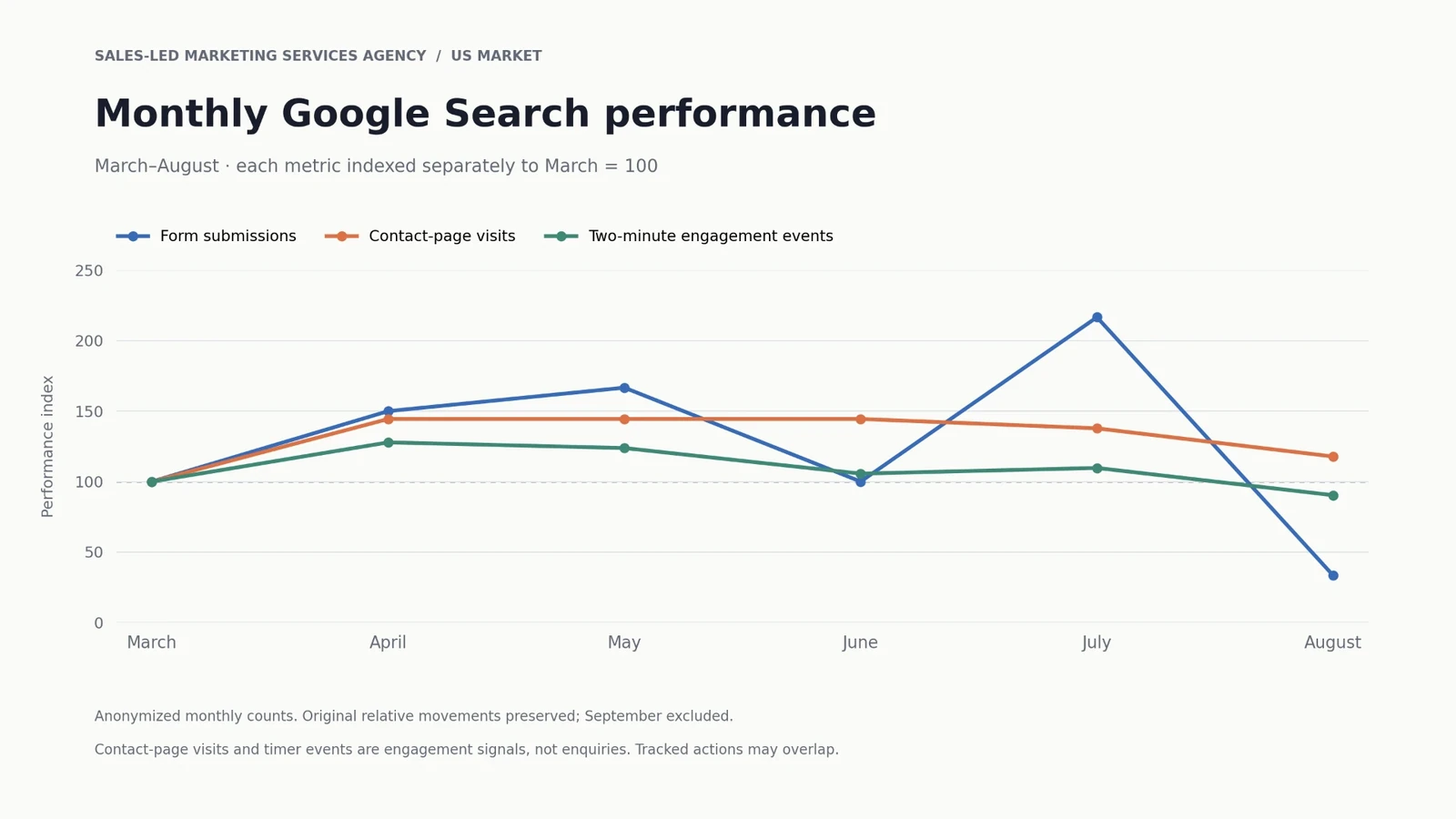
Client identity and specific service specialisation are withheld. Results cover an eight-month Google Search campaign targeting US technology businesses. The $430,000 figure is client-reported potential monthly recurring deal value associated with Search activity, not a monthly revenue figure achieved by the agency. It represents prospective business, not signed contracts, collected revenue or an achieved return on advertising spend. The source does not supply lead or opportunity counts, close rates, realised revenue, advertising spend or sufficient information to calculate ROI or ROAS. Client sales feedback informed assessment of discovery source and prospective budgets; this is not independently verified causal attribution. Pricing-page visits and selected case-study interactions were supporting engagement signals for automated optimisation, distinct from enquiries and qualified sales opportunities. The accompanying chart shows anonymized monthly Google Search engagement for March–August, with each metric indexed separately to March = 100: form submissions, contact-page visits and two-minute engagement events. September was excluded from the published chart. Contact-page visits and two-minute engagement events are engagement signals, not enquiries, and tracked actions may overlap. The chart is not a revenue, deal-value, spend or return-on-ad-spend report and does not show the reported prospective deal value.
Related services and reading
Looking to reach US buyers through Google Search?
Kraftvertising helps B2B service companies build search campaigns around their expertise and evaluate the business opportunities those campaigns generate.
Talk to us about your Google Search campaigns