
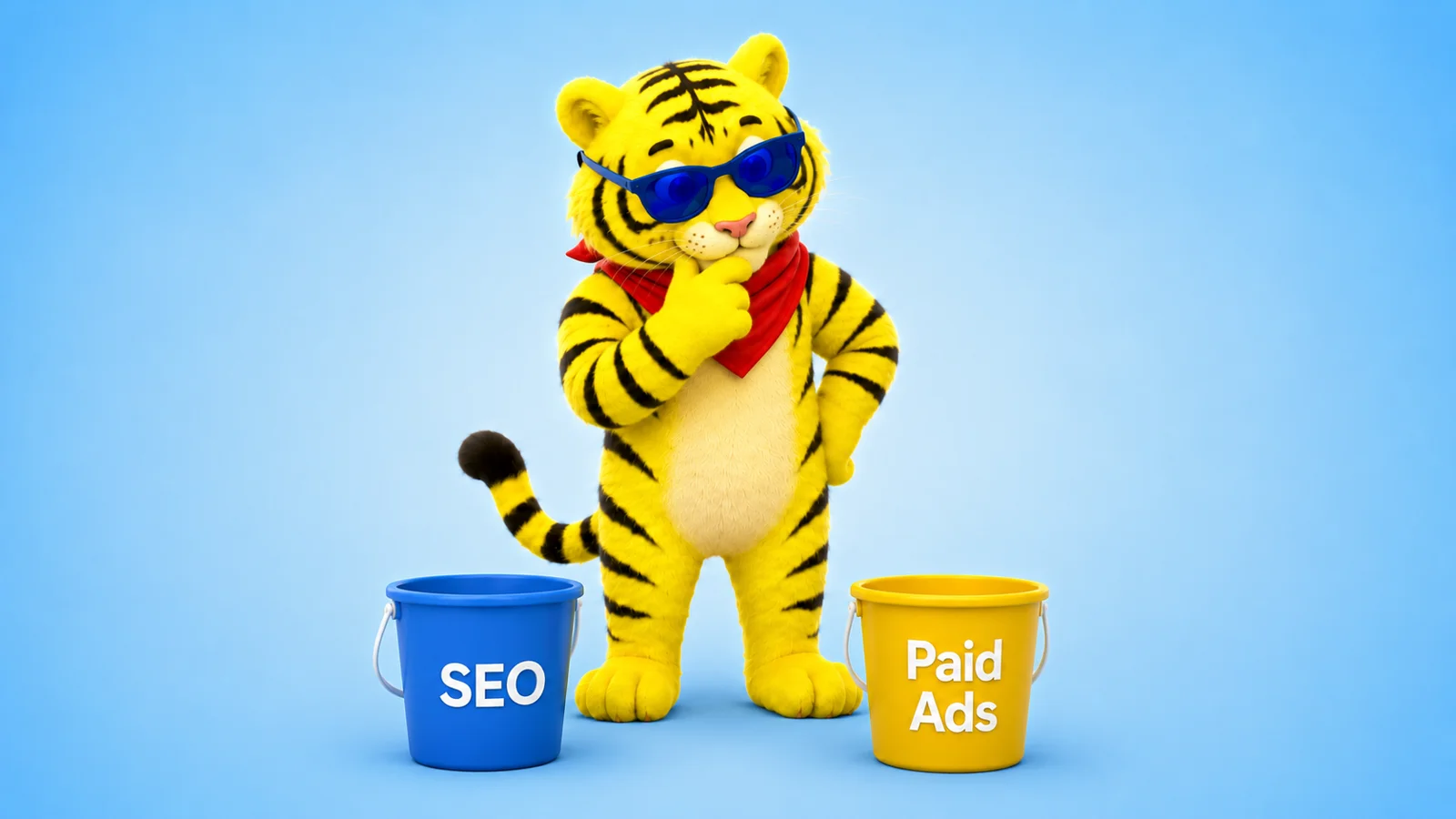
Should a B2B company invest in SEO or paid ads?
Our rule of thumb is: if we have to pick one, we usually start with paid ads.
What a shocker. A B2B paid ads agency recommends paid ads.
But there is a reason behind it.
The main problem is that we usually don't know beforehand which keywords are actually going to perform.
Keyword research can tell us what people might search for and give us estimated volumes. But we have seen both much higher and much lower actual traffic than expected from keyword research.
Paid search gives us real data much faster.
SEO is the long game. A page or blog post you publish today may start having an effect weeks or months later. In a competitive market, it can take much longer.
So if we have a set of 10 or 20 keywords we think we want to rank for, our preference is usually to test them with paid search first.
The question we want to answer is:
What would happen if we were already visible for these keywords today?
Would the traffic actually exist?
Would people engage?
Would they convert?
Because spending six or twelve months trying to rank for a keyword, only to find out that the traffic doesn't convert, is not a great outcome.
Our B2B SEO vs. Paid Ads decision framework
The biggest variables for us are:
- market maturity and competition;
- realistically available search volume;
- conversion or customer value;
- budget.
And before all of those:
Are people actually searching for the solution?
1. How mature is the market?
This is probably the first question.
How many competitors are there? How long have they been playing this game?
If you're entering a mature market late, then paid ads becomes the obvious first option. SEO becomes secondary or tertiary because you're trying to push out established players that may have been building those positions for years. If they are doing their job properly, they are not just going to disappear.
You might move from position 60 to 40 and feel like you're making progress. Search Console will show you more impressions. Then you move from 40 to 30.
But commercially, that might still mean almost nothing.
Being position 40 is technically showing up. In reality, you aren't. And getting from position 40 to 30 can be harder than getting from 60 to 40. Getting into the positions where people actually click is harder again.
If the market is fresh, the calculation changes. If there isn't much competition yet, and you expect the category and search volume to grow, then SEO can make sense early. You want to establish those positions before everybody else does.
In that case, we would still typically run paid search at the same time if there is demand available.
2. How much traffic could you realistically intercept?
Headline search volume isn't enough. What matters is how much traffic you could reasonably get.
A keyword might have 100,000 searches per month, but if the market is already established and realistically you could only intercept 100 or 200 visits, then the 100,000 number doesn't mean very much.
As a rough rule:
- If we expect SEO to bring less than around 100 relevant clicks per month, we lean more toward paid search.
- If we think we can reasonably get more than 100 relevant clicks per month, SEO starts becoming more interesting.
Again, this is not a hard rule. Customer value matters enormously. But if there are only 10 or 20 searches per month, building an extensive content hub to capture that traffic can make very little economic sense. You can potentially just pay for those searches.
3. Very low search volume can be a good Google Ads case
Google Ads can work extremely well when search volume is low. If there are only a handful of highly relevant searches every month, you can bid strongly and try to show up for almost all of them. That's an easier problem than trying to build a large SEO operation around a tiny amount of demand.
We spoke with one company where there were roughly 20 relevant searches per month. They were considering spending around €2,000 on paid search and another €2,000 on SEO. The economics simply didn't fit the size of the market. Paid search was the more reasonable channel. But even the proposed paid-search budget was too high for the amount of available traffic.
The first question should therefore not be:
How much budget do we want to spend?
It should be:
How much relevant search demand actually exists?
4. If people aren't searching for the category, neither SEO nor paid search is the main answer
If customers have the problem but don't yet know that your category exists, then neither SEO nor Google Ads is usually the first thing we would focus on. There is no demand to capture yet.
In that situation, paid social usually makes more sense because you can get in front of the right people and educate them. Google Search gives you very little space to communicate. A Google ad mostly needs to tell the person: we are relevant to the thing you just searched for. That's different from explaining a new problem, a new category or a complicated proposition.
If you need to do a lot of education before the buyer understands why the product matters, Google Search is usually not the ideal platform for that job. The same logic applies if product-market fit is still unclear — building a large SEO presence before you know whether the product actually resonates is a slow way to find out. Paid traffic gives you information much faster.
5. Why we usually use paid search before SEO
The biggest overlap between paid search and SEO, in our experience, is keyword information.
Let's say there are 20 keywords we think we should rank for. We can use Google Ads to see which searches actually happen and which ones generate relevant traffic. That matters because keyword tools are still estimates. Long-tail searches, variations and match types all affect what the real available traffic looks like.
And traffic volume itself is not the main thing we're looking for. We want engagement and conversions. If one keyword has 1,000 searches but doesn't convert, and another has 50 searches but repeatedly brings in good leads, then the second keyword can be far more important.
This is why paid search can be useful before a major SEO investment. It tells us which keywords are actually worth fighting for.
That doesn't mean everything from paid search transfers directly into SEO. A landing page that works well for paid traffic does not necessarily make a strong SEO page. And paid search isn't where we mainly test broad messaging either — that's more the job of paid social. The clearest overlap is the keyword and search-intent data.
6. SEO is not free
Another mistake we see constantly is treating the comparison like this:
Paid ads cost money. SEO brings free traffic.
SEO is not free. Someone has to do the work. There is the agency or employee managing it. There is the content production. There is internal expert time.
Good B2B content usually requires people inside the company to contribute knowledge. That time has a cost too, even though companies rarely calculate it. If a salesperson earning €5,000 per month spends 20 hours helping a content writer extract company know-how, that is part of the SEO investment.
There is also technical work and ongoing maintenance. Content has to stay fresh. Pages have to be updated. SEO is an ongoing investment. One blog post published five years ago is not going to do the job in a competitive market.
7. When does SEO start making more economic sense?
One of SEO's biggest benefits is that it is not capped by a media budget in the same way paid search is. With Google Ads, traffic depends on search volume, competition and how much budget you are willing to spend. SEO doesn't have a cost attached to every incremental click.
This matters when the available traffic becomes large. If there are only 20 valuable searches per month, you might be able to buy that traffic for years and still spend less than building and maintaining a large SEO operation. But if there are thousands of valuable searches and your paid-search budget can only capture a small part of them, organic visibility becomes much more attractive. That is where SEO can start making economic sense.
There is a catch, though. If the traffic is valuable and there is a lot of it, competitors probably know that as well. So the SEO opportunities with the highest potential value are often also the ones with the highest competition.
8. How does budget change the decision?
If a B2B company has only €2,000–€3,000 per month to spend on SEO and paid advertising combined, we would put that into paid ads in more than 90% of cases. At that budget, trying to do both seriously usually means doing both badly. €2,000–€3,000 can buy paid traffic immediately. The same amount spent on SEO can easily disappear into one content resource whose work might not generate meaningful traffic for months.
If the founder is writing the content personally, then the equation changes slightly. But the founder's time still has a cost.
At €10,000–€20,000 per month, the situation changes. If you can reasonably spend that much on paid acquisition and still get good-quality traffic and leads, then there is clearly enough demand for search to matter. At that point, it makes much more sense to invest in SEO and GEO alongside paid ads.
9. Is there a minimum Google Ads budget?
Not really. If there are ten relevant searches and you can buy those ten clicks for €20, then spending €20 can make sense. An agency obviously wouldn't make sense for that account. But the advertising itself can.
Google Ads is pay-per-click. If traffic is low, your spend can also be low. Even with €100, you can buy €100 worth of traffic and see what happens. For us, the bigger risk is often simply not showing up at all when somebody searches for what you sell.
10. There is a practical minimum for SEO
SEO behaves differently. You can't publish one article, stop, and expect it to remain a meaningful strategy. There needs to be continuity. There needs to be enough volume of content and enough effort over time.
If you stop investing, those optimizations can be lost. Competitors keep working. Search behavior changes. The environment changes. So SEO has a much more meaningful minimum level of commitment than paid search.
11. Paid search is like being on the shelf
One way we think about paid search is physical availability. Imagine you're selling shampoo. Before someone can choose your shampoo, you first need to be on the shelf with the other shampoos. Whether they choose you from the 50 alternatives is another question.
Search works similarly. If someone searches for exactly the kind of B2B product or service you sell, you generally want to be there. With Google Ads, showing up does not cost anything. You pay when somebody effectively picks you off the shelf and has a closer look. They click. That still doesn't mean they buy. But you're in the consideration set.
The alternative is not being on the shelf at all. And for most B2B companies, when somebody is actively searching for the solution they sell, they want to be there.
12. Customer value makes both more attractive
The higher the value of the customer, the more both paid search and SEO can make sense. A €10 or €20 click doesn't tell you whether Google Ads is expensive.
Suppose you pay €10 per click. 100 clicks cost €1,000. If 10% start a free trial, then the cost per trial is €100. The important questions come after that: How many trials become customers? What is the average deal size? What is the lifetime value?
The same applies to SEO. If one customer is worth enough, then spending substantial money to build organic visibility can also be justified.
13. SEO or paid ads? In an optimal world, both.
If we have to choose, we usually choose paid ads first. If we have the resources, we normally want both.
Paid search gives us traffic, conversions and information immediately. SEO is the longer-term investment. And paid search can tell us where that SEO investment is most likely to be worth making.
The easiest analogy is:
Paid search is renting the house. SEO is building the house brick by brick.
If you know you want to live there, building the house makes sense. But you don't have to stay homeless while you're building it. You can rent the house now and build the one you eventually want to own at the same time.
14. AI search changes the SEO calculation
AI search makes this more complicated.
Historically, informational SEO often worked like this: question → Google → blog post → website visit. Now the user can ask ChatGPT, Gemini or another AI system and receive the answer directly. The AI can use information from your website without sending the user to your page. That means companies with a lot of know-how content can see organic traffic fall even if the content itself remains useful.
But there is another side to this. If someone asks an AI system for a recommendation, being included can be very valuable. For example: which B2B marketing agencies specialize in Google Ads? That is different from simply answering an informational question. It can work more like an expert recommendation.
So SEO now also has to be considered together with GEO and AI visibility. The goal isn't only to generate website traffic. It is also to make the company understandable and recommendable when relevant questions are asked.
The short version
If we have to choose between SEO and paid ads for a B2B company, our default is paid ads first.
We lean particularly toward paid when:
- the market is mature and competitors are already established;
- realistically available organic traffic is low;
- the total monthly budget is only around €2,000–€3,000;
- we still don't know which keywords actually convert.
SEO becomes more attractive when:
- the market is still young or growing;
- there is a large amount of valuable search demand;
- we can realistically capture meaningful traffic;
- customer value is high enough to justify investing in both;
- we want to build long-term organic and AI visibility.
But if SEO makes sense, paid search usually makes sense too. If the traffic is valuable enough to spend months or years trying to rank for it, it is usually valuable enough to pay for today while you build the organic position.
If you already run Google Ads and want to check whether the account is buying the right searches before deciding on SEO, a B2B Google Ads audit answers that separately — €450 per account, with a written assessment and a prioritized action plan within 14 days.
The money side of this is covered in B2B SEO vs. paid ads: budget, costs and ROI, the channel roles in the B2B demand framework, the AI-search angle in does B2B SEO still make sense after ChatGPT, and the measurement caveats in why B2B SEO vs. PPC attribution is often misleading. We run the paid part as a B2B advertising agency through B2B Google Ads and B2B LinkedIn Ads.
Frequently asked questions
Should a B2B company invest in SEO or paid ads first?
If we have to pick one, we usually start with paid ads. Paid search gives real data on which keywords actually perform much faster than SEO, which can take months to show results. We can test 10 or 20 candidate keywords with paid search and learn which ones bring traffic that engages and converts — before committing six or twelve months to ranking for them organically.
When does SEO make more sense than paid ads for B2B?
SEO becomes more attractive when the market is still young or growing, there is a large amount of valuable search demand, you can realistically capture meaningful traffic, customer value is high enough to justify investing in both, and you want to build long-term organic and AI visibility. If the traffic is valuable enough to spend months trying to rank for, it is usually also valuable enough to pay for today.
Is SEO really free traffic?
No. SEO is not free. Someone has to do the work — the agency or employee managing it, content production, internal expert time, technical work and ongoing maintenance. Good B2B content usually requires people inside the company to contribute knowledge, and that time has a cost. Content also has to stay fresh and pages have to be updated; SEO is an ongoing investment, not a one-time cost.
What budget do you need to do both SEO and paid ads?
At €2,000–€3,000 per month combined, we put that into paid ads in over 90% of cases — doing both seriously at that budget usually means doing both badly. Around €10,000–€20,000 per month, if you can reasonably spend that much on paid acquisition and still get good-quality traffic, there is clearly enough demand for search to matter, and it makes much more sense to invest in SEO and GEO alongside paid ads.
Is there a minimum budget for Google Ads?
Not really. Google Ads is pay-per-click, so if traffic is low, your spend can also be low. If there are ten relevant searches and you can buy those ten clicks for €20, then spending €20 can make sense — an agency would not make sense for that account, but the advertising itself can. The bigger risk is often simply not showing up at all when somebody searches for what you sell.
How does AI search change the SEO vs. paid ads decision?
AI search complicates the SEO calculation. Users can now ask ChatGPT, Gemini or another AI system and receive an answer directly, sometimes using information from your website without sending the user to your page — so informational organic traffic can fall even when the content remains useful. But if someone asks an AI for a recommendation, being included can be very valuable. SEO now has to be considered together with GEO and AI visibility, not just website traffic.
How to Launch the Marketing for a New B2B Brand or Product
What to build first, what can change later and how to gather buyer feedback before months of assumptions become expensive.
Who Should Run the Marketing Launch of a New B2B Brand?
How to assign ownership across branding, website, tracking and campaigns while the product is still changing.
When Is a New B2B Product Ready for Paid Advertising?
What to learn through conversations first, what must be ready before paid traffic and how to judge an early campaign.