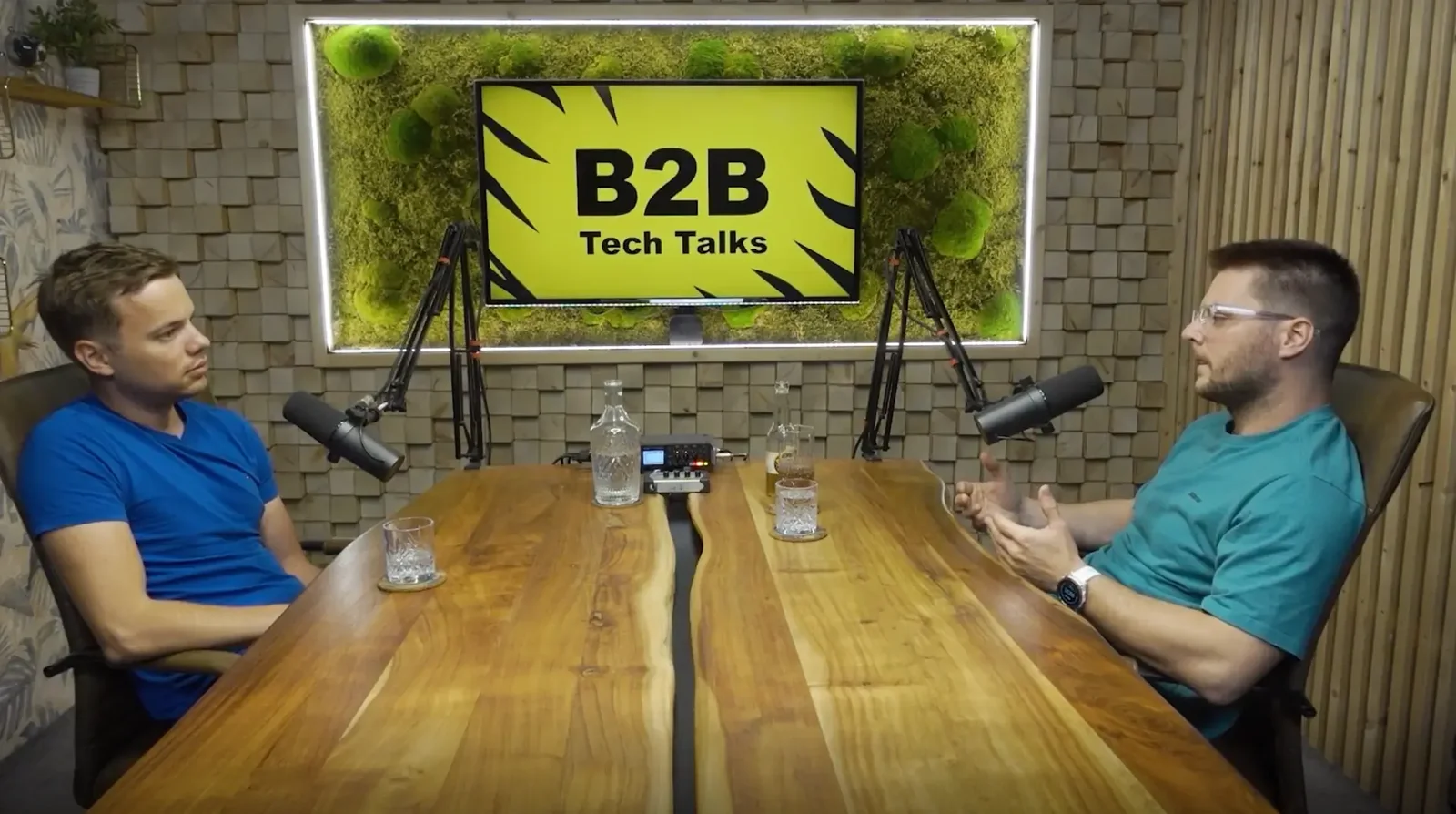
Full English transcript
The conversation was recorded in Slovak; this is the supplied English translation, followed by a bonus section that was originally recorded in English. Statements about AI tools, platform capabilities and market conditions reflect the discussion as recorded in May 2024 and should not be treated as current specifications or advice. The episode was published on 28 May 2024 and runs 37 minutes 15 seconds.
From developer to founder: how Brackets started
Martin Brath: Alright, welcome to everyone listening to or watching another edition of B2B Tech Talks. My guest is Pavol Perdík, CEO and co-founder of Brackets, a software studio here in Bratislava, and also one of Slovakia's leading AI experts. Welcome to the studio. Thank you for inviting me. Alright, Pali, we've known each other for a while, but I understand you've been running a business for quite a long time. Could you start by telling us why and how you got into business?
Pavol Perdík: I started ten years ago, and I think it had always been a goal of mine, a kind of life goal, perhaps since secondary school and definitely at university. I used to tell myself that once I finished university, I wanted to have my own company, lead a team of people, and do something meaningful. I started working while I was still at university. I joined Triad as a developer, and over time we began working on systems and larger projects that had nothing, or very little, to do with advertising. So we said, great, this is a win-win: I want to have a company, so let's do it together. And that's how Brackets came about.
Martin Brath: Okay, so you're essentially a technical founder. There are a number of important and challenging aspects to running a business. That's probably beyond debate. But for technical founders, some things are easier and others are harder, although that's a fairly generic statement. For you personally, which things come more easily, or do you think you're better at than an average founder, and which do you find harder?
Pavol Perdík: An average founder, an average washing powder. Generally, I'd say that things you're doing for the first time, or that I'm doing for the first time, are harder, just as they are for anyone. When I was starting out, I remember that winning that very first client, or those first few clients, was something outside the routine of my previous life as a developer, of course. Later, once I had a team, I had to deal with the various problems that come up in a company. Looking back, I'd call them everyday problems, but at the time they felt major: people suddenly becoming unavailable, or a project falling through, for example. Or having to let someone go for the first time. That's not an easy thing either; it's challenging. After ten years, I feel I've learned a thing or two and improved at a lot of things. But one thing that's remained difficult is starting new conversations. That's something I still find challenging.
Pavol Perdík: When we're at an event, I'm not really the networking type. On the other hand, once a conversation gets going, I'm fine and I enjoy it, because I'm interested in things. If it's an interesting discussion, I often catch myself thinking, wow, what was I even worried about? But those worries are still there, so that's probably the difficult part.
Networking and founder visibility
Martin Brath: Of course, networking is one aspect of business people talk about, but plenty of entrepreneurs don't network at all, and it doesn't seem to be essential or necessary for them. How do you see it?
Pavol Perdík: I think it is necessary. As a founder or CEO, you should be visible. Of course, it depends on your business model and what you're selling: whether you provide services or have a product that, in quotation marks, sells itself. It depends on the type of company. But in the business I'm in, I think it's important for me to be visible, and networking is part of that. I'm not saying it's absolutely crucial and you can't do without it, but it is important.
Martin Brath: Absolutely. So being visible is fundamental. I meant networking more in the sense of meeting new people at networking events, but I understand your point.
Sales as a technical founder
Martin Brath: I'm primarily interested in sales. As a founder, you still sell, and you're essentially an account manager at Brackets on some projects, on most projects, so you're quite hands-on. How do you see sales? How has the way you sell to clients changed from when you started to now?
Pavol Perdík: That's a very difficult question. I think the change is that when I started, we didn't have any sales at Brackets, or rather, we didn't have any active outreach or anything like that. We really grew with the wind in our sails that came from Triad. We took over some of our first clients and gradually started building our brand and brand awareness.
Pavol Perdík: Over time, that stopped being enough, and we were forced to, or rather, motivated to give it more of a push and devote more attention to it. But that's another thing I'd put in the category of areas where a technical leader is weaker, at least for me personally.
Pavol Perdík: The harder part of sales is precisely that outreach side, the same thing I find difficult about networking: making the initial contact, lead generation, that kind of thing. But once we're discussing a specific project, I can say from experience that it works very well, because...
Pavol Perdík: Because as a technical leader, I understand these things. I understand how things work, or perhaps I can picture them more easily. I can go into the technical details and ask good questions. We often hear clients say, finally, we're talking to someone who understands us and can grasp what we want. That's one aspect. Another is that clients often have only a vague idea of what they want. It's like when I go to buy a house: I don't know exactly what I could even consider wanting in that house. So it's good to have a guide who can take you through the process. I feel a technical leader can handle that better, provided they have good enough communication skills.
Martin Brath: So if I understand correctly, the outreach part, what an SDR would do, where you need to approach people to generate leads, is harder for you. Then the consultative part, or closing, where you need to demonstrate expertise and show that you understand what they need, is where you have an advantage. That would make sense to me.
When to hire developers and when to bring in a software studio
Martin Brath: You're a software studio that builds custom software. If I'm a technology company, a SaaS company, or an IT company and I need to develop a new product, how should I approach that? When should I hire people, and when should I bring in a software studio?
Pavol Perdík: Great question. I think several factors come into that decision, perhaps three main ones: cost, time, and expertise or quality. If you want to move quickly, get to market fast, and validate a first version, an initial MVP, as soon as possible, you don't really have much choice. There isn't time to build your own team unless you've already built one. Hiring is difficult, as we can all imagine, and it comes with costs, although those may pay off in the long term. If the project later proves viable in the market and achieves product-market fit, then I can see it being worthwhile to build an internal team. And these options don't have to be either-or. We often set up the collaboration with a client right from the start so that we'll build...
Pavol Perdík: ...a first version or first iteration of a product, with the strategic intention that their internal team will take it over later. We develop it with that goal in mind. That means everything is properly documented, and we gradually involve their team during the project, or even from the start, so that the transition is as smooth as possible.
Pavol Perdík: So that was time. Then I mentioned money and so on. If you have enough time, if you don't need to meet some incredibly tight time-to-market deadline, you can certainly hire your own team. The question then is how well that team will work together and when it will become functional enough to be sufficiently productive and efficient. Also, will the new team you build have the necessary know-how and expertise? It may still be easier to hire an existing team that already knows the subject. You can choose from the available companies based on their references and whether they understand the problem or domain you're working in.
Pavol Perdík: And the third one? The third was... Actually, that was the third. Sorry.
Martin Brath: Okay, so for a technology company that needs to develop a product now, it's clear that hiring is difficult. There are also costs associated with sometimes not being able to make full use of a developer. How do you handle that? Or how quickly can a client stop working with you if, for example, they discover that it isn't working, compared with having an employee?
Pavol Perdík: That's exactly the advantage: the enormous flexibility the client has. Compared with an internal team, which isn't so easy to scale up or down, with companies like ours they can essentially end the collaboration at any time. There are short notice periods, but under certain circumstances even those don't have to be observed, theoretically allowing it to end overnight.
Pavol Perdík: It really minimizes the risk of a wrong move. If they validate a project or product and discover it was a bad idea, or it turns out they won't be able to sell it, or any other related problems emerge, they can stop it, cancel it, and focus on something else.
Martin Brath: Okay, is that standard practice for software studios, or is it your own internal decision to allow that, with no long notice period?
Pavol Perdík: There are different forms of collaboration. In some, you contract a team of people for a set period in advance, essentially staff augmentation. But there's also a pure time-and-materials approach: you pay for the work done, without those kinds of committed periods. Then probably the most common is fixed scope, where a specific solution is priced according to a specification or an agreed scope-of-work document and then delivered. You can't cancel that halfway through, or at least not without penalties; that's true. But what I meant was that if you build a team solely to develop an MVP and then decide not to continue, you still have that team. You face the dilemma of how to use it, what to do with it, or whether to disband it. You're already thinking about the costs of hiring another team, but the next project isn't quite ready yet, and so on. So you simply have...
Pavol Perdík: ...much greater flexibility, and the software company handles those problems: keeping people utilized and balancing out those fluctuations.
Pavol Perdík: One more thing: a general rule of thumb is that if you have a larger project, with a planned budget of around 500,000 euros or a million euros, and its initial phase will take more than a year, it starts to make sense to consider building your own team. For smaller projects, I probably wouldn't even consider it.
Martin Brath: So for over a million and over a year, hiring would be the better option?
Pavol Perdík: You should consider it and do the calculations. There are other factors as well, as I said, including time.
Czech, DACH and Polish markets compared
Martin Brath: You also work internationally and have clients abroad. When you compare the Slovak market with, for example, the Czech market, what are the biggest differences you see?
Pavol Perdík: I don't really see the Czech Republic as a foreign market. I see the Czech Republic and Slovakia as one market, and I'll explain why. We have several clients who are essentially Czech-Slovak clients, for whom we build one solution or one application used in both markets. In some companies, the regions are even larger: the Czech Republic and Slovakia might be part of a market that also includes Hungary, for example.
Pavol Perdík: It's more when you look at other countries, such as the DACH region, that you see a difference. Or rather, we see a difference, and of course that may be down to which clients we have in each market. In the DACH region, our clients tend to be startups or innovation labs, or companies where the people on the client side are product people or solution architects.
Pavol Perdík: Often it's either straightforward staff augmentation or outsourcing, or we deliver the full package, but they have a technical lead on their side. They want much greater control, or rather ownership, that's the word, over the development too. That means more frequent reporting, and sometimes they even attend stand-ups, or at least sprint planning sessions. With Czech-Slovak clients, who are mostly established companies, large multinationals, or local startups that may not have technical people or any development team at all, they tend to leave it to us. So there we provide a full service.
Martin Brath: So is there more trust, or would you say clients in the Czech-Slovak market are less clear about what they want?
Pavol Perdík: I wouldn't generalize like that. I think it's more about the types of clients we can win in each market. In foreign markets, we can probably add value mainly for startups, but not ones that are just starting out. They've already raised funding, perhaps two or three rounds, so they're established and used to working in this way, where the supplier is almost part of their team. Whereas here in Slovakia, I haven't encountered that setup yet.
Martin Brath: And what about Poland?
Pavol Perdík: Poland is an unusual market in the sense that we don't actually have a client there. Our first one may be on the horizon now. We have users there, because a Slovak client is launching its product there, but no clients. I don't know why. It's a huge market, so I assume it's more to do with strong competition. I think salary and price levels are very similar to Slovakia's and very competitive.
Where AI genuinely helps companies
Martin Brath: Could be. It's a huge market, and many companies have had similar experiences. Breaking into it is relatively difficult. Alright, we were talking about AI expertise. At least in my circles, you're seen as one of the AI experts. There are quite a few on LinkedIn, so it's hard to distinguish between them or say who understands it better and who less well. How do you see it? Where does your expertise lie, and how do you see yourself in this respect?
Pavol Perdík: Yes, that's exactly why I smiled when you introduced me as an AI expert. I don't really like that label. It's a spectrum, right? I see myself somewhere on that spectrum, and there are certainly people, quite a lot of people, for whom I'm an AI expert. But I also look at the people further along who are much bigger experts than I am, so I wouldn't describe myself that way.
Martin Brath: Sam Altman is above you.
Pavol Perdík: Yes, definitely, but so are plenty of people in Slovakia, of course. I'm more someone who tries to stay informed about technology. I'm certainly not someone who would lead the development of our own model or anything like that. But I try to have a sufficiently good understanding of the tools and capabilities of the individual components of the AI world so we can use them effectively in different projects, whether for clients or our own. The AI progress we've been seeing over the past two years is essentially just another set of tools for us as a software studio. We already had a toolkit, and now we've gained some more tools we can integrate or use, but only where they make sense, of course.
Martin Brath: How many companies seem interested in implementing an AI element in their software? I assume many more companies could benefit from connecting to an AI through an API. But how do you see the market at the moment and this revolution itself?
Pavol Perdík: A year ago, when we ran a campaign in response to GPT-4 and similar developments, a huge number of companies contacted us saying they wanted to explore that path. I see that as a very positive trend. It's exactly what companies should be doing and thinking about. They should allocate resources to it, whether that's people or at least making it part of someone's job description to follow developments and think about how to use them to their advantage and stay competitive. On the other hand, it's not like going to the grocery store and buying a bread roll. You can't buy AI, put it in your company, and suddenly have it magically generate 20% profit or something like that. It's good to turn to experts, and I'm not saying it has to be me, although it certainly can be, who can at least analyze or look at the processes inside the company, see how things work, and say, here...
Pavol Perdík: ...there's a part that could be automated or made more efficient. That's the category of using AI for automation or improving a process. Then there's the other use case, which may be closer to what you meant in your question: integrating AI into your own products for end customers. That also makes perfect sense, but it has to add value. If all you have is an AI label and users don't see any value in it, there's no point. Right now, we're at a stage where all of this is changing and developing dramatically, and those use cases are only beginning to be discovered.
Martin Brath: Okay, I think [unclear wording in the source transcript] major changes, apart from the databases getting bigger, or the feedback loop getting faster, and... So if those use cases exist, at least they can already be found in some early form now, right?
Pavol Perdík: Yes, definitely, and some are already working successfully.
Pavol Perdík: I was really referring to the fact that when GPT-3 came out, everyone in my technology bubble thought, wow, within a year there will be seismic changes, or something like that. And it turns out that isn't how it works. Society has enormous inertia, for one thing, and then there's the question of trust in AI and so on. So adoption will take some time. It won't happen overnight. But at the same time, the companies that crack it, the ones that... In the end, everyone will adopt it. Those who do it first will be the winners, and those who do it last will be the losers, of course.
Martin Brath: Okay, so for small and medium-sized companies, or perhaps somewhat larger companies [unclear wording in the source transcript mentioning Google], if I understand correctly, the main application at the moment would be automation. That's where I see cost reductions. Things people currently do manually, or that take them a long time, could be taken off their hands. I see quite a lot of room there for improving their profit margins.
Martin Brath: Can you give some general examples of how AI can help companies, or areas where it could be implemented but isn't being implemented yet?
Pavol Perdík: The classic answer is customer support, contact centers, customer care. Even before the era of generative AI, before ChatGPT, there were all kinds of chatbots that could take some of the load off agents and handle some tickets or customers automatically. Now AI can make that much more sophisticated. At the same time, it brings its own challenges: hallucinations, errors, and so on, which you also have to address. So it's still not foolproof, at least not yet. But progress is being made, and GPT-4o came out just last week, which is another big step forward. I think these things will eventually reach a level where people may even prefer them to dealing with humans in certain use cases. We're still human, and we'll still prefer personal contact for many things. But for some things, such as...
Pavol Perdík: ...sorting out a problem with my mobile plan with my phone provider, I don't need a human for that. In fact, if I can get it done really quickly, it's a win-win for both sides.
Consulting, discovery and the advantage of a smaller studio
Martin Brath: Service desk staff can be quite rude sometimes, so AI might be preferable. Do you also offer consulting without doing the development, or how does that work?
Pavol Perdík: Yes. And that applies not only to AI, but of course to AI as well. When a client or lead comes to us, or we reach them or connect in some way, the first phase is typically analysis or discovery: understanding their problem and what they'd like to address. That could be one call, or a series of joint workshops or brainstorming sessions. The outcome is our recommendation for the next steps or a possible solution. In software projects or mobile applications, for example, that might take the form of a requirements specification document. It may also include proposed wireframes, or it might simply be a recommendation for a direction worth exploring. We do some of those very initial activities for free, and when we want to go a little deeper, it becomes paid analysis.
Martin Brath: I see.
Martin Brath: You're still relatively hands-on in the company, so with most clients you still know what's happening and you're actively involved. How do you see the benefit to the client of having someone like you involved? Is it a benefit at all compared with larger software studios?
Pavol Perdík: I'll answer your question from a slightly different angle. I feel smaller software companies can give clients a greater level of commitment. Let me explain why. As a client, you're much more likely to be important to a small software company than to a large one. Whether you account for 10% of its revenue or 1%, we can say what we like, but the reality is that the level of care will be different. I think that's related to the CEO's involvement too, particularly a technical CEO: that oversight and the fact that we care a great deal about the project turning out well in every respect, financially, in terms of quality, and so on. That's definitely a benefit, and I see it in the feedback clients give us. That's probably the difference between smaller and larger software companies.
The 20-year outlook, books and mentoring
Martin Brath: So the feedback is that they feel better looked after. Alright. As an entrepreneur, where do you see yourself in 20 years? Where would you like Brackets or any other projects to be? Would you like to be able to hand this over to someone else, or how do you see it?
Pavol Perdík: Wow, 20 years is such a long time. I have this theory that in 20 years you're not even the same person anymore, because your outlook on life changes. In 20 years, I might just be sitting in a cabin playing the guitar.
Martin Brath: That's your ideal scenario, a cabin and a guitar.
Pavol Perdík: Something like that.
Pavol Perdík: I still think, even looking 20 years ahead, that I'll be creating something, because that's something that hasn't changed since I was little. I've played with Lego since I was very young, and I still do.
Martin Brath: Thanks to the kids.
Pavol Perdík: So I definitely can't imagine doing nothing. I'd want to create something, and I'd want it to be meaningful. But I certainly wouldn't rule out it not being software. What I mean is, it doesn't have to be software; it could be something completely different. Twenty years really is a long time, and perhaps over time you start seeing your values differently. We'll see. But for now, I'm not thinking in that direction.
Martin Brath: Is there a book you'd recommend to future entrepreneurs, or developers who want to start a company at some point? What helped you most?
Pavol Perdík: You know, I have to admit that I'm a terrible book reader. I really want to read books, and I've bought them. I have a stack this high at home, my wife can confirm it, and I've started all of them but finished almost none.
Martin Brath: That doesn't really matter. Usually you find out fairly early which books are good and what you can take away from them. That's how it always is for me.
Pavol Perdík: Yes. For developers, I really couldn't say. But one great book that I quoted several times last year, including publicly, is Uri Levine's Fall in Love with the Problem, Not the Solution. It's a kind of startup bible for aspiring startup founders or entrepreneurs. It was great, really good. I think I actually did finish that one, now that I think about it.
Pavol Perdík: Apart from that, I've been reading Feynman's autobiography for a long time, although that's off topic, outside tech: Surely You're Joking, Mr. Feynman! It's great.
Martin Brath: Is it worth it? It's on my list, but I haven't started it.
Pavol Perdík: Yes, I'm about halfway through, but I'm reading it very slowly. This is my second year.
Martin Brath: Alright, how do you see coaching and mentoring? Have you explored that for yourself? Do you have a mentor, or do you mentor anyone?
Pavol Perdík: I have, and I still do, or rather, it developed quite naturally. Because I co-founded the company as a spin-off from Triad, my natural mentor was our co-owner Marek Mrazik, who's also a co-owner of the other companies. He mentored me for many years and helped me move forward, and still does, although the intensity is different from the beginning, of course. For the past two years, I think, we've also had a coach within the group, a colleague who does coaching. That's great too; I really recommend it. I was...
Pavol Perdík: ...skeptical. I couldn't imagine what benefits it would bring. But it's great to hear challenging questions that help you arrive at the answers yourself. Without the coach, you might never have reached them, because you wouldn't have been asked the right questions. That's really valuable. I don't mentor anyone yet, but when you asked about the future, that's something I could see myself doing. I'd put it in the category of meaningful work. The next generation. Yes. But I probably still need to gain some experience. I don't feel quite ready for it yet.
Martin Brath: There are people you could help already. Anyway, with this coach, I assume it's more... Usually the way people approach it is that they have a vision of where they want to get to in terms of revenue or business, and then find someone to approach. Is this coach more of a trained coach than a business person?
Pavol Perdík: Yes.
Martin Brath: Alright, Pali, thank you for coming. It's been a very enjoyable conversation, and see you next time. Thank you for inviting me.
Bonus in original English: why DACH startups choose Brackets
Martin Brath: Alright, you guys, Brackets is a software studio that is also doing a lot of business in the DACH region and also other countries in the region. So why are you, why is this a good fit? So why do you guys work well with, let's say, German or Austrian startups? How do you get these clients? Why do they choose you if there is an alternative within their country?
Pavol Perdík: And we like to work with startups in that region because they usually prefer to be or to have really hands -on and to be present in the project itself, which is really a win -win because we get like instant feedback and we get immediate responses to anything. So, we actually work as a joint teams together usually and which directly translates to more successful outcomes than like with a traditional client who is like more demo meetings every month or something. And so this is much better to work with clients that have this more agile approach or more agile mindset.
Martin Brath: So you don't mind that they are bothering you every day or...
Pavol Perdík: No, they are not bothering. They are actually like really beneficial because they just give us the opportunity to talk to talk to them and not, yeah, yeah, let's have a meeting in two weeks. So this is not the case. They are there for us and we are there for them, of course. And it's not like a waste of time. Like, they have the same mindset as we do, that, yeah, let's let's not waste the time with the formalities and stuff like that. It's really getting things done.
Martin Brath: So they're getting to the point way faster than other countries would, right? You mentioned something in the term that they also come to your stand point, stand -ups and you guys are okay with that or your employees are okay with this?
Pavol Perdík: Yeah, yeah, sure, sure. Because if we have questions regarding some functionalities or some features, it's always better to have somebody who represents the product and can do immediate decisions right on the meeting so we don't first gather options and talk to them and all these things would take a lot more time. then in that way we can like really resolve things quickly and go on and go on with the work.
Martin Brath: I see. So working with a fast -paced company is ideal for you. Yeah. All right. Why would you say they would prefer you since in the also in Austria and Germany there's a lot of also software studios who are making software. Why, why is this working out? Like, why did they choose, why do they choose you typically?
Pavol Perdík: I think those countries tend to work with, with other, or the companies from other markets, like it's, it's something that's not like unusual thing to do. And but they are still preferring somebody who is like close enough, especially like for Austria and especially for Vienna, which is really, really close. So we can like get on train and be there like, I mean, physically, but even for startups that are like a little bit further, for example, in Germany or something, it's still doable to jump on the car or even plane and be there if it's needed. So I think this is the geographical and cultural proximities, something that really may play the role,
Pavol Perdík: but also the way of work, I would say. So we are using the same approach to working like the same processes, processes, same style of software development processes, so for example, Scrum or using same tools and so it's really like fit. We don't need to like waste time in the beginning of the project to like align ourselves together because it's like almost immediate fit, yeah, we also use like, yeah, we will. Okay.
Martin Brath: All right. What do you think is the benefit of choosing like a smaller software studio like Brackets compared to a big one?
Pavol Perdík: Yeah. I think the key difference is or the most important thing is that for small, that as a client, you are more important for smaller agency than for a big software house because Usually, they have less or we have less clients overall, so one client represents a bigger portion of work and also for revenue. Therefore, we give extra care for securing the project, the smooth development of the project. So we pay extra attention or to detail, for example, and also resolving any possible problems that arise during the way, maybe in like faster way and maybe more pro -client way than bigger software, I would say. Because for them, it's like just another client.
Martin Brath: And for you, it's not just another claim?
Pavol Perdík: No, because we find them or we look at them as a partner, as partners. So it's our mutual project or mutual cooperation that leads to successful result, which of course for us is also to generate profit, but also to actually have something or to create something that we can share with others and be proud of.